Question
Write down the Coulomb's law and get the vector form of it.

Answer

→ The electric force (Coulomb force) between two point stationary charges is proportional to the product of the values of the charges and inversely proportional to the square of the distance between them. The direction of this force is in the direction of the line joining the two charges.
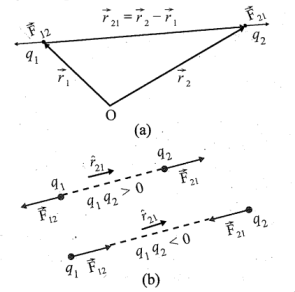
→ Let the position vectors of charges $q_1$ and $q_2$ be $\vec{r}_1$ and $\vec{r}_2$ respectively [see Fig. (a)].

Image


→ We denote force on $q_1$ due to $q_2$ by $\vec{F}_{12}$ and force on $q_2$ due to $q_1$ by $\overrightarrow{ F }_{21}$. The two point charges $q_1$ and $q_2$ have been numbered 1 and 2 for convenience and the vector leading from 1 to 2 is denoted by $\vec{r}_{21}$ :
$\vec{r}_{21}=\vec{r}_2-\vec{r}_1$

→ In the same way, the vector leading from 2 to 1 is denoted by $\vec{r}_{12}$ :
$\vec{r}_{12}=\vec{r}_1-\vec{r}_2=-\vec{r}_{21}$

→ The magnitude of the vectors $\vec{r}_{21}$ and $\vec{r}_{12}$ is denoted by $r_{21}$ and $r_{12}$, respectively $\left(r_{12}=r_{21}\right)$.
→ The direction of a vector is specified by a unit vector along the vector. To denote the direction from 1 to 2 (or from 2 to 1 ), we define the unit vectors:
$\hat{r}_{21}=\frac{\overrightarrow{r_{21}}}{r_{21}}, \hat{r}_{12}=\frac{\overrightarrow{r_{12}}}{r_{12}}, \hat{r}_{21}=-\hat{r}_{12}$

→ Coulomb's force law between two point charges

$q_1$ and $q_2$ located at $\vec{r}_1$ and $\vec{r}_2$, respectively is then expressed as
$\overrightarrow{ F }_{21}=\frac{1}{4 \pi \varepsilon_0} \frac{q_1 q_2}{r_{21}^2} \cdot \hat{r}_{21}$

→ Equation is valid for any sign of $q_1$ and $q_2$ whether positive or negative.
→ If $q_1$ and $q_2$ are of the same sign (either both positive or both negative), $F _{21}$ is along $\hat{r}_{21}$, which denotes repulsion, as it should be for like charges. If $q_1$ and $q_2$ are of opposite signs, $F_{21}$ is along $-\hat{r}_{21}=\hat{r}_{12}$, which denotes attraction, as expected for unlike charges.
→The force $\overrightarrow{ F }_{12}$ on charge $q_1$ due to charge $q_2$ is obtained from Eq. by simply interchanging 1 and 2 , i.e.,
$\overrightarrow{ F }_{12}=\frac{1}{4 \pi \varepsilon_0} \frac{q_1 q_2}{r_{12}^2} \hat{r}_{12}=-\overrightarrow{ F }_{21}$

→Thus, Coulomb's law agrees with Newton's third law.

Need a full question paper?

Generate a complete, print-ready paper with questions like this in minutes — across 16+ boards, with answer keys.
Start Generating Free

Similar questions

What is the parallel and crossed arrangement of polaroid?
A bomb is dropped from a plane flying horizontally with uniform speed. Show that the bomb will explode vertically below the plane. Is the statement true if the plane flies with uniform speed but not horizontally?
A metallic rod of length ‘l’ is rotated with a frequency ‘v’, with one end hinged at the centre and the other end at the circumference of a circular metallic ring, about an axis passing through the centre and perpendicular to the plane of the ring. A constant and uniform magnetic field B parallel to the axis is present everywhere.
  1. Obtain the expression for the emf induced between the centre and the ring.
  2. Given that the rod has resistance ‘R’, then how much power will be generated?

By how much would the stopping potential for a given photosensitive surface go up if the frequency of the incident radiations were to be increased from 4 × 10¹⁵ Hz to 8 × 10¹⁵ Hz?
Given h = 6.4 × 10⁻³⁴ J-s, e = 1.6 × 10⁻¹⁹C and c = 3 × 10⁸ ms-1.
Draw the circuit diagram of a common emitter amplifier using n-p-n transistor. What is the phase differnece between the input signal and output voltage? State two reasons why a common emitter amplifier is preferred to a common base amplifier.
A solid sphere rolling on a rough horizontal surface with a linear speed v collides elastically with a fixed, smooth, vertical wall. Find the speed of the sphere after it has started pure rolling in the backward direction.
Two charges $3 \times 10^{-8} C$ and $-2 \times 10^{-8} C$ are located $15 cm$ apart. At what point on the line joining the two charges is the electric potential zero? Take the potential at infinity to be zero.
When a photon is emitted by a hydrogen atom, the photon carries a momentum with it. (a) Calculate the momentum carries by the photon when a hydrogen atom emits light of wavelength 656.3nm. (b) With what speed does the atom recoil during this transition? Take the mass of the hydrogen atom = 1.67 × 10⁻²⁷kg. (c) Find the kinetic energy of recoil of the atom.
A pair of adjacent coils has a mutual inductance of 1.5H. If the current in one coil changes from 0 to 20A in 0.5s, what is the change of flux linkage with the other coil?
Suppose, one wishes to construct a 1.0 farad capacitor using circular discs. If the separation between the discs be kept at 1.0mm, what would be the radius of the discs?