Question
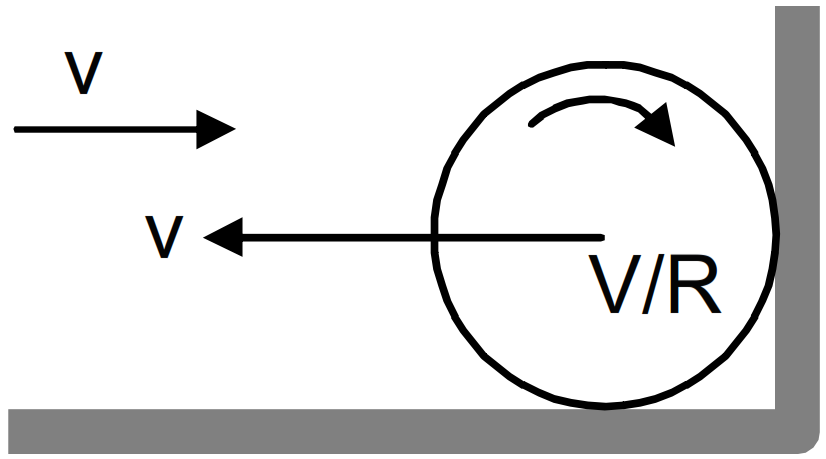
A solid sphere rolling on a rough horizontal surface with a linear speed v collides elastically with a fixed, smooth, vertical wall. Find the speed of the sphere after it has started pure rolling in the backward direction.
Answer


When the solid sphere collides with the wall, it rebounds with velocity ‘v’ towards left but it continues to rotate in the clockwise direction.

So, the angular momentum $=\text{mvR}-\Big(\frac{2}{5}\Big)\text{mR}^2\times\frac{\text{v}}{\text{R}}$

After rebounding, when pure rolling starts let the velocity be v' and the corresponding angular velocity is $\frac{\text{v}'}{\text{R}}$

Therefore angular momentum $=\text{mv}'\text{R}+\Big(\frac{2}{5}\Big)\text{mR}^2\Big(\frac{\text{v}'}{\text{R}}\Big)$

So, $\text{mvR}-\Big(\frac{2}5{}\Big)\text{mR}^2,\ \frac{\text{v}}{\text{R}}=\text{mvR}+\Big(\frac{2}{5}\Big)\text{mR}^2\Big(\frac{\text{v}'}{\text{R}}\Big)$

$\text{mvR}\times\Big(\frac{3}{5}\Big)=\text{mvR}\times\Big(\frac{7}{5}\Big)$

So, the sphere will move with velocity $\frac{\text{3v}}{7}.$

Need a full question paper?

Generate a complete, print-ready paper with questions like this in minutes — across 16+ boards, with answer keys.
Start Generating Free

Similar questions

The human eye has an approximate angular resolution of $\phi=5.8\times10^{-4}$ rad and a typical photoprinter prints a minimum of 300dpi (dots per inch, 1inch = 2.54cm). At what minimal distance z should a printed page be held so that one does not see the individual dots.
An object is to be seen through a simple microscope of focal length 12cm. Where should the object be placed so as to produce maximum angular magnification? The least distance for clear vision is 25cm.
What are valence band and conduction band? Define forbidden energy gap.
The potential difference between the terminals of a battery of emf 6.0V and internal resistance $1\Omega$ drops to 5.8V when connected across an external resistor. Find the resistance of the external resistor.
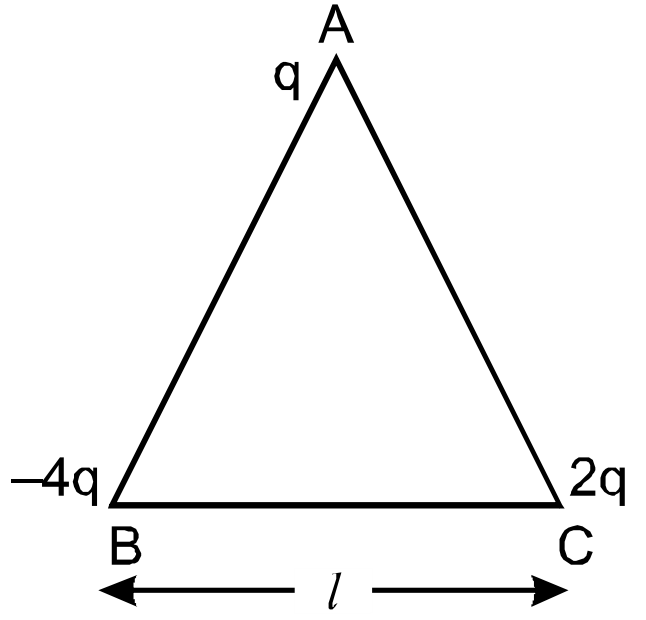
  1. Three point charges q, -4q and 2q are placed at the vertices of an equilateral triangle ABC of side ‘l’ as shown in the figure. Obtain the expression for the magnitude of the resultant electric force acting on the charge q.

  1. Find out the amount of the work done to separate the charges at infinite distance.
What is Wheatstone bridge? Explain its principle.
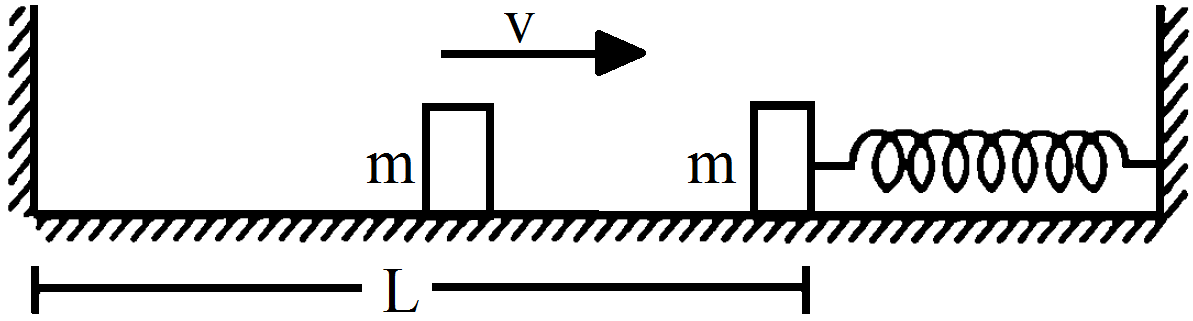
The left block in figure moves at a speed v towards the right block placed in equilibrium. All collisions to take place are elastic and the surfaces are frictionless. Show that the motions of the two blocks are periodic. Find the time period of these periodic motions. Neglect the widths of the blocks.

The band gap between the valence and the conduction bands in zinc oxide (ZnO) is 3.2eV. Suppose an electron in the conduction band combines with a hole in the valence band and the excess energy is released in the form of electromagnetic radiation. Find the maximum wavelength that can be emitted in this process.
A sinusoidal voltage of peak value 283 V and frequency 50 Hz is applied to a series LCR circuit in which $R =3 \Omega, L=25.48 mH$ and $C =796 \mu F$. Find
(a) The impedance of the circuit.
(b) The phase difference between the voltage across the source and the current.
(c) The power dissipated in the circuit.
A long, straight wire carries a current. Is Ampere's law valid for a loop that does not enclose the wire? That encloses the wire but is not circular?