Question
Write down the difference between forward bias and reverse bias of $p-n$ junction diode.

Answer

Forward BiasReverse Bias
$p$ - type semiconductor of $p-n$ junction is connected to positive terminal and $n$ - type is connected with negative terminal of battery. Such a biasing is called forward biasing.$p$ - type semiconductor of $p-n$ junction is connected to negative terminal and $n$ - type is connected with positive terminal of battery. Such a biasing is called reverse biasing.
In forward bias, the current is due to majority charge carriers.In Reverse bias, the current is due to minority charge carriers.
Current obtained in forward bias is of the order of $m A$.Current obtained in Reverse bias is of the order of $\mu A$.
When diode is connected in forward bias, width of its depletion layer and height of potential barrier reduces.When diode is connected in reverse bias, width of its depletion layer and height of potential barrier increases.
Resistance is of the order of $10 \Omega$ to $100 \Omega$.Resistance is of the order of $10 M \Omega$.

Need a full question paper?

Generate a complete, print-ready paper with questions like this in minutes — across 16+ boards, with answer keys.
Start Generating Free

Similar questions

Two satellites going in equatorial plane have almost same radii. As seen from the earth one moves from east to west and the other from west to east. Will they have the same time period as seen from the earth? If not, which one will have less time period?
A convex lens made of a material of refractive index n1 is kept in a medium of refractive index n2. Parallel rays of light are incident on the lens. Complete the path of rays of light emerging from the convex lens if: (i) n1 > n2 (ii) n1 = n2 (iii) n1 < n2.
$\frac{1}{\text{f}}=\Big(\frac{\text{n}_1}{\text{n}_2}-1\Big)\Big(\frac{1}{\text{R}_2}+\frac{1}{\text{R}_2}\Big)$
Assuming the nuclei to be spherical in shape, how does the surface area of a nucleus of mass number A1 compare with that of a nucleus of mass number A2?
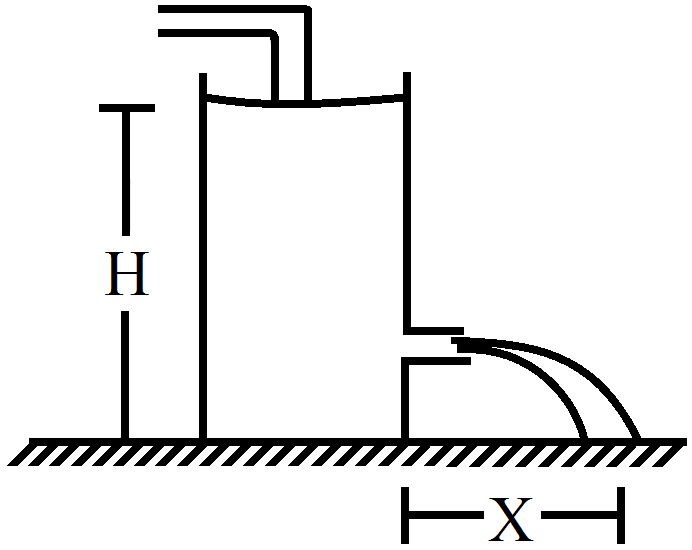
Water level is maintained in a cylindrical vessel upto a fixed height H. The vessel is kept on a horizontal plane. At what height above the bottom should a hole be made in the vessel so that the water stream coming out of the hole strikes the horizontal plane at the greatest distance from the vessel.

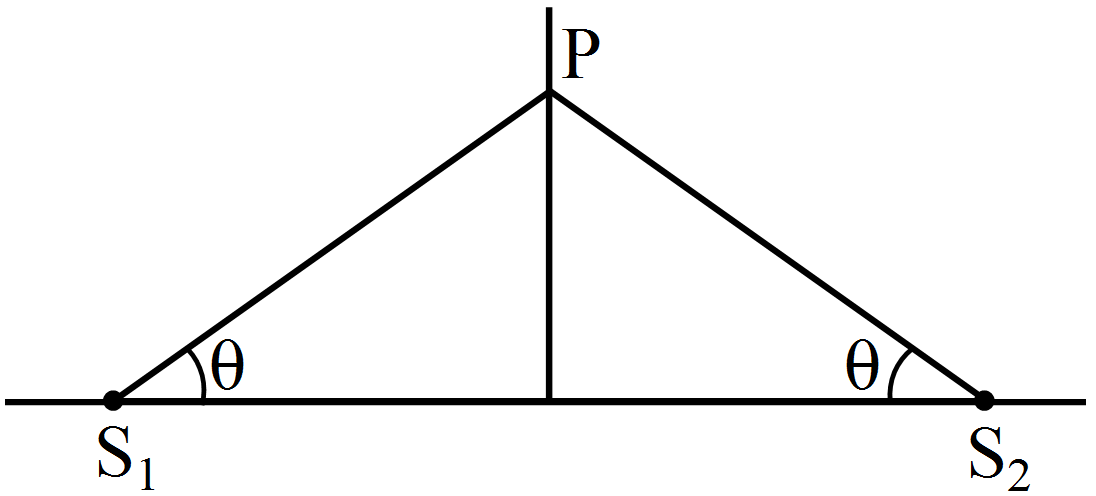
Two sources of sound S1 and S2 vibrate at same frequency and are in phase figure. The intensity of sound detected at a point P as shown in the figure is I0.

  1. If 0 equals 45°, what will be the intensity of sound detected at this point if one of the sources is switched off?
  2. What will be the answer of the previous part if = 60°?

What is conductivity ? On which what factors does it depend and also write its unit and dimension.
Calculate the dimensions of:
  1. $\int\vec{\text{E}}.\vec{\text{dl}}.$
  2. $\text{vBl}$
  3. $\frac{\text{d}\psi_{\text{B}}}{\text{dt}}$
The symbols have their usual meanings.
Find the maximum potential difference which may be applied across an X-ray tube with tungsten target without emitting any characteristic K or L X-ray. The energy levels of the tungsten atom with an electron knocked out are as follows.
Cell containing vacancy
K
L
M
Energy in keV
69.5
11.3
2.3
A proton and an alpha particle are accelerated through the same potential. Which one of the two has, (i) greater value of de-Broglie wavelength associated with it and (ii) less kinetic energy. Give reasons to justify your answer.
A driver takes 0.20s to apply the brakes after he sees a need for it. This is called the reaction time of the driver. If he is driving a car at a speed of 54km/h and the brakes cause a deceleration of 6.0m/s2, find the distance travelled by the car after he sees the need to put the brakes on.