Question
Write down the difference between $SN^{1}$ and $SN^{2}$ reaction.
| $SN^2$ Reaction | $SN^1$ Reaction |
| $\rightarrow$ $SN^2$ reaction means it is bimolecular nucleophilic substitution reaction. | $\rightarrow$ $SN^1$ reaction means it is unimolecular nucleophilic substitution reaction. |
| $\rightarrow$ The rate of $SN^2$ reaction depends on the concentration of Substrate and Nucleophiles both. Rate $= K [S]^1. [Nu]^1$ | $\rightarrow$ The rate of $SN^1$ reaction depends on the concentration of Substrate on Rate $= K [S]^1$ |
| $\rightarrow$ $SN^2$ reaction follow second order kinetics. | $\rightarrow$ $SN^1$ reaction follows first order kinetics. |
$\rightarrow$ The reaction of chloromethane and hydroxide ion gives methanol and chloride ion is example of $SN^2$ reaction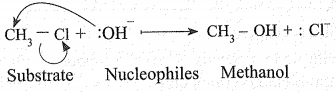 |
$\rightarrow$ The reaction of tert$-$butyl bromide with hydroxide ion gives tert$-$butyl alcohol is example of $SN^1$ reaction.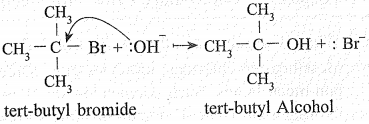 |
| $\rightarrow$ $SN^2$ reaction complete in a single step without formation of an intermediate | $\rightarrow$ $SN^1$ reaction complete in twosteps. Step $1:$ Formation of carbocation by cleavage of $CX$ in haloalkane Step $2: $ Attack of nucleophiles on carbocation to form product. |
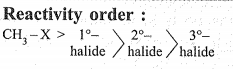 |
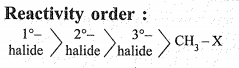 |
| $\rightarrow$ $SN^2$ reaction shows inversion of configuration. | $\rightarrow$ $SN^1$ reaction shows reacemic mixture. |
Generate a complete, print-ready paper with questions like this in minutes — across 16+ boards, with answer keys.
| Column I | Column II | ||
| (i) | Impurity defect | (a) | $NaCl$ with anionic sites called $F-$centres. |
| (ii) | Metal excess defect | (b) | $FeO $with $Fe^{3+}.$ |
| (iii) | Metal deficiency defect | (c) | $NaCl$ with $Sr^{2+}$ and some cationic sites vacant. |