Question
Write down the differences between diffusion and osmosis.

Answer

 
Diffusion
 
Osmosis
1.
Diffusion can occur in any medium.
1.
It occurs only in liquid medium.
2.
The diffusing molecules may be solids, liquids or gases.
2.
It involves movement of solvent molecules only.
3.
Semipermeable membrane is not required.
3.
Semipermeable membrane is required.
4.
An equilibrium in the free energy of diffusion molecules is achieved in the system.
4.
Equilibrium in the free energy of solvent molecules is never achieved.

Need a full question paper?

Generate a complete, print-ready paper with questions like this in minutes — across 16+ boards, with answer keys.
Start Generating Free

Similar questions

Draw a labelled diagram of a neuron.
State and explain the law of conservation of energy with an example.
List five characteristics by which compounds can be distinguished from mixtures.
Give two examples each of longitudinal waves and transverse waves.
When extremely small particles X derived from the another of a flower were suspended in a liquid Y and observed through a microscope, it was found that the particles X were moving throughout the liquid Y in a very zig zag way. It was also observed that warmer the liquid Y, faster the particles X moved in its surface.
  1. What could particles X be?
  2. What do you think liquid Y is?
  3. What is the zig-zag movement of particles X?
  4. What is causing the zig-zag movement of particles X?
  5. Name the scientist who discovered this phenomenon.
  6. What does this experiment tell us about the nature of liquid Y?
What weight of oxygen gas will contain the same number of molecules as $56g$ of nitrogen gas$?$
$(O = 16u; N = 14u)$
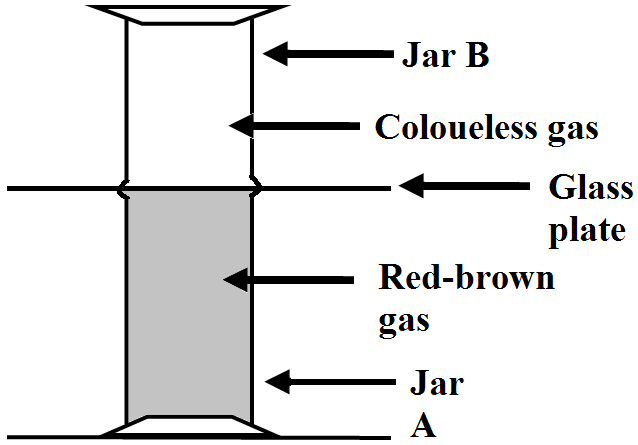
Look at the diagram on the right side. Jar A contains are d-brown gas whereas Jar B contains a colourless gas. The two gas jars are separated by a glass plate placed between them:
  1. What will happen when the glass plate between the two jars is pulled away?
  2. What name is given to the phenomenon which takes place?
  3. Name the brown gas which could be in jar A.
  4. Which is the colorless gas most likely to be present in jar B?
  5. Name one coloured solid and one colourless liquid which can show the same phenomenon.
State the main points of difference between homogeneous and heterogeneous mixtures.
How can reverberations in a big hall or auditotium be reduced?`
Discuss the method of separating a mixture containing chalk powder, iron fillings and naphthalene.