Question
Write down the equation of displacement current and derive the Ampere-Maxwell's law.
Answer

→Displacement Current $i_d=\varepsilon_0 \frac{d \phi_E}{d t}$ but $\phi_{ E }= AE$
$\therefore i_d=\varepsilon_0 A \frac{d E }{d t}$
Image
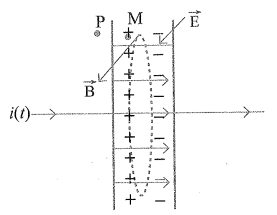
→Fig. shows the electric and magnetic fields inside the parallel plate capacitor discussed above. At point M shown in the fig., both these fields are normal to each other.
→As per the generalisation made by Maxwell, the source of magnetic field is not just the conduction electric current due to flowing charges, but also the time rate of change of electric field.
→Which means, the total current $i$ is the sum of conduction current $\left(i_{ c }\right)$ and the displacement
$\begin{array}{l}\text { current }\left(i_{ d }\right)\left(\text { where } i_{ d }=\varepsilon_{ o } \frac{d \phi_E}{d t}\right) \text {. } \\\quad i=i_{ C }+i_{ d } \\\therefore i=i_{ C }+\varepsilon_{ o } \frac{d \phi_E}{d t} \\\therefore i=i_{ C }+\varepsilon_{ o } A \frac{d E }{d t}......(1)\end{array}$
→Eq. (1) can be interpreted as follows :
Outside the capacitor plates, we have only conduction current $i_{ c }=i$ and no displacement current $i_{ d }=0$. On the other hand, inside the capacitor, there is no conduction current, i.e. $i_{ c }=0$, and there is only displacement current, so that $i_{ d }=i$.
→The generalised (and correct) form of Ampere's circuital law is
$\oint \overrightarrow{ B } \cdot \overrightarrow{d l}=\mu_0 i(t)$
(But there is a difference; "The total current passing through any surface of which the closed loop is the perimeter" is the sum of the conduction current and the displacement current.) Generalised law is :
$\begin{array}{l}\therefore \oint \overrightarrow{ B } \cdot \overrightarrow{d l}=\mu_0\left(i_c+i_{ d }\right) \\\therefore \oint \overrightarrow{ B } \cdot \overrightarrow{d l}=\mu_0\left(i_c+\varepsilon_0 \frac{d \phi}{d t}\right) \\\therefore \oint \overrightarrow{ B } \cdot \overrightarrow{d l}=\mu_0 i_c+\mu_0 \varepsilon_0 \frac{d \phi}{d t}\end{array}$
→This equation is known as Ampere-Maxwell law.
Ampere-Maxwell law : "The total current passing through any surface of which the closed loop is the perimeter, is the sum of conduction current and the displacement current."

Need a full question paper?

Generate a complete, print-ready paper with questions like this in minutes — across 16+ boards, with answer keys.

Start Generating Free

Similar questions

A light bulb is rated at $100 W$ for a $220 V$ supply. Find (a) the resistance of the bulb; (b) the peak voltage of the source; and (c) the rms current through the bulb.
Spring fitted doors close by themselves when released. You want to keep the door open for a long time, say for an hour. If you put a half kg stone in front of the open door, it does not help. The stone slides with the door and the door gets closed. However, if you sandwitch a 20g piece of wood in the small gap between the door and the floor, the door stays open. Explain why a much lighter piece of wood is able to keep the door open while the heavy stone fails.
Describe experiment of two coils explaining electromagnetic induction.
 The oscillating magnetic field in a plane electromagnetic wave is given by

 $\text{B}_{y} = ( 8 \times 10^{-6}) sin [2\times 10 ^{11}t + 300 \pi\text{x}] T$.
  1. Calculate the wavelength of the electromagnetic wave.
  2. Write down the expression for the oscillating electric field.
Write the definition of wave front.
If we walk barefoot on a nylon mat for some time and touch the metal handle of a door, we get an electric shock. Why does this happen?
It is said that the separation between the two charges forming an electric dipole should be small. Small compared to what?
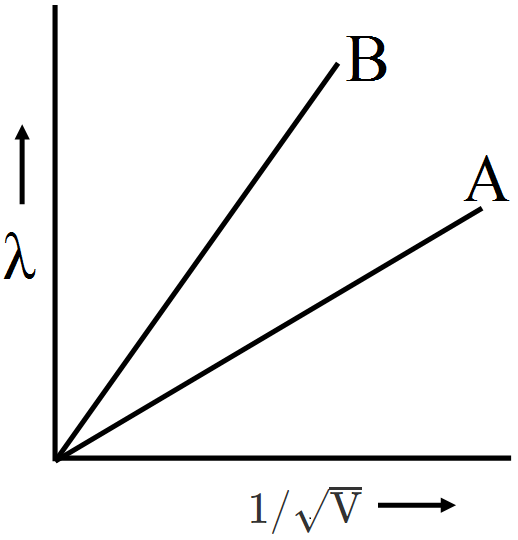
Two lines A and B shown in the graph represent the de Broglie wavelength $(\lambda)$ as a function of $\frac{1}{\sqrt{\text{V}}}$ (V is the accelerating potential) for two particles having the same charge. Which of the two represents the particle of smaller mass?

State the concept of mobile telephony and explain its working.
The separation between the consecutive dark fringes in a Young's double slit experiment is 1.0mm. The screen is placed at a distance of 2.5m from the slits and the separation between the slits is 1.0mm. Calculate the wavelength of light used for the experiment.