Question
Write down the IUPAC name for each of the following complexes and indicate the oxidation state, electronic configuration, and coordination number. Also, give stereochemistry and magnetic moment of the complex:
$a. \left.K \left[ Cr \left( H _2 O \right)_2\right\}\left( C _2 O _4\right)_2\right] \cdot 3 H _2 O$
$b. \left[ Co \left( NH _3\right)_5 Cl \right] Cl _2$
$c. CrCl _3( py )_3$
$d. Cs \left[ FeCl _4\right]$
$e. K _4\left[ Mn ( CN )_6\right]$
Answer

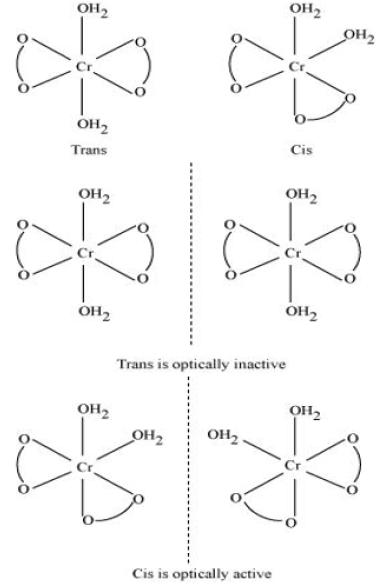
$a. \left.K \left[ Cr \left( H _2 O \right)_2\right\}\left( C _2 O _4\right)_2\right] \cdot 3 H _2 O$ The $\text{IUPAC}$ name $=$ Potassium diaquadioxalatochromate $(III)$ trihydrate
The Oxidation state of chromium $=3$
Electronic configuration: $3 d^3: t_{2 g}{ }^3$
Coordination number od compound $=6$
Shape: octahedral
Stereochemistry:
Image
$\text { Magnetic moment, } \mu=\sqrt{n(n+2)}$
$=\sqrt{3(3+2)}$
$=\sqrt{15} \sim 3.87 B M$
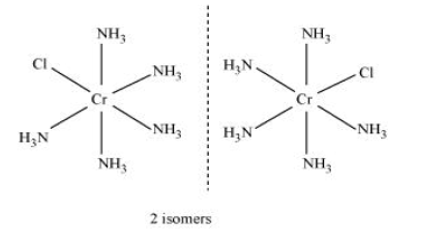
$b. \left[ Co \left( NH _3\right)_5 Cl \right] Cl _2$ The $\text{IUPAC}$ name: Pentaamminechloridocobalt$(III)$ chloride
The oxidation state of $Co =+3$
Coordination number of compound $=6$
Shape: octahedral.
Electronic configuration:
$d^6: t_{2 g}{ }^6$
Stereochemistry:
Image
Magnetic Moment $=0$
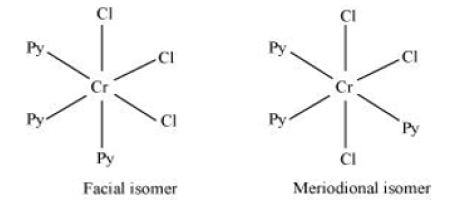
$c. CrCl _3( py ) 3$ The $\text{IUPAC}$ name: Trichloridotripyridinechromium $(III)$
The oxidation state of chromium $=+3$
Electronic configuration for $d^3=t_{2 g}{ }^3$
Coordination number of compound $=6$
Shape: octahedral.
Stereochemistry:​​​​​​​
Image
Both isomers are optically active. Therefore, a total of $4$ isomers exist. Magnetic moment,
$\mu=\sqrt{n(n+2)}=\sqrt{3(3+2)}$
$=\sqrt{15} \sim 3.87 B M$
$d. Cs \left[ FeCl _4\right]$ The $\text{IUPAC}$ name : Caesium tetrachloroferrate $(III)$
The oxidation state of $Fe =+3$
Electronic configuration of $d^6=e_g{ }^2 t_{2 g}{ }^3$
Coordination number of compound $=4$
Shape: tetrahedral
Stereochemistry: optically inactive
Magnetic moment:
$\mu=\sqrt{n(n+2)}=\sqrt{5(5+2)}$
$=\sqrt{35} \sim 6 B M$
$e. K _4\left[ Mn ( CN )_6\right]$ The IUPAC name $=$ Potassium hexacyanomanganate $(II)$
The oxidation state of manganese $=+2$
Electronic configuration: $d^{5+}: t_{2 g}{ }^5$
Coordination number of compound $=6$ Shape: octahedral.
Stereochemistry: optically inactive Magnetic moment, $\mu=\sqrt{n(n+2)}$
$=\sqrt{1(1+2)}=\sqrt{3}$
$=1.732$

Need a full question paper?

Generate a complete, print-ready paper with questions like this in minutes — across 16+ boards, with answer keys.

Start Generating Free

Similar questions

a. i. How is the variability in oxidation states of transition metals different from that of the p-block elements?
ii. Out of $Cu ^{+}$and $Cu ^{2+}$, which ion is unstable in aqueous solution and why?
iii. Orange colour of $Cr _2 O _7{ }^{2-}$ ion changes to yellow when treated with an alkali. Why?
b. Chemistry of actinoids is complicated as compared to lanthanoids. Give two reasons.
  1. State Raoult’s law for a solution containing volatile components.
How does Raoult’s law become a special case of Henry’s law?
  1. $1.00\ g$ of a non-electrolyte solute dissolved in $50\ g$ of benzene lowered the freezing point of benzene by $0.40\ K$. Find the molar mass of the solute. $(K_f$ for benzene$= 5.12\ kg\ mol^{-1})$.
  1. Explain the following:
  1. $NF_3$ is an exothermic compound whereas $NCl_3$ is not.
  2. $F_2$ is most reactive of all the four common halogens.
  1. Complete the following chemical equations:
  1. $C + H_2SO_4 (conc.)\rightarrow $
  2. $P_4 + NaOH + H_2O\rightarrow $
  3. $Cl_2 + F_2 \rightarrow $
(excess)
$(a)$ Give plausible explanation for each of the following$:$
$i.$ Why are amines less acidic than alcohols of comparable molecular masses?
$ii.$ Why are primary amines highest boiling than tertiary amines?
$iii.$ Why are aliphatic amines stronger bases than aromatic amines?
$(b)$ Complete the following reactions$:$
$i. C _6 H _5 N_2 Cl + C _2 H _5 OH \rightarrow$
$ii. C _6 H _5 NH _2+\left( CH _3 CO \right)_2 O \rightarrow$
  1. What type of deviation is shown by a mixture of ethanol and acetone? Give reason.
  2. A solution of glucose (molar mass = $180 g\ mol^{–1}$) in water is labelled as $10\%$ (by mass). What would be the molality and molarity of the solution?
(Density of solution = $1.2 g\ mL^{–1}$).
Explain why on addition of 1mol of NaCl to 1 litre of water, the boiling point of water increases, while addition of 1mol of methyl alcohol to one litre of water decreases its boiling point.
An element has a body-centred cubic bcc structure with a cell edge of $288\ pm$. The density of the element is $7.2g/ cm^3$​​​​​​​. How many atoms are present in $208\ g$ of the element?
A colorless substance ' $A$ ' $\left( C _6 H _7 N\right)$ is sparingly soluble in water and gives a water-soluble compound ' B ' on treating with a mineral acid. On reacting with CHCl 3 and alcoholic potash ' A ' produces an obnoxious smell due to the formation of compound ' C '. The reaction of ' A ' with benzene sulphonyl chloride gives compound ' D ' which is soluble in alkali. With $NaNO _2$ and HCl , ' A ' forms compound ' E ' which reacts with phenol in alkaline medium to give an orange dye ' $F$ '. Identify compounds ' $A$ ' to ' $F$ '.

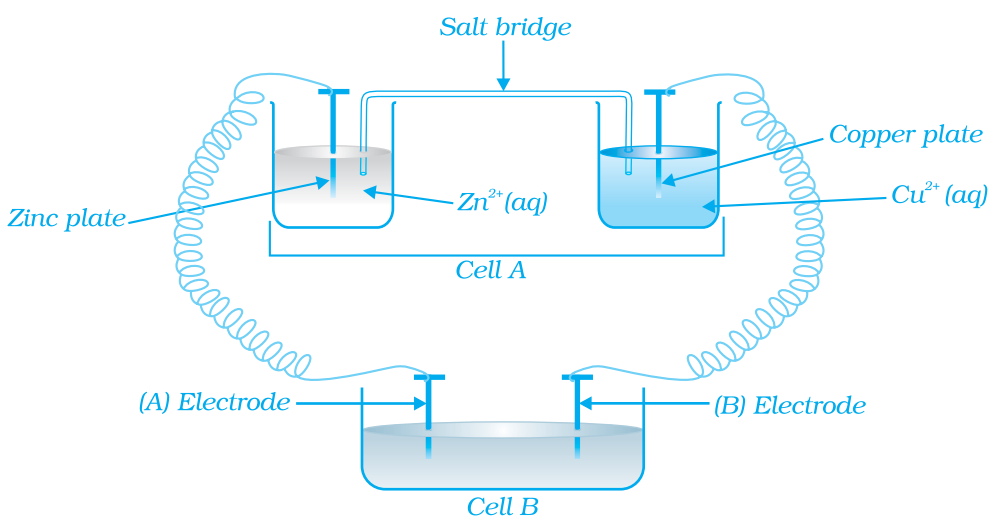
Consider the and answer the following questions.

i. Cell 'A' has $E_{\text {Cell }}=2 \mathrm{~V}$ and Cell 'B' has $E_{\text {Cell }}=1.1 \mathrm{~V}$ which of the two cells ' $A$ ' or ' $B$ ' will act as an electrolytic cell. Which electrode reactions will occur in this cell?
ii. If cell 'A' has $E_{C e l l}=0.5 \mathrm{~V}$ and cell 'B' has $E_{C e l l}=1.1 \mathrm{~V}$ then what will be the reactions at anode and cathode?
  1. Complete the following chemical reaction equations:
  1. $P_4 + SO_2Cl_2 \rightarrow $
  2. $XeF_6 + H_2O \rightarrow $
  1. Predict the shape and the asked angle ($90o$ or more or less) in each of the following cases:
  1. $SO^{2–}_3$ and the angle $O–S–O$.
  2. $ClF_3$ and the angle $F–Cl–F$.
  3. $XeF_2​​​​​​​$​​​​​​​ and the angle $F–Xe–F$.