Question
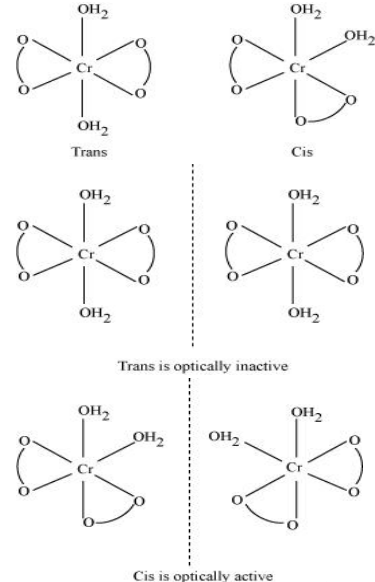
Write down the $\text{IUPAC}$ name for the following complex and indicate the oxidation state, electronic configuration and coordination number. Also give stereochemistry and magnetic moment of the complex:
$\ce{K[Cr(H_2O)_2(C_2O_4)_2].3H_2O}$

Answer

$\ce{K[Cr(H_2O)_2(C_2O_4)_2].3H_2O}$
Potassium diaquadioxalatochromate $(III)$ trihydrate.
Oxidation state of chromium $= 3$
Electronic configuration:$ 3d^3 : t_{2g}^3$
Coordination number $= 6$
Shape: octahedral
Stereochemistry:

Magnetic moment, µ = $\sqrt{\text{n}(\text{n}+2)}$
$=\sqrt{3(3+2)}$
$=\sqrt{15}$
$=\text{~}4\text{BM}$

Need a full question paper?

Generate a complete, print-ready paper with questions like this in minutes — across 16+ boards, with answer keys.

Start Generating Free

Similar questions

State reasons for the following:
  1. $pK_b$ value for aniline is more than that for methylamine.
  2. Ethylamine is soluble in water whereas aniline is not soluble in water.
  3. Primary amines have higher boiling points than tertiary amines.
Although $+3$ oxidation states is the characteristic oxidation state of lanthanoids but cerium shows $+4$ oxidation state also. Why?
Arrange the following compounds in the increasing order of their property indicated:
$i.$ Acetaldehyde, Benzaldehyde, Acetophenone, Acetone $($Reactivity towards $HCN)$
$ii. \ce{(CH_3)_2CHCOOH, CH_3CH_2CH(Br)COOH, CH_3CH(Br)CH_2COOH} ($Acidic strength$)$
$iii. \ce{CH_3CH_2OH, CH_3CHO, CH_3COOH} ($Boiling point$)$
Explain the preparation of ethers with mech$-$anism by dehydration of alcohols.
What is lanthanoid contraction? What are the consequences of lanthanoid contraction?
(a) Write the product when D-glucose reacts with conc. $HNO_3$.
(b) Amino acids show amphoteric behaviour. Why?
(c) Write one difference between $\alpha$-helix and $\beta$-pleated structures of proteins.
  1. Calculate the mass of Ag deposited at cathode when a current of $2$ amperes was passed through a solution of $AgNO_3$ for $15$ minutes.
$($Given: Molar mass of $Ag = 108 \ g \ mol^{–1} 1F = 96500 \ C \ mol^{–1})$​​​​​​​
  1. Define fuel cell.
Calculate the half$-$life of a first order reaction from their rate constants given below:
  1. $\ce{200 s^{–1}}$
  2. $\ce{2 min^{–1}}$
  3. $\ce{4 years^{–1}}$
How will you convert fructose into glucose?
Explain Crystal field splitting in tetrahedral complax.