Question
Need a full question paper?
Generate a complete, print-ready paper with questions like this in minutes — across 16+ boards, with answer keys.
Explore more
More "5 Marks Questions" from Semiconductor Electronics: Materials, Devices and Simple Circuits→Semiconductor Electronics: Materials, Devices and Simple Circuits — all question types→Physics STD 12 Science question papers→Rajasthan Board STD 12 Science question papers→Rajasthan Board question paper generator→
Similar questions
Four particles having masses m, 2m, 3m and 4m are placed at the four corners of a square of edge a. Find the gravitational force acting on a particle of mass m placed at the centre.
A series $\text{LCR}$ circuit is connected to an $a.c$. source having voltage $V=V_m \sin \omega t$. Derive the expression for the instantaneous current $I$ and its phase relationship to the applied voltage. Obtain the condition for resonance to occur. Define power factor. State the conditions under which it is
$i.$ maximum and
$ii$. minimum.
→$i.$ maximum and
$ii$. minimum.
State Soddy $-$ Fajan’s displacement laws for radioactive transformations.
→Repeat the previous problem if the particle C is displaced through a distance x along the line AB.
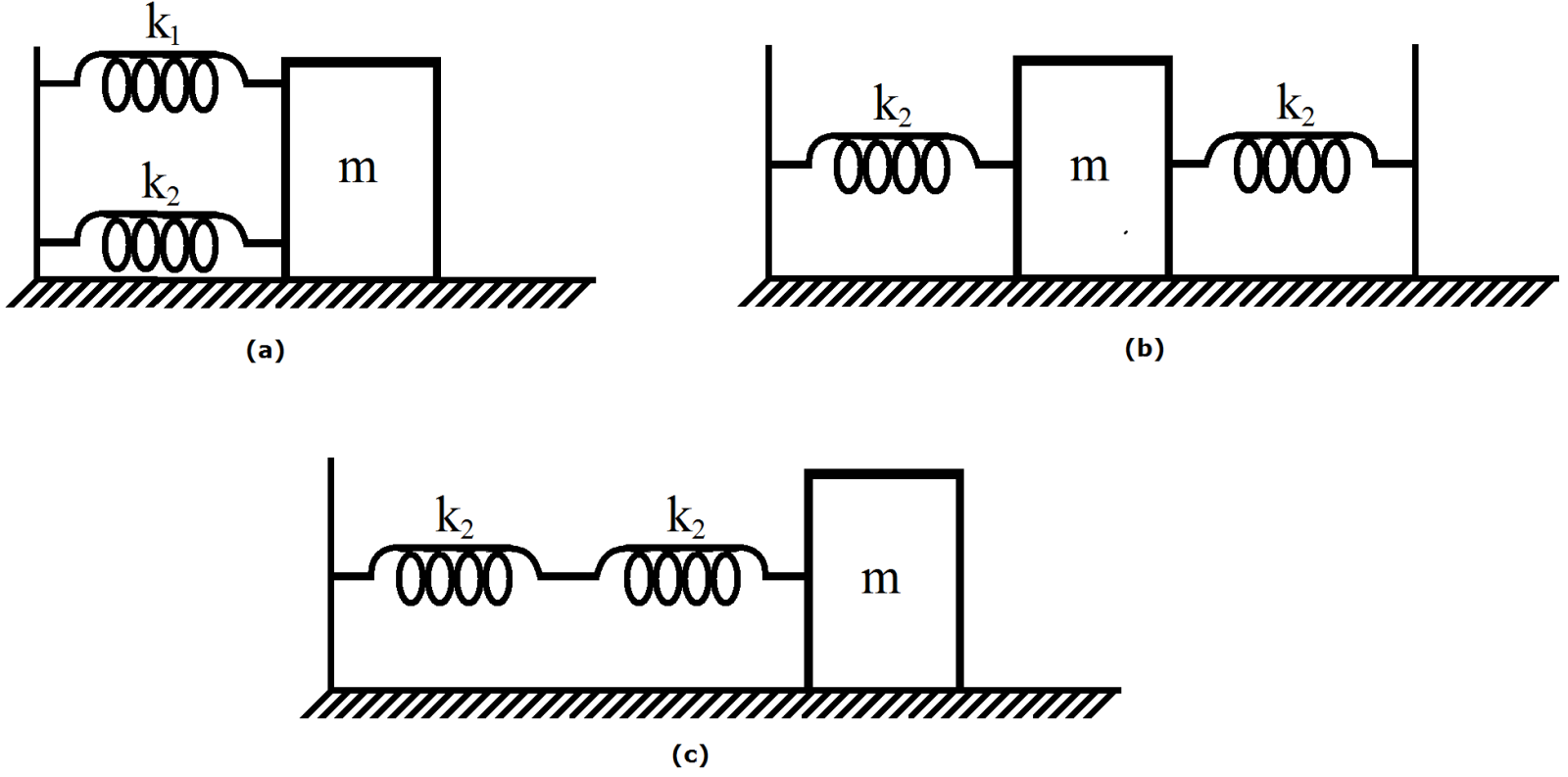
Find the time period of the oscillation of mass $m$ in figure What is the equivalent spring constant of the pair of springs in each case?
→Define common potential. Find the expression for redistribution of charges and energy loss when capacitors are connected together.
A bar magnet of length $1\ cm$ and cross-sectional area $1.0\ cm^2$ produces a magnetic field of $1.5 \times 10$. T at a point in end-on position at a distance $15\ cm$ away from the centre.
→- Find the magnetic moment $M$ of the magnet.
- Find the magnetization $I$ of the magnet.
- Find the magnetic field $B$ at the centre of the magnet.
- Draw a ray diagram to show refraction of a ray of monochromatic light passing through a glass prism.
- Deduce the expression for the refractive index of glass in terms of angle of prism and angle of minimum deviation.
- Explain briefly how the phenomenon of total internal reflection is used in fibre optics.
A wave propagates on a string in the positive $x-$direction at a velocity v. The shape of the string at $t =$ to is given by $\text{g}(\text{x},\text{t}_0)=\text{A}\sin\big(\frac{\text{x}}{\text{a}}\big).$ Write the wave equation for a general time t.
→A charge of $8 \ mC$ is located at the origin. Calculate the work done in taking a small charge of $–2 \times 10^{–9} C$ from a point $P (0, 0, 3 \ cm)$ to a point $Q (0, 4 \ cm, 0),$ via a point $R (0, 6 \ cm, 9 \ cm)$.
→