Question
Write Einstein's photoelectric equation and explain any two observations related to the photoelectric effect.

Answer

The photoelectric equation of Einstein,
$\frac{1}{2} mv_{\max }^2=h v-\phi_0$
Observations related to photoelectric effect :
(1) On frequency of incident light is less than the threshold frequency or $v <v_0$, then from equation $\frac{1}{2} mv _{\max }^2= h \left( v - v _0\right)$, the value of kinetic energy of electron will be negative since kinetic energy is negative. So if $v<$ $v_0$, emission of photo-electrons is not possible, i.e. the frequency of incident light must be greater than or equal to the threshold frequency.
(2) The number of electrons emitted depends on the number of incident photons. In other words, we can say that the number of electrons emitted in unit time for light of fixed frequency from unit area of surface, depends on the number of photons incident on unit area in unit time on the surface i.e. the intensity of light.
(3) From eq. $\frac{1}{2} mv _{\max }^2= h \left(v-v_0\right)$ it is clear that kinetic energy of emitted photoelectrons depends on the frequency of the incident proton but not on the intensity of light.
(4) According to quantum theory, energy of light remains in the form of photons. Therefore as soon as a photon of sufficient energy strikes on the surface, an electron is emitted due to the absorptions, i.e. there is no time lag in the emission of photoelectrons.

Need a full question paper?

Generate a complete, print-ready paper with questions like this in minutes — across 16+ boards, with answer keys.
Start Generating Free

Similar questions

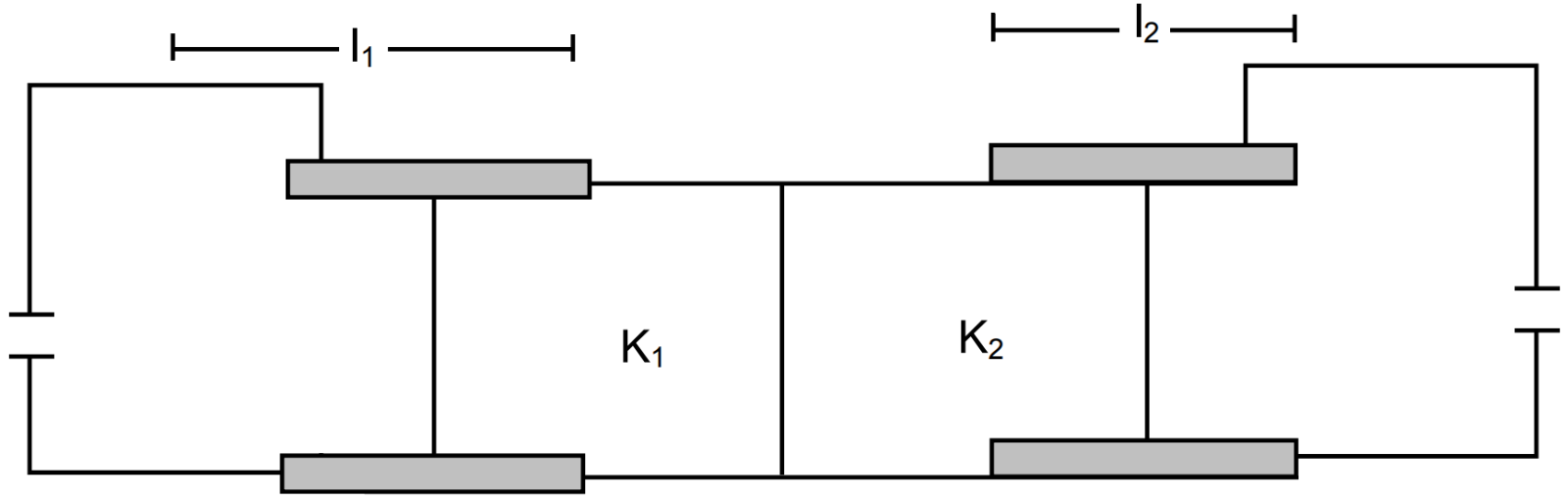
Figure shows two parallel plate capacitors with fixed plates and connected to two batteries. The separation between the plates is the same for the two capacitors. The plates are rectangular in shape with width b and lengths l1 and l2 The left half of the dielectric slab has a dielectric constant K1 and the right half K2. Neglecting any friction, find the ratio of the emf of the left. battery to that of the right battery for which the dielectric slab may remain in equilibrium.

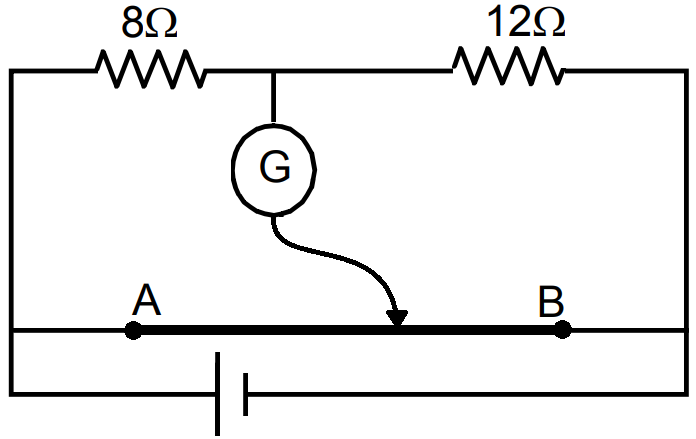
The potentiometer wire AB shown in the figure. is 40cm long. Where should the free end of the galvanometer be connected on AB so that the galvanometer may show zero deflection?

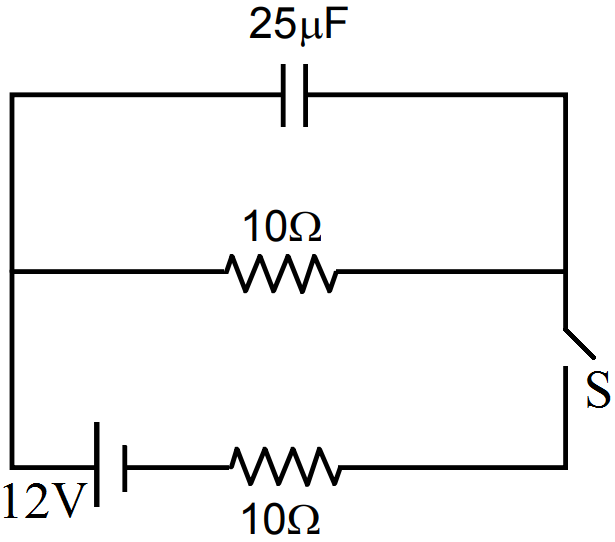
The switch S shown in figure. is kept closed for a long time and is then opened at t = 0. Find the current in the middle $1.0\Omega$ resistor at t = 1ms.

Figure shows a charge array known as an electric quadrupole. For a point on the axis of the quadrupole, obtain the dependence of potential on r for r/a >> 1, and contrast your results with thatdue to an electric dipole, and an electric monopole (i.e., a single charge).

  1. Draw a ray diagram showing the image formation by a compound microscope. Hence obtain expression for total magnification when the image is formed at infinity.
  2. Distinguish between myopia and hypermetropia. Show diagrammatically how these defects can be corrected.
A copper wire having resistance 0.01 ohm in each metre is used to wind a 400-turn solenoid of radius 1.0cm and length 20cm. Find the emf of a battery which when connected the solenoid will eauee a magnetic field of 1.0 × 10⁻²T near the centre of the solenoid.
A square-shaped copper coil has edges of length 50cm and contains 50 turns. It is placed perpendicular to a 1.0T magnetic field. It is removed from the magnetic field in 0·25s and restored in its original place in the next 0·25s. Find the magnitude of the average emf induced in the loop during:
  1. Its removal.
  2. Its restoration.
  3. Its motion.
Suppose the smaller pulley of the previous problem has its radius 5.0cm and moment of inertia 0.10kg-m2. Find the tension in the part of the string joining the pulleys.
Calculate the frequency of beats produced in air when two sources of sound are activated, one emitting a wavelength of 32cm and the other of 32.2cm. The speed of sound in air is 350m/s.
An electrical technician requires a capacitance of 2μF in a circuitacross a potential difference of 1kV. A large number of 1μF capacitors are available to him each of which can withstand a potential difference of not more than 400V. Suggest a possible arrangement that requires the minimum number of capacitors.