Question
Write Faraday's laws of electromagnetic induction and derive them.

Answer

SELF

Need a full question paper?

Generate a complete, print-ready paper with questions like this in minutes — across 16+ boards, with answer keys.
Start Generating Free

Similar questions

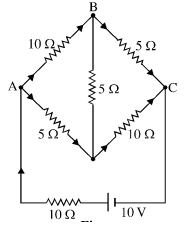
Determine the current in each branch of the network shown in Fig.:
Image
What is Wheatstone bridge ? Explain its use in detail.
A paperweight in the form of a hemisphere of radius 3.0cm is used to hold down a printed page. An observer looks at the page vertically through the paperweight. At what height above the page will the printed letters near the centre appear to the observer?
An LR circuit contains an inductor of 500mH, a resistor of $25.0\Omega$ and emf 5.00 V in series. Find the potential difference across the resistor at.
  1. 20.0ms
  2. 100ms and
  3. 1.00s
i. An ac source generating a voltage $V = V _0 \sin \omega t$ is connected to a capacitor of capacitance C . Find the expression of the current I flowing through it. Plot a graph of $V$ and I versus $\omega t$ to show that the current is $\frac{\pi}{2}$ ahead of the voltage.
ii. A resistor of $200 \Omega$ and a capacitor of $15 \mu F$ are connected in series to a $220 V, 50 Hz$ ac source. Calculate the current in the circuit and the rms voltage across the resistor and the capacitor. Why the algebraic sum of these voltages is more than the source voltage?
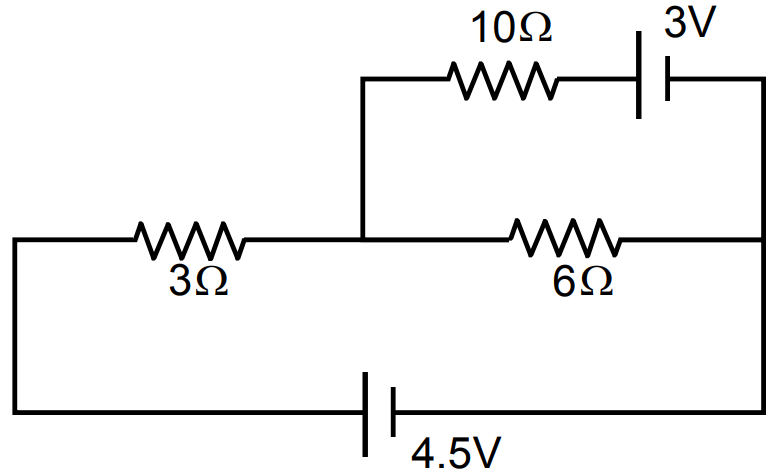
Find the current through the $10\Omega$ resistor shown in figure.

A body of mass 2kg is lying on a rough inclined plane of inclination 30°. Find the magnitude of the force parallel to the incline needed to make the block move:
  1. Up the incline
  2. Down the incline. Coefficient of static friction = 0.2.
k transparent slabs are arranged one over another. The refractive indices of the slabs are $\mu_1,\mu_2,\mu_3, \ ...\mu_{\text{k}}$ and the thicknesses are t1, t2, t3, ... tk . An object is seen through this combination with nearly perpendicular light. Find the equivalent refractive index of the system which will allow the image to be formed at the same place.
Suppose a 'n' - type wafer is created by doping Si crystal having 5 × 1028 atoms/m3 with 1ppm concentration of As. On the surface 200 ppm Boron is added to create ‘P’ region in this wafer. Considering ni = 1.5 × 1016m-3.
  1. Calculate the densities of the charge carriers in the n & p regions.
  2. Comment which charge carriers would contribute largely for the reverse saturation current when diode is reverse biased.
An angular magnification (magnifying power) of 30X is desired using an objective of focal length 1.25 cm and an eyepiece of focal length 5 cm. How will you set up the compound microscope?