Question
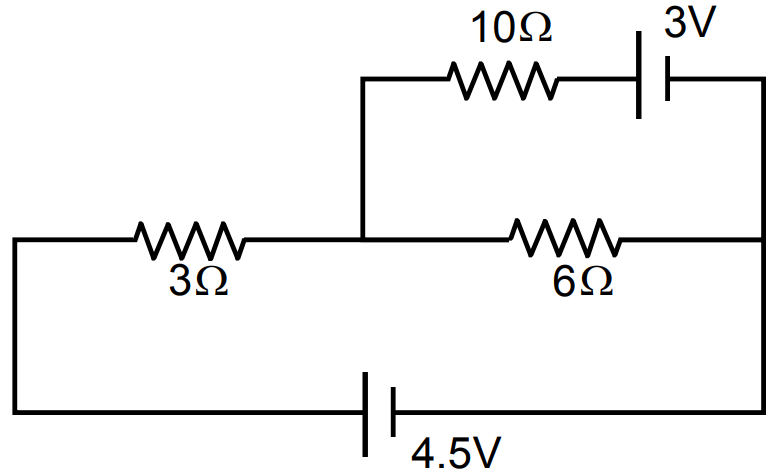
Find the current through the $10\Omega$ resistor shown in figure.

Answer

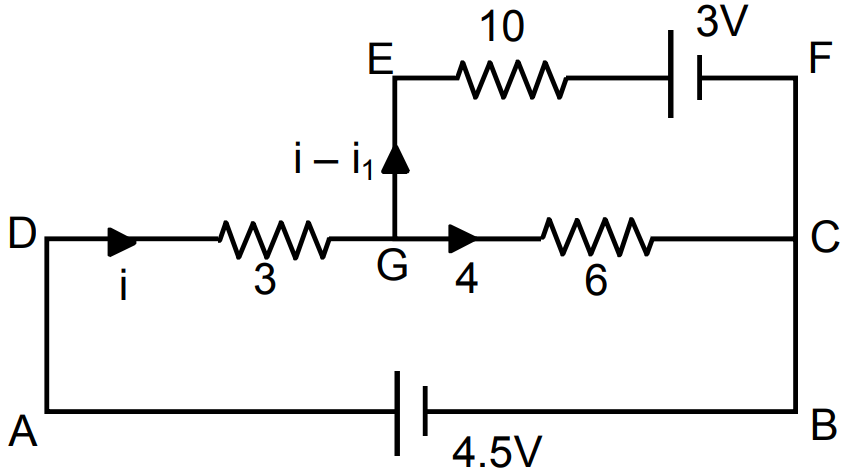
In the circuit ADCBA,

$3\text{i}+6\text{i}_1-4.5=0$
In the circuit GEFCG,
$3\text{i}+6\text{i}_1=4.5$
$=10\text{i}-10\text{i}_1-6\text{i}_1=-3$
$\Rightarrow[10\text{i}+16\text{i}_1=-3]3\ ...(1)$
$[3\text{i}+6\text{i}_1=4.5]10\ ...(2)$
From (1) and (2)
$-108\text{i}_1=-54$
$\Rightarrow\text{i}_1=\frac{54}{108}=\frac{1}{2}=0.5$
$3\text{i}+6\times\frac{1}{2}-4.5=0$
$3\text{i}-1.5=0\Rightarrow\text{i}=0.5$
Current through $10\Omega$ resistor = 0A.

Need a full question paper?

Generate a complete, print-ready paper with questions like this in minutes — across 16+ boards, with answer keys.
Start Generating Free

Similar questions

The energy from the sun reaches just outside the earth's atmosphere at a rate of 1400W/m2. The distance between the sun and the earth is 1.5 × 10¹¹m.
  1. Calculate the rate at which the sun is losing its mass.
  2. How long will the sun last assuming a constant decay at this rate? The present mass of the sun is 2 × 1080kg.
A coil of number of turns N, area A is rotated at a constant angular speed ω, in a uniform magnetic field B and connected to a resistor R. Deduce expression for:
  1. Maximum emf induced in the coil.
  2. Power dissipation in the coil.
A particle of mass m and charge q is thrown at a speed u against a uniform electric field E. How much distance will it travel before coming to momentary rest?
A normal eye has retina 2cm behind the eye-lens. What is the power of the eye-lens when the eye is
  1. Fully relaxed,
  2. Most strained?
A body of mass 2kg is lying on a rough inclined plane of inclination 30°. Find the magnitude of the force parallel to the incline needed to make the block move:
  1. Up the incline
  2. Down the incline. Coefficient of static friction = 0.2.
Two identical balls, each having a charge of 2.00 × 10-7C and a mass of 100g, are suspended from a common point by two insulating strings each 50cm long. The balls are held at a separation 5.0cm apart and then released. Find,
  1. The electric force on one of the charged balls.
  2. The components of the resultant force on it along and perpendicular to the string.
  3. The tension in the string.
  4. The acceleration of one of the balls. Answers are to be obtained only for the instant just after the release.
Water leaks out from an open tank through a hole of area 2mm2 in the bottom. Suppose water is filled up to a height of 80cm and the area of cross-section of the tank is 0.4m2. The pressure at the open surface and at the hole are equal to the atmospheric pressure. Neglect the small velocity of the water near the open surface in the tank.
  1. Find the initial speed of water coming out of the hole.
  2. Find the speed of water coming out when half of water has leaked out.
  3. Find the volume of water leaked out during a time interval dt after the height remained is h. Thus find the decrease in height dh in terms of h and dt.
  4. From the result of part c find the time required for half of the water to leak out.
Derive an expression for equivalent capacitance of three capacitors when connected
i. in series and
ii. in parallel.
A small source of sound oscillates in simple harmonic motion with an amplitude of 1.7cm. A detector is placed along the line of motion of the source. The source emits a sound of frequency 800Hz which travels at a speed of 340m/s. If the width of the frequency band detected by the detector is 8Hz, find the time period of the source.
A $100\mu\text{F}$ capacitor is joined to a 24V battery through a $1.0\text{M}\Omega$ resistor. Plot qualitative graphs (a) between current and time for the first 10 minutes and (b) between charge and time for the same period.