Question
Write Faraday's laws of electromagnetic induction.

Answer

Faraday's Laws of electromagnetic induction :
(1) Whenever there is a change in the magnetic flux linked with a coil, emf is induced in the coil. This emf is called induced emf and it lasts so long as the change in the flux is taking place. When the coil circuit is closed an electric current flows through the circuit corresponding to induced emf and is known as induced current. This phenomenon is called electromagnetic induction.
(2) The induced emf is equal to the negative rate of change of magnetic flux.
If $\Delta\Phi$ be the change in magnetic flux linked with a circuit in time interval $\Delta t$ then the induced emf in the circuit according to second law is given by:
$e=-(\frac{\Delta\Phi}{\Delta t})$ ...(1)
Under the condition: lim $\Delta t \rightarrow 0$ equation (1) in its differential form can be expressed as follows:
$e=-(\frac{d\Phi}{dt})$ ...(2)
The (-ve) sign indicates that the induced emf opposes the change in magnetic flux.

Need a full question paper?

Generate a complete, print-ready paper with questions like this in minutes — across 16+ boards, with answer keys.
Start Generating Free

Similar questions

Describe principle and construction of AC generator with figure and discuss its working.
Define the term “cut off frequency” in photoelectric emission. The threshold frequency of a metal is $f.$ When the light of frequency $2f$ is incident on the metal plate, the maximum velocity of photo$-$electrons is $v_1.$ When the frequency of the incident radiation is increased to $5f,$ the maximum velocity of photo$-$electrons is $v_2.$ Find the ratio $v_1 : v_2.$
Explain the phenomenon of nuclear fission.
A uniform wire of resistance $100\Omega$ is melted and recast as a wire of length is double that of the original. What would be the resistance of the wire?
Explain frequency and wavelength of electromagnetic spectrum.
A magnifying glass is a converging lens placed close to the eye. A farsighted person uses spectacles having converging lenses. Compare the functions of a converging lens used as a magnifying glass and as spectacles.
Define half-life of a radioactive sample. Which of the following radiations: $\alpha-$rays, $\beta-$rays and $\gamma-$rays.
  1. Are similar to X-rays.
  2. Are easily absorbed by matter.
  3. Travel with the greatest speed.
  4. Are similar in nature to cathode rays?
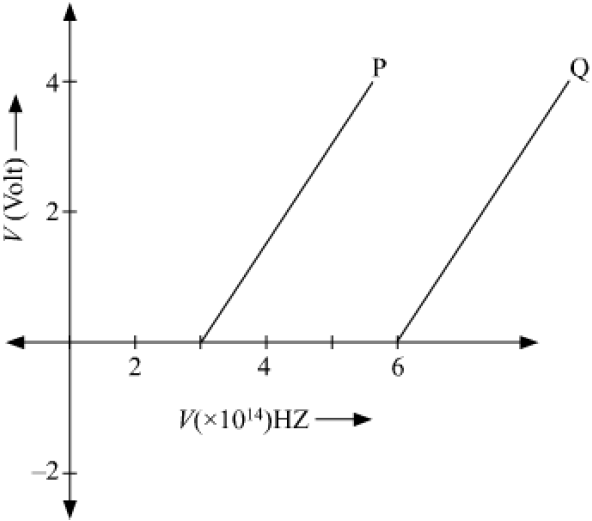
In the study of a photoelectric effect the graph between the stopping potential $V$ and frequency $v$ of the incident radiation on two different metals $P$ and $Q$ is shown below
  1. Which one of the two metals has higher threshold frequency?
  2. Determine the work function of the metal which has greater value.
  3. Find the maximum kinetic energy of electron emitted by light of frequency $8 \times 10^{14} Hz$ for this metal.
When a charged comb is brought near a small piece of paper, it attracts the piece. Does the paper become charged when the comb is brought near it?
When we stir a liquid vigorously, it becomes warm. Is it a reversible process?