Question
When we stir a liquid vigorously, it becomes warm. Is it a reversible process?

Answer

When we stir a liquid vigorously, we do work on it due to which its temperature rises and it becomes warm. To bring back the liquid to the initial temperature, heat needs to be extracted from it. But it is an irreversible process that cannot be brought back to the initial state by stirring the liquid again in the opposite direction.

Need a full question paper?

Generate a complete, print-ready paper with questions like this in minutes — across 16+ boards, with answer keys.
Start Generating Free

Similar questions

  1. In Young's double slit experiment, two slits are $1\ mm$ apart, and the screen is placed $1m$ away from the slits. Calculate the fringe width when light of wavelength $500\ nm$ is used.
  2. What should be the width of each slit in order to obtain $10$ maxima of the double slits pattern within the central maximum of the single slit pattern?
An electric bulb, when connected across a power supply of 220V, consumes a power of 60W. If the supply drops to 180V, what will be the power consumed? If the supply is suddenly increased to 240V, what will be the power consumed?
In Exercise $4.11$ obtain the frequency of revolution of the electron in its circular orbit. Does the answer depend on the speed of the electron? Explain.
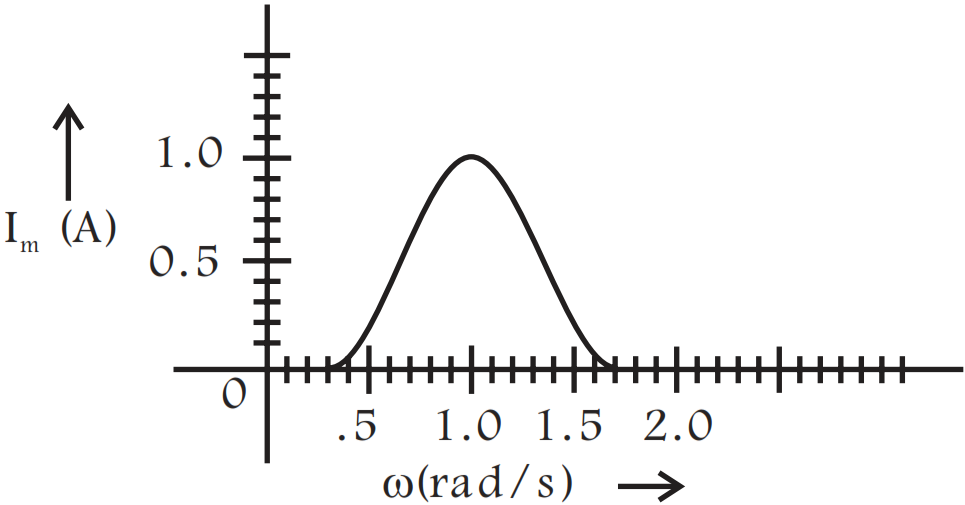
In series $\text{LCR}$ circuit, the plot of $I_{max}$ vs $\omega$ is shown in Fig. Find the bandwidth and mark in the figure.
Name the charge carriers of electric current in:
  1. Silver foil.
  2. Hydrogen discharge tube.
  3. Germanium semiconductor.
  4. Wire made of alloy nichrome.
  5. Superconductor.
What is Malus Law ?
A circular loop of radius R carries a current I. Another circular loop of radius r ( << R) carries a current i and is placed at the centre of the larger loop. The planes of the two circles are at right angle to each other. Find the torque acting on the smaller loop.
A gas cylinder has walls that can bear a maximum pressure of $1.0 \times 10^6Pa.$ It contains a gas at $8.0 \times 10^5Pa$ and $300K.$ The cylinder is steadily heated. Neglecting any change in the volume, calculate the temperature at which the cylinder will break.
A small telescope has an objective lens of focal length $144 \ cm$ and an eyepiece of focal length $6.0 \ cm$. What is the magnifying power of the telescope? What is the separation between the objective and the eyepiece?
Should the energy of a photon be called its kinetic energy or its internal energy?