Question
Write formula for the following compound:

Iron(III) sulphate.

Answer

Iron(III) sulphate:
Fe2(SO4)3

Need a full question paper?

Generate a complete, print-ready paper with questions like this in minutes — across 16+ boards, with answer keys.
Start Generating Free

Similar questions

Which of the following element have second highest ionization enthalpy, and why?
$Be , Li , B$ and C
Dihydrogen gas used in Haber's process is produced by reacting methane from natural gas with high temperature steam. The first stage of two stage reaction involves the formation of CO and $H _2$. In second stage, CO formed in first stage is reacted with more steam in water gas shift reaction,
$CO ( g )+ H _2 O ( g ) \rightleftharpoons CO _2(g)+ H _2(g)$
If a reaction vessel at $400^{\circ} C$ is charged with an equimolar mixture of CO and steam such that $p _{ co }=$ $p _{ H _2 O }=4.0$ bar, what will be the partial pressure of $H _2$ at equilibrium? $K _{ p }=10.1$ at $400^{\circ} C$.
Calculate the wavelength of the radiation which would cause photochemical dissociation of a chlorine molecule.
The bond dissociation energy $Cl - Cl$ of bond is $245 kJ mol ^{-1}$.
What happens when Cl2 gas is passed through aqueous solution of KBr?  What type of redox reaction is it?
Define oxidation and reduction according to electronic concept.
When 4.2g of NaHCO3 is added to a solution of CH3COOH weighing 10.0g, 1120cm2 at of CO2 at is released into atmosphere leaving behind 12.0g of residue. Prove that this observation is in accordance with law of conservation of mass.
Sn form two compounds in different oxidation states : $S n C l _{ 2 }$ and $S n C l _{ 4 }$ but in these $S n C l _{ 2 }$ is solid while $SnCl _4$ is volatile liquid, why?
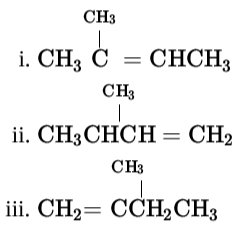
Arrange the following alkenes in the decreasing order of stability.
Image
A compound contains $40 \%$ carbon, $6.67 \%$ hydrogen and remaining oxygen. If molecular mass of compound is 180 gm . Find moleculer formula.
$\text{E}^\circ_\frac{\text{Zn}^{2+}}{\text{Zn}}=-0.76\text{V}$
$\text{E}^\circ_\frac{\text{Cr}^{2+}}{\text{Cr}}=-0.74$ 
$\text{E}^\circ_\frac{\text{H}^+}{\text{H}_2}=0$ 
$\text{E}^\circ_\frac{\text{Fe}^{3+}}{\text{Fe}^{3+}}=0.77\text{V}$
Which is the strongest oxidising agent out of them?