Question
Write Gauss's law and explain.

Answer

Image

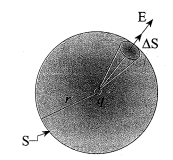
→ Let us consider the total flux through a sphere of radius $r$, which encloses a point charge $q$ at its centre. Divide the sphere into small area elements, as shown in fig.
→ The flux through an area element $\Delta S$ is
$\Delta \phi=\overrightarrow{ E } \cdot \Delta \overrightarrow{ S }=\frac{q}{4 \pi \varepsilon_0 r^2} \hat{r} \cdot \overrightarrow{\Delta S }$
→ The unit vector $\hat{r}$ is along the radius vector from the centre to the area element.
→ Now, since the normal to a sphere at every point is along the radius vector at that point, the area element $\Delta S$ and $\hat{r}$ have the same direction.
Therefore,
$\Delta \phi=\frac{q}{4 \pi \varepsilon_0 r^2} \Delta S$
→ The total flux through the sphere is obtained by adding up flux through all the different area elements:
→ Now S, the total area of the sphere, equals $4 \pi r^2$. Thus,
$\phi=\frac{q}{4 \pi \varepsilon_0 r^2} \times 4 \pi r^2=\frac{q}{\varepsilon_0}$
→ Equation (1) is a simple illustration of a general result of electrostatics called Gauss's law.
→ "The total electric flux associated with a closed surface is equal to the ratio of total enclosed charge and $\varepsilon_0$."
$\therefore \phi=\int \overrightarrow{ E } \cdot d \overrightarrow{ S }=\frac{\sum q}{\varepsilon_0}$
$\phi=\sum_{\text {avl } \Delta S } \frac{q}{4 \pi \varepsilon_0 r^2} \Delta S$
→ Since each area element of the sphere is at the same distance $r$ from the charge,
$\phi=\frac{q}{4 \pi \varepsilon_0 r^2} \sum_{\text {all } \Delta S } \Delta S =\frac{q}{4 \pi \varepsilon_0 r^2} S$

Need a full question paper?

Generate a complete, print-ready paper with questions like this in minutes — across 16+ boards, with answer keys.
Start Generating Free

Similar questions

Consider Galileo's method of measuring the speed of light using two lanterns. To get an accuracy of about 10%, the time taken by the experimenter in closing or opening the shutter should be about one tenth of the time taken by the light in going from one experimenter to the other. Assume that it takes $\frac{1}{100}$ second for an experimenter to close or open the shutter. How far should the two experimenters be to get a 10% accuracy? What are the difficulties in having this separation?
Suppose white light falls on a double slit but one slit is covered by a violet filter (allowing $\lambda=400\text{nm}$). Describe the nature of the fringe pattern observed.
A point source emitting light uniformly in all directions is placed 60cm above a table-top. The illuminance at a point on the table-top, directly below the source, is 15 lux. Find the illuminance at a point on the table-top 80cm away from the first point.
Calculate the magnetic dipole moment corresponding to the motion of the electron in the ground state of a hydrogen atom.
The average separation between the proton and the electron in a hydrogen atom in ground state is $5.3 \times 10^{-11} m.$
  1. Calculate the Coulomb force between them at this separation.
  2. When the atom goes into its first excited state the average separation between the proton and the electron increases to four times its value in the ground state.What is the Coulomb force in this state?
2g of hydrogen is sealed in a vessel of volume $0.02m^3$ and is maintained at 300K. Calculate the pressure in the vessel.
A source emits light of wavelengths 555nm and 600nm. The radiant flux of the 555nm part is 40W and of the 600nm part is 30W. The relative luminosity at 600nm is 0'6. Find:
  1. The total radiant flux.
  2. The total luminous flux.
  3. The luminous efficiency.
A voltage $V = V_o$ sin $\omega\text{t}$ is applied to a series LCR circuit. Derive the expression for the average power dissipated over a cycle. Under what condition is (i) no power dissipated even though the current flows through the circuit, (ii) maximum power dissipated in the circuit?
A thin prism of crown glass $(\mu_\text{r}=1.515,\mu_\text{v}=1.525)$ and a thin prism of flint glass $(\mu_\text{r}=1.612,\mu_\text{v}=1.632)$ are placed in contact with each other. Their refracting angles are 5.0° each and are similarly directed. Calculate the angular dispersion produced by the combination.
The thickness of a glass plate is measured to be 2.17mm, 2.17mm and 2.18mm at three different places. Find the average thickness of the plate from this data.