Question
The average separation between the proton and the electron in a hydrogen atom in ground state is $5.3 \times 10^{-11} m.$
  1. Calculate the Coulomb force between them at this separation.
  2. When the atom goes into its first excited state the average separation between the proton and the electron increases to four times its value in the ground state.What is the Coulomb force in this state?
Answer

Average separation between the proton and the electron of a Hydrogen atom in ground state, $r = 5.3 \times 10^{−11}m$​​​​​​​
  1. Coulomb force when the proton and the electron in a hydrogen atom in ground state
$\text{F}=9\times10^9\times\frac{\text{q}_1\text{q}_2}{\text{r}_2}$

$=\frac{9\times10^9\times(1.6\times10^{-19})^2}{(5.3\times10^{-11})^2}=8.2\times10^{-8}\text{N}$
  1. Coulomb force when the average distance between the proton and the electron becomes 4 times that of its ground state
Coulomb force, $\text{F}=\frac{1}{4\pi\in_0}=\frac{\text{q}_1\text{q}_2}{(4\text{r})^2}$

$=\frac{9\times10^9\times(1.6\times10^{-19})^2}{16\times(5.3)^2\times10^{-22}}$

$=\frac{9\times(1.6)^2}{10\times(5.3)^2}\times10^{-7}$

$=0.0512\times10^{-7}$

$=5.1\times10^{-9}\text{N}$

Need a full question paper?

Generate a complete, print-ready paper with questions like this in minutes — across 16+ boards, with answer keys.

Start Generating Free

Similar questions

The magnetic field at a point inside a 2.0mH inductor coil becomes 0.80 of its maximum value in 20µs when the inductor is joined to a battery. Find the resistance of the circuit.
Draw a circuit diagram for use of NPN transistor as an amplifier in common emitter configuration. The input resistance of a transistor is $1000 \Omega$. On changing its base current by $10\mu\text{A}$ the collector current increases by 2mA. If a load resistance of $5\text{K}\Omega$. Is used in the circuit, calculate:
  1. The current gain.
  2. Voltage gain of the amplifier.
Half life of $^{238}\text{U}_{92}$against$\alpha$ decay is $4.5 \times 10^{9}$years. Calculate the activity of Ig sample of$^{238}\text{U}_{92}$? Given Avogadro's number $= 6 \times 10^{26}$atoms/kmol.
(a) In Example 3.1, the electron drift speed is estimated to be only a few $mm s ^{-1}$ for currents in the range of a few amperes? How then is current established almost the instant a circuit is closed?
(b) The electron drift arises due to the force experienced by electrons in the electric field inside the conductor. But force should cause acceleration. Why then do the electrons acquire a steady average drift speed?
(c) If the electron drift speed is so small, and the electron's charge is small, how can we still obtain large amounts of current in a conductor?
(d) When electrons drift in a metal from lower to higher potential, does it mean that all the 'free' electrons of the metal are moving in the same direction?
(e) Are the paths of electrons straight lines between successive collisions (with the positive ions of the metal) in the (i) absence of electric field, (ii) presence of electric field?
Consider the situation of the previous problem. Find the average electric field energy stored in the capacitor and the average magnetic field energy stored in the coil.

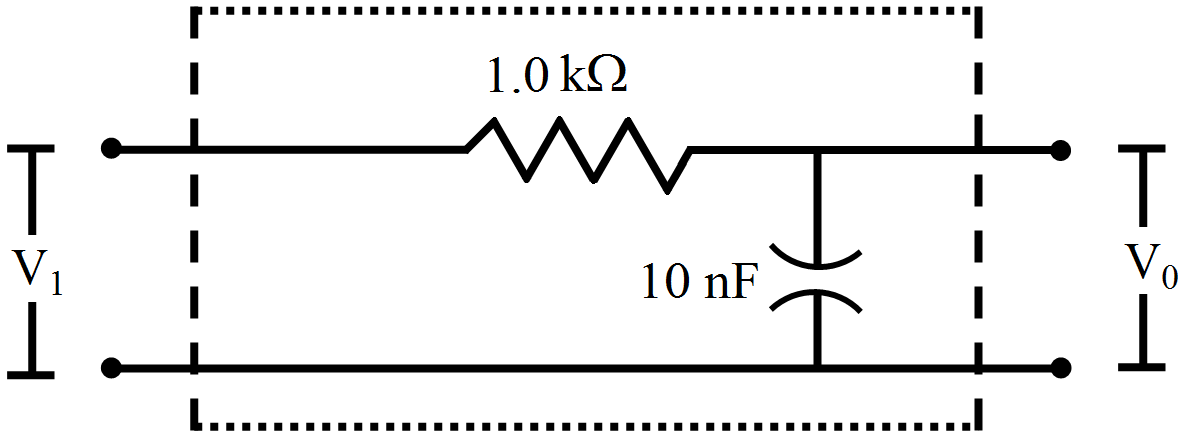
Figure shows a typical circuit for a low-pass filter. An AC input $V_{i }= 10mV$ is applied at the left end and the output $V_0$ is received at the right end. Find the output voltage for ν = 10kHz, 1.0MHz and 10.0MHz. Note that as the frequency is increased the output decreases and, hence, the name low-pass filter.
Explain Electro static potential energy.
A large conducting plane has a surface charge density $1.0\times10^{-4}\text{Cm}^{-2}.$ Find the electrostatic energy stored in a cubical volume of edge 1.0cm in front of the plane.
A cylinder rotating at an angular speed of 50rev/s is brought in contact with an identical stationary cylinder. Because of the kinetic friction, torques act on the two cylinders, accelerating the stationary one and decelerating the moving one. If the common magnitude of the acceleration and deceleration be one revolution per second square, how long will it take before the two cylinders have equal angular speed?
Classify metals, conductors and semiconductors.