Question
Write limitations of Huygen's Principle.

Answer

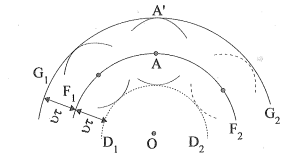
Following is the limitation (short coming) of Huygen's principle:

Image

As per Huygen's principle, we get two wavefronts : one, in the direction of propogation of the wavefront (forward) and second, in the backward direction of the wavefront. They are shown in the fig. with $G_1 G_2$ and $D_1 D_2$.
But we get wavefront only in the forward direction, and not in the backward direction. This is the limitation of Huygen's principle.
To explain this, Huygen argued that the amplitude of the secondary wavelets is maximum in the forward direction and zero in the backward direction.
By making this adhoc assumption, Huygens could explain the absense of the backwave.
However, this adhoc assumption is not satisfactory and the absence of the back wave is really justified from more rigorous wave theory.

Need a full question paper?

Generate a complete, print-ready paper with questions like this in minutes — across 16+ boards, with answer keys.
Start Generating Free

Similar questions

A compound microscope forms an inverted image of an object. In which of the following cases it is kely to create difficulties?
  1. Looking at small germs.
  2. Looking at circular spots.
  3. Looking at a vertical tube containing some water.
As temperature increases, the viscosity of liquids decreases considerably. Will this decrease the resistance of an electrolyte as the temperature increases?
A wire is bent in the form of a regular hexagon and a total charge q is distributed uniformly on it. What is the electric field at the centre? You may answer this part without making any numerical calculations.
Write the relation for the forces $\overrightarrow{F}$ acting on a charge carrier q moving with a velocity $\overrightarrow{V}$ through a magnetic field $\overrightarrow{B}$ in vector notation. Using this relation, deduce the conditions under which this force will be (1) maximum (2) minimum.
Figure shows a boy pulling a wagon on a road. List as many forces as you can which are relevant with this figure. Find the pairs of forces connected by Newton's third law of motion.
Plot a graph showing variation of de-Broglie wavelength $\lambda$ versus $\frac{1}{\sqrt{V}} ,$ where V is accelerating potential for two particles A and B carrying same charge but of masses $m_1, m_2\left(m_1>m_2\right)$. Which one of the two represents a particle of smaller mass and why?
A proton beam is going from east to west. Is there an electric current? If yes, in what direction?
Explain : Static electric field inside a conductor is zero.
Find the increase in mass when 1kg of water is heated from 0°c to 100°C. Specific heat capacity of water = 4200J/kg-K.
Find the thermo-emf developed in a copper-silver thermocouple when the junctions are kept at $0^\circ$C and $40^\circ$C. Use the data in table.
 
Metal with
a
b
lead (Pb)
$\mu\text{V}/^\circ\text{C}$
$\mu\text{V}/^\circ(\text{C})^2$
Aluminium
-0.47
0.003
Bismuth
-43.7
-0·47
Copper
2.76
0·012
Gold
2.90
0.0093
Iron
16.6
-0.030
Nickel
19.1
-0.030
Platinum
-1.79
-0.035
Silver
2.50
0.012
Steel
10.8
-0.016