Question
Write limitations of Huygen's Principle.

Answer

Following is the limitation (short coming) of Huygen's principle:

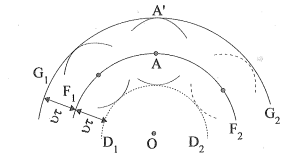
Image

As per Huygen's principle, we get two wavefronts : one, in the direction of propogation of the wavefront (forward) and second, in the backward direction of the wavefront. They are shown in the fig. with $G_1 G_2$ and $D_1 D_2$.
But we get wavefront only in the forward direction, and not in the backward direction. This is the limitation of Huygen's principle.
To explain this, Huygen argued that the amplitude of the secondary wavelets is maximum in the forward direction and zero in the backward direction.
By making this adhoc assumption, Huygens could explain the absense of the backwave.
However, this adhoc assumption is not satisfactory and the absence of the back wave is really justified from more rigorous wave theory.

Need a full question paper?

Generate a complete, print-ready paper with questions like this in minutes — across 16+ boards, with answer keys.
Start Generating Free

Similar questions

Derive Einstein's Photoelectric equation.
Define the term ‘Half$-$life’ of a radioactive substance. Two different radioactive substances have half$-$lives $T_1$ and $T_2$ and number of undecayed atoms at an instant $N_1$ and $N_2,$ respectively. Find the ratio of their activities at that instant.
Think over the experiment number 2 of Faraday and Henry and tell :
(a) What will you do to obtain more deflection in the galvanometer?
(b) How will you show the presence of current in the absence of a galvanometer?
A wire of resistance 16 ohm is clongated to double its lengths find the new resistance ?
Lithium $(Z = 3)$ has two stable isotopes $^6Li$ and $^7Li.$ When neutrons are bombarded on lithium sample, electrons and $\alpha-$particles are ejected. Write down the nuclear process taking place.
Can virtual image be formed on the retina in a seeing process?
Monochromatic light of frequency $6.0 \times 10^{14} Hz$ is produced by a laser. The power emitted is $2.0 \times 10^{-3} W$. (a) What is the energy of a photon in the light beam? (b) How many photons per second, on an average, are emitted by the source?
  1. Find the first excitation potential of $He^+ \text{ion}.$
  2. Find the ionization potential of $Li^{++ } \text{ion}.$
A single lens is mounted in a tube. A parallel beam enters the tube and emerges out of the tube as a divergent beam. Can you say with certainty that there is a diverging lens in the tube?
Under what condition, force on moving charged particle in a magnetic field will be (i) maximum (ii) minimum?