Question
Write limitations of Huygen's Principle.

Answer

Following is the limitation (short coming) of Huygen's principle:

Image

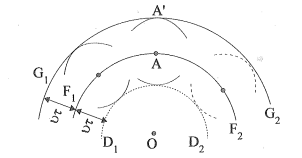
As per Huygen's principle, we get two wavefronts : one, in the direction of propogation of the wavefront (forward) and second, in the backward direction of the wavefront. They are shown in the fig. with $G_1 G_2$ and $D_1 D_2$.
But we get wavefront only in the forward direction, and not in the backward direction. This is the limitation of Huygen's principle.
To explain this, Huygen argued that the amplitude of the secondary wavelets is maximum in the forward direction and zero in the backward direction.
By making this adhoc assumption, Huygens could explain the absense of the backwave.
However, this adhoc assumption is not satisfactory and the absence of the back wave is really justified from more rigorous wave theory.

Need a full question paper?

Generate a complete, print-ready paper with questions like this in minutes — across 16+ boards, with answer keys.
Start Generating Free

Similar questions

The two rails of a railway track, insulated from each other and from the ground, are connected to a millivoltmeter. What will be the reading of the millivoltmeter when a train travels on the track at a speed of 180km/h-1? The vertical component of earth's magnetic field is 0.2 × 10⁻⁴ T and the rails are separated by 1m.
Verify that the units weber and volt-second are the same.
Write the factors affecting the capacitance of a capacitor.
Suppose you are given a chance to repeat the alpha-particle scattering experiment using a thin sheet of solid hydrogen in place of the gold foil. (Hydrogen is a solid at temperatures below 14 K.) What results do you expect?
A convex lens of diameter 8.0cm is used to focus a parallel beam of light of wavelength 620nm. If the light be focused at a distance of 20cm from the lens, what would be the radius of the central bright spot formed?
Elemental semiconductor and compound semiconductors. Explain with examples.
A metallic rod of 'L' length is rotated with angular frequency of '$\omega$' with one end hinged at the centre and the other end at the circumference of a circular metallic ring of radius L, about an axis passing through the centre and perpendicular to the plane of the ring. A constant and uniform magnetic field B parallel to the axis is present everywhere. Deduce the expression for the emf between the centre and the metallic ring.
Write down Huygen's principle and explain how a new plane wavefront is formed at the end of a very small time interval.
The lower end of a capillary tube is immersed in mercury. The level of mercury in the tube is found to be 2cm below the outer level. If the same tube is immersed in water, upto what height will the water rise in the capillary?
Two point electric charges of unknown magnitude and sign are placed at some distance ‘d’ apart. The electric field intensity is zero at a point, not between the charges but on the line joining them.
Write two essential conditions for this to happen.