Question
Write note on Hydrogen Oxygen fuel cell.

Answer

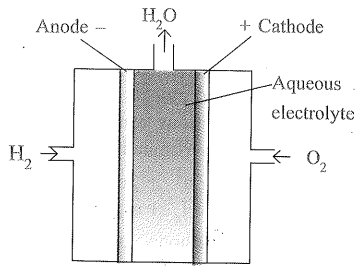
→ One of the most successful fuel cells uses the reaction of hydrogen with oxygen to form water
Image
→ In the cell, hydrogen and oxygen are bubbled through porous carbon electrodes into concentrated aqueous sodium hydroxide solution.
→ Catalysts like finely divided platinum or palladium metal are incorporated into the electrodes for increasing the rate of electrode reactions.
→ The electrode reactions are given below :
Cathode : $O _2(g)+2 H _2 O (l)+4 e ^{-} \rightarrow 4 OH ^{-}( aq )$
Anode : $2 H _2(g)+4 OH ^{-}( aq ) \rightarrow 4 H _2 O ( l )+4 e ^{-}$
Net reactions : $2 H _2(g)+ O _2(g) \rightarrow 2 H _2 O (l)$

Need a full question paper?

Generate a complete, print-ready paper with questions like this in minutes — across 16+ boards, with answer keys.
Start Generating Free

Similar questions

Calculate the emf of the following cell at 298 K :
$\mathrm{Fe}(\mathrm{~s})\left|\mathrm{Fe}^{2+}(0.001 \mathrm{M})\right|\left|\mathrm{H}^{+}(1 \mathrm{M})\right| \mathrm{H}_2(\mathrm{~g})\left(1 \text { bar), Pt (s) (Given } \mathrm{E}_{\text {cell }}^0=+0.44 \mathrm{~V}\right. \text { ) }$
Define the following terms:
  1. Glycosidic linkage.
  2. Invert sugar.
  3. Oligosaccharides.
Explain bimolecular nucleophilic substitutio $(SN^2)$ reaction with example.
In a pseudo first order hydrolysis of ester in water, the following results were obtained:
t/s $0$ $30$ $60$ $90$
[Ester]/mol $L^{-1}$ $0.55$ $0.31$ $0.17$ $0.085$
  1. Calculate the average rate of reaction between the time interval $30 $to $60 $seconds.
  2. Calculate the pseudo first order rate constant for the hydrolysis of ester.
How the following conversions can be carried out?
i. 2-Bromopropane to 1-bromopropane
ii. Chloroethane to butane
iii. Benzene to diphenyl
'Stability of a crystal is reflected in the magnitude of its melting points'. Comment. Collect melting points of solid water, ethyl alcohol, diethyl ether and methane from a data book. What can you say about the intermolecular forces between these molecules?
Explain the following terms giving a suitable example in each case:
  1. Emulsification.
  2. Homogeneous catalysis.
Calculate the mass percentage of benzene $(C_6H_6) $ and carbon tetrachloride $(CCl_4)$ if $22$ g of benzene is dissolved in $122$ g of carbon tetrachloride.
Explain Halogenation, Nitration, Sulphonation and Friedel crafts reaction of chlorobenzene.
Explain types of Electrodes with examples