Questions

3 Marks Question

🎯

Test yourself on this topic

20 questions · timed · auto-graded

Question 13 Marks
Write note on lead storage cell.
Answer
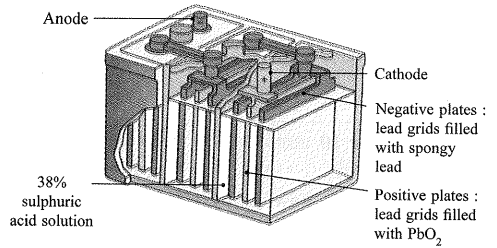
$\rightarrow $ In consists of a lead anode and a grid of lead packed with lead dioxide $\left( PbO _2\right)$ as cathode.
$\rightarrow $ A $38\%$ solution of sulphuric acid is used as an electrolyte.
Image
\rightarrow The cell reactions when the battery is in use are given below :
Anode : $Pb ( s )+ SO _4^{2-}( aq ) \rightarrow PbSO _4(s)+2 e ^{-}$
Cathode : $PbO _2(s)+ SO _4{ }^{2-}( aq )+4 H ^{+}( aq )+2 e ^{-}$
$\rightarrow PbSO _4(s)+2 H _2 O (l)$
$\rightarrow$ Overall cell reaction consisting of cathode and anode reactions is :
$Pb ( s )+ PbO _2(s)+2 H _2+ SO _4( aq ) \rightarrow 2 PbSO _4(s)$
$+2 H _2 O (l)$
$\rightarrow$ On charging the battery, the reaction is reversed and $PbSO _4(s)$ on the anode and cathode is converted into Pb and $PbO _2$, respectively.
View full question & answer
Question 23 Marks
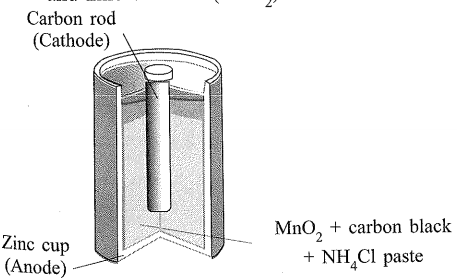
Short Note on dry cell ### Explain Leclanche cell.
Answer
→ The cell consists of a zinc container that also acts as anode, while the cathode is a carbon (graphite) rod surrounded by powered manganese dioxide and carbon.
→ The space between the electrodes is filled with a moist of paste of ammonium chloride $\left( NH _4 Cl \right)$ and zinc chloride $\left( ZnCl _2\right)$
Image
→ Dry cells are often used in devices like transistors, toys and clocks.
→ The electrode reactions are complex, by they can be written approximately as follows :
Anode $: Zn ( s ) \rightarrow Zn ^{2+}+2 e ^{-}$
Cathode : $MnO _2+ NH _4^{+}+ e ^{-} \rightarrow MnO ( OH )+ NH _3$
→ In the reaction at cathode, manganese is reduced from the +4 oxidation state to the +3 state.
→ Ammonia produced in the reaction forms a complex with $Zn ^{+2}$ to give $\left[ Zn \left( NH _3\right)_4\right]^{+2}$. The cell has a potential of nearly 1.5 V .
View full question & answer
Question 33 Marks
Write note on Hydrogen Oxygen fuel cell.
Answer
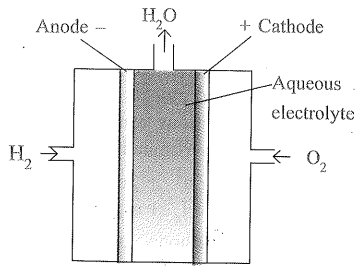
→ One of the most successful fuel cells uses the reaction of hydrogen with oxygen to form water
Image
→ In the cell, hydrogen and oxygen are bubbled through porous carbon electrodes into concentrated aqueous sodium hydroxide solution.
→ Catalysts like finely divided platinum or palladium metal are incorporated into the electrodes for increasing the rate of electrode reactions.
→ The electrode reactions are given below :
Cathode : $O _2(g)+2 H _2 O (l)+4 e ^{-} \rightarrow 4 OH ^{-}( aq )$
Anode : $2 H _2(g)+4 OH ^{-}( aq ) \rightarrow 4 H _2 O ( l )+4 e ^{-}$
Net reactions : $2 H _2(g)+ O _2(g) \rightarrow 2 H _2 O (l)$
View full question & answer
Question 43 Marks
Explain stoichiometry calculation of chemical reaction occurs on the electrode of electrolytic cell and it's formula. $($for numerical$)$
Answer
$\rightarrow $ If $I$ is constant current passed for t sec. then, $Q = I x t$
Where, $I$ current in ampere
$t =$ time in second
$Q =$ current in coulomb
$\rightarrow $ The amount of electricity $($or charge$)$ required for oxidation or reduction depends on the stoichiometry of the electrode reaction.
$\rightarrow $ For example, in the reaction: $Ag ^{+}( aq )+ e ^{-} \rightarrow Ag ( s )$
$\rightarrow $ One mole of the electron is required for the reduction of one mole of silver ions. We know that charge on one electron is equal to $1.6021 \times$
$10^{-19} C$. Therefore, the charge on one mole of electrons is equal to :
$= N _{ A } \times 1.6021 \times 10^{-19} C$
$=6.022 \times 10^{23} \times 1.6021 \times 10^{-19} C$
$=96487 \ C\ mol ^{-1}$
$\rightarrow$ This quantity of electricity is called Faraday and is represented by the symbol $F.$
$\rightarrow$ For approximate calculations we use $1 F=$
$96500 C mol ^{-1}$.
$\rightarrow$ For the electrode reactions :
$Mg ^{2+}(l)+2 e ^{-} \rightarrow Mg ( s )$
$Al ^{3+}(l)+3 e ^{-} \rightarrow Al ( s )$
$\rightarrow$ It is obvious that one mole of $Mg ^{2+}$ and $Al ^{3+}$ require 2 mol of electrons $(2 F)$ and $3$ mol of electrons $(3 F)$ respectively.
View full question & answer
Question 53 Marks
What is Electrolytic cell? Explain simplest electrolytic cell in details?
Answer
→ In an electrolytic cell external source of voltage is used to bring about a chemical reaction.
→ The electrochemical processes are of great importance in the laboratory and the chemical industry.
→ One of the simplest electrolytic cell consists of two copper strips dipping in an aqueous solution of copper sulphate.
→ If a DC voltage is applied to the two electrodes, then $Cu ^{+2}$ ions discharged at the cathode (negatively charged) and the following reaction takes place :
$
Cu ^{2+}( aq )+2 e ^{-} \rightarrow Cu ( s )
$
→ Copper metal is deposited on the cathode. At the anode, copper is converted into $Cu ^{+2}$ ions by the reaction :
$
Cu ( s ) \rightarrow Cu ^{2+}( s )+2 e ^{-}
$
→ Thus copper is dissolved (oxidised) at anode and deposited (reduced) at cathode.
→ This is the basis for an industrial process inwhich impure copper is converted in to copper of high purity. The impure copper is made theanode that dissolves on passing current andpure copper is deposited at the cathode.
→ Many metals like Na, Mg, Al, etc. are produced on large scale by electrochemical reduction of their respective cations where no suitable chemical reducing agents are available for this purpose.
→ Sodium and magnesium metals are produced by the electrolysis of their fused chlorides and aluminium is produced by electrolysis of aluminium oxide in presence of cryolite.
View full question & answer
Question 63 Marks
Explain electrolysis of concentration aqueous solution of $\text{NaCl}$
Answer
$\rightarrow $ During the electrolysis of aqueous sodium chloride solution, the products are $NaOH , Cl _2$ and $H _2$.
$\rightarrow $ In this case besides $Na ^{+}$and $Cl ^{-}$ions we also have $H ^{+}$and $OH ^{-}$ions along with the solvent molecules, $H _2 O$.
$\rightarrow $ At the cathode there is competition between the following reduction reactions :
$Na ^{+}( aq )+ e ^{-} \rightarrow Na ( s ) E _{\text {(cell) }}^{\ominus}=-2.71 V$
$H ^{+}( aq )+ e ^{-} \rightarrow \frac{1}{2} H _2(g) E _{\text {(cell) }}^{\ominus}=0.00 V$
\rightarrow The reaction with higher value of $E ^{\ominus}$ is preferred and, therefore the reaction at the cathode during electrolysis is :
$H ^{+}( aq )+ e ^{-} \rightarrow \frac{1}{2} H _2(g)...(1)$
but $H ^{+}( aq )$ is produced by the dissociation of $H _2 O$ i.e.,
$H _2 O (l) \rightarrow H ^{+}( aq )+ OH ^{-}( aq )...(2)$
Therefore, the net reaction at the cathode may be written as the sum of $(1)$ and $(2)$ and we have
$H _2 O ( l )+ e ^{-} \rightarrow \frac{1}{2} H _2(g)+ OH ^{-}$
At the anode the following oxidation reactions are possible :
$Cl ^{-}( aq ) \rightarrow \frac{1}{2} Cl _2(g)+ e ^{-} E _{\text {(cell) }}^{\ominus}=1.36 V \ldots \ldots . .(3)$
$2 H _2 O ( l ) \rightarrow O _2(g)+4 H ^{+}( aq )+4 e ^{-} E _{\text {(cell) }}^{\ominus}=1.23 V$
\rightarrow The reaction at anode with lower value of $E ^{\ominus}$ is preferred and therefore, water should get oxidised in preference to $Cl ^{-}$(aq). However, on account of over potential of oxygen, reaction $(3)$ is preferred. Thus, the net reactions may be summarised as:
$NaCl ( aq ) \xrightarrow{ H _2 O } Na ^{+}( aq )+ Cl ^{-}( aq )$
Cathode : $H _2 O (l)+ e ^{-} \rightarrow \frac{1}{2} H _2(g)+ OH ^{-}( aq )$
Anode : $Cl ^{-}( aq ) \rightarrow \frac{1}{2} Cl _2(g)+ e ^{-}$
Net reaction :
$NaCl ( aq )+ H _2 O ( l ) \rightarrow Na ^{+}( aq )+ OH ^{-}( aq )+\frac{1}{2} H _2(g)+\frac{1}{2} Cl _2(g)$
View full question & answer
Question 73 Marks
What is weak electrolyte? Explain relation between concentration of weak electrolyte and molar conductivity.
Answer
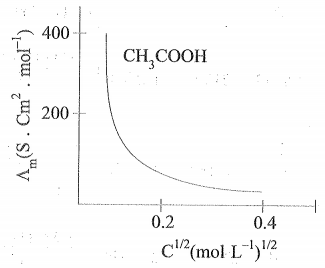
→ "Electrolyte which is incompletely ionized in its aqueous solution are known as weak electrolyte.
→" Weak electrolytes like acetic acid have lower degree of dissociation at higher concentrations and hence for such electrolytes, the change in $\hat{m}_{ m }$ with dilution is due to increase in the degree of dissociation and consequently the number of ions in total volume of solution that contains 1 mol of electrolyte.
→ In such cases $\wedge_{ m }$ increases steeply on dilution especially near lower concentrations. Therefor $\wedge_{ m }^0$ cannot be obtained by extra polation of $\wedge_{ m }^0$ zero concentration.
→ At infinite dilution (i.e. concentration $c \rightarrow$ zero electrolyte dissociates completely $(\alpha=1)$, but such low concentration the conductivity of the solution is so low that it cannot be measured accurately.
→ Therefore, $\wedge_{ m }^0$ for weak electrolytes is obtained by using Kohlrausch law of independent migration of ions.
Image
→ At any concentration c , if a is the degree of dissociation then it can be approximated to the ratio of molar conductivity $\wedge_{ m }$ at the concentration c to limiting molar conductivity, $\wedge_{ m }^0$ Thus we have :
$\begin{aligned} \alpha & =\frac{\Lambda_{ m }}{\Lambda_{ m }^0} \\ k _{ a } & =\frac{ c \alpha^2}{1-\alpha}=\frac{ c \Lambda_{ m }^2}{\Lambda_{ m }^{02}\left(1-\frac{\Lambda_{ m }}{\Lambda_{ m }^0}\right)}=\frac{ c \Lambda_{ m }^2}{\Lambda_{ m }^0 \Lambda_{ m }^0-\Lambda_{ m }}\end{aligned}$
View full question & answer
Question 83 Marks
Explain kohlrausch Law with example.
Answer
$\rightarrow$ "The law states that limiting molar conductivity of an electrolyte can be represented as the sum of the individual contributions of the anion and cation of the electrolyte."
$\rightarrow$ Thus, if $\lambda_{ Na ^{+}}^0$ and $\lambda_{ Cl ^{-}}^0$ are limiting molar conductivity of the sodium and chloride ions respectively. then the limiting molar conductivity for sodium chloride is given by the equation :
$\wedge_{ m ( NaCl )}^0=\lambda_{ Na ^{+}}^0+\lambda_{ Cl ^{-}}^0$
$\rightarrow$ In general, if an electrolyte on dissociation gives $v_{+}$ cations and $v_{-}$ anions then its limiting molar conductivity is given by :
$E _{ m }^0= v _{+} \lambda_{+}^0+ v _{-} \lambda^0$
$\rightarrow$ Here, $\lambda_{+}^0$ and $\lambda_{-}^0$ are the limiting molar conductivities of the cation and anion respectively.
$\rightarrow \text { If } \lambda_{ m ^{+}}^0 \text { for } Na ^{+}=50.1 \ S\ cm ^2\ mol^{-1}$
$\lambda_{ m ^{-}}^0 \text { for } Cl ^{-}=76.3 \ S \ cm ^2 \ mol^{-1}$
$\lambda_{ m ( NaCl )}=\lambda_{ m \left( Na ^{+}\right)}^0+\lambda_{ m \left( Cl ^{-}\right)}^0$
$=50.1+76.3$
$=126.4 \ S \ \cdot \ cm ^2 \ mol^{-1}$
View full question & answer
Question 93 Marks
What is limiting molar conductivity ? Explain relation between molar conductivity and concentration of solution with strong electrolyte.
Answer
→ "When the concentration of solution approaches zero, the molar conductivity is known as limiting molar conductivity and is represented by the symbol $\wedge_m^0$
→ Electrolytes which is completely ionize is known as strong electrolyte.
e.g. $KCl , NaCl , MgCl _2, CaCl _2, NaNO _3, KNO _3$ etc.
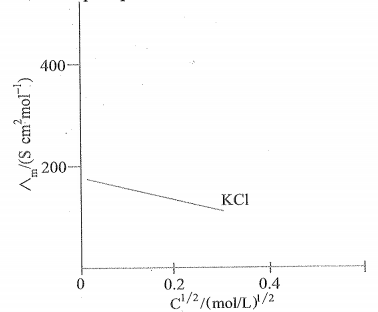
→ For strong electrolytes, $\wedge_{ m }$increases slowly with dilution and can be represented by the equation : $
\wedge_{ m }=\Lambda^0{ }_{ m }- Ac ^{\frac{1}{2}}
$
→ It can be seen that if we plot $\wedge_{ m }$ against $c ^{\frac{1}{2}}$, we obtain a straight line with intercept equal to $\wedge^0{ }_{ m }$ and slope equal to - A .
Image
→ The value of the constant A for a given solvent and temperature depends on the type of electrolyte.
→ Thus, $NaCl , CaCl _2, MgSO _4$ are known as 1-1, 2-1 and 2-2 electrolytes respectively. Al electrolytes of a particular type have the same value for 'A'.
View full question & answer
Question 103 Marks
Explain measurement and calculation of resistance and conductivity of electrolytic solution.
Answer
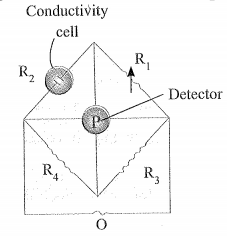
→ The set up for the measurement of the resistance is shown in below figure.
→ It consists of two resistance $R_3$ and $R_4$, a variable resistance $R_1$ and the conductivity cell having the unknown resistance $R _2$.
Image
→ The wheatstone bridge is fed by an oscillator O (a source of a.c. power in the audio frequency range 550 to 5000 cycles per second).
→ P is a suitable detector (a headphone or other electronic device) and the bridge is balanced when no current passes through the detector. Under these conditions.
Unknown resistance $R _2=\frac{ R _1 R _4}{ R _3}$
→ Now a days, inexpensive conductivity meters are available which can directly read the conductance or resistance of the solution in the conductivity cell.
→ Once the cell constant and the resistance of the solution in the cell is determined, the conductivity of the solution is given by the equation:
$k =\frac{\text { cell constant }}{ R }=\frac{ G ^*}{ R }$
View full question & answer
Question 113 Marks
Write a mote on molar conductivity $\left(\wedge_{\text {m }}\right)$ of solution and write down it's formula.
Answer
$\rightarrow $ The conductivity of solutions of different electrolytes in the same solvent and at a given temperature differs due to charge and size of the ions in which they dissociate, the concentration of ions or ease with which the ions move under a potential gradient.
$\rightarrow $ It, therefore becomes necessary to define physically more meaningful quantity called molar conductivity denoted by the symbol $^m ($Greek, lambda$)$
Molar conductivity $=\wedge_{ m }=\frac{\kappa}{ c }$
$\rightarrow $ In the above equation, if $k$ is expressed in $S$
$m ^{-1}$ and the concentration, $c$ in mol $m ^{-3}$ then the units of $\wedge_{ m }$ are in $S\ m ^2\ mol^{-1}$. It may be noted that :
$1 \ mol m ^{-3}=1000\left(L / m ^3\right) \times$ molarity $( mol / L )$, and hence
$\rightarrow \wedge_{ m }\left( S\ m ^2mol^{-1}\right)=\frac{\kappa Sm ^{-1}}{1000 Lm ^{-3} \times \text { molarity } mol L ^{-1}}
$
$\rightarrow $ If we use $S \ cm ^{-1}$ as the units for $k$ and mol $cm ^3$, the units of concentration, then the units for $\wedge_{ m }$ are $S \ cm ^2 mol^{-1}$.It can be calculated by using the equation :
$\wedge_{ m }\left( S \ cm ^2\ mol^{-1}\right)=\frac{\kappa S \ cm ^{-1} \times 1000 \ cm^3 L}{ molarity mol L }$
$1\ S\ m ^2\ mol^{-1}=10^4 \ S \ cm ^2 \ mol^{-1} \text { or }$
$1 \ S\ cm ^2 \ mol^{-1}=10^{-4} \ S\ m ^2\ mol^{-1}$
View full question & answer
Question 123 Marks
Classification of solid based on conductivity
Answer
→ Materials are classified into conductors, insulators and semiconductors depending on the magnitude of their conductivity.
→ Metals and their alloys have very high conductivity and are known as conductors.
→ Certain non-metals like carbon-black, graphite and some organic polymers* are also possess electronically conductivity.
→ Substances like glass, ceramics, etc., having very low conductivity are known as insulators.
→ Substance like silicon, doped silicon and gallium arsenide having conductivity between conductors and insulators are called semiconductors and are important electronic materials.
→ Certain material called superconductors exhibit zero resistivity or infinite conductivity.
→ Earlier, only metals and their alloys at very low temperatures (0 to 15 K) were known to behave as superconductors, but now days a number of ceramic materials and mixed oxides are also known to show superconductivity at temperatures as high as 150 K.
→ The values of Conductivity of some Selected Materials at 298.15 K are given below.
MaterialConductivity/S$m ^{-1}$MaterialConductivity/S$m ^{-1}$
Conductors Aqueous Solution
Sodium$2.1 \times 10^3$Pure water$3.5 \times 10^{-5}$
Copper$5.9 \times 10^3$0.1 M HCl3.91
Silver$6.2 \times 10^3$0.01 M KCI0.14
Gold$4.5 \times 10^3$0.01M NaCl0.12
Iron$1.0 \times 10^3$0.1 M HAc0.047
Graphite$1.2 \times 10$0.01M HAc0.016
Insulators Semiconductors
Glass$1.0 \times 10^{-16}$CuO$1 \times 10^{-7}$
Teflon$1.0 \times 10^{-18}$Si$1.5 \times 10^{-2}$
View full question & answer
Question 133 Marks
Explain Equilibrium constant for Daniell by nernst equation and calculate it's value
Answer
$\rightarrow$ The cell reaction of Daniell cell is represented as : $\ce{Zn(s) + Cu ^{2+}(aq) \rightarrow Zn ^{2+}(aq) + Cu(s)}$
$\rightarrow$ As time passes, the concentration of $Zn ^{2+}$ keeps on increasing while the concentration of $Cu ^{+2}$ keeps on decreasing.
$\rightarrow$ At the same time voltage measured on the voltmeter decreases
$\rightarrow$ After some time, it will be observed that there is no change in the concentration of $Cu ^{+2}$ and $Zn ^{+2}$ ions and at the same time, voltmeter shows zero reading.
This indicates that equilibrium has been attained.
$E _{\text {cell }}= E _{\text {cell }}^0-\frac{0.059}{ n } \log \frac{\left[ Zn ^{2+}\right]}{\left[ Cu ^{2+}\right]}$
$\rightarrow$ At Equilibrium state
$E _{\text {cell }}=0.0 V, \frac{\left[ Zn ^{2+}\right]}{\left[ Cu ^{2+}\right]}= K _{ c }$
$\therefore 0.0= E _{\text {cell }}^0-\frac{0.059}{ n } \log K _{ C }$
$\therefore E _{\text {cell }}^0=\frac{0.059}{ n } \log K _{ C }$
For Daniell cell $n =2$
$E _{\text {cell }}^0=1.1 V$
$E _{\text {cell }}^0=\frac{0.059}{2} \log K _{ C }$
$\therefore 1.1=\frac{0.059}{2} \log K _{ C }$
$\therefore \frac{1.1 \times 2}{0.059}=\log K _{ C }$
$\therefore \log K _{ C }=37.288$
$\therefore K _{ C }=2 \times 10^{37}$
View full question & answer
Question 143 Marks
What is the standard electrode potential? Explain it details.
Answer
$\rightarrow$ "Reduction potential of electrode at standard condition at $298 \ K$ temperature and $1$ bar pressure is known as standard electrode potential."
$\rightarrow$ The standard electrode potentials are very important and we can extract a lot of useful information from them.
$\rightarrow$ If the standard electrode potential of an electrode is greater than zero then its reduced from is more stable compared to hydrogen gas If the standard electrode potential is negative then hydrogen gas is more stable than the reduced form of the species.
$\rightarrow$ It can be seen that the standard electrode potential for fluorine is the highest in the table indication that fluorine gas $(F_2)$ has the maximum tendency to get reduced to fluoride ions $(F^-)$
$\rightarrow$ Therefore, fluorine gas is the strongest oxidising agent and fluoride ion is the weakest reducing agent
$\rightarrow$ Lithium has the lowest electrode potentia indicating that lithium ion is the weakes oxidising agent while lithium metal is the mos powerful reducing agent in an aqueous solution
$\rightarrow$ It may be seen that as we go form top to bottom in Table the standard electrode potentia decreases. With this decrease, the oxidizing power of the species on the left diminishes and the reducing power of the species on the right hand side of the reaction increases.
$1.$ A negative $E ^{\ominus}$ means that the redox couple is a stronger reducing agent than the $H ^{+} / H _2$ couple
$2.$ A positive $E ^{\ominus}$ means that the redox couple is a weaker reducing agent than the $H ^{+} / H _2$ couple.
View full question & answer
Question 153 Marks
Explain types of Electrodes with examples
Answer
$(1)$ Active electrode :
$\rightarrow $ The active electrodes of metal are like $\text{Zn, Ni, Cu, Ag}$ etc.
$\rightarrow $ Atoms of this kind of electrode undergo oxidation or reduced.
$ Zn \rightarrow Zn ^{2+}+2 e ^{-} \text {(oxidation) }$
$Cu ^2++2 e ^{-} \rightarrow Cu \text { (reduction) }$
$(2)$ Inert electrode :
$\rightarrow $ Sometimes metals like platinum or gold are used as inert electrodes.
They do not participate in the reaction but provide their surface for oxidation or reduction reactions and for the conduction of electrons.
$\rightarrow $ For example, Pt is used in the following half cells:
Hydrogen electrode : $Pt ( s )\left| H _2(g)\right| H ^{+}( aq )$
with half$-$cell reaction: $H ^{+}( aq )+ e ^{-} \rightarrow \frac{1}{2} H _2(g)$
Bromine electrode : $Pt ( s )\left| Br _2( aq )\right| Br ^{-}( aq )$
with half$-$cell reaction : $\frac{1}{2} Br _2( aq )+ e ^{-} \rightarrow Br ^{-}( aq )$
View full question & answer
Question 163 Marks
Discuss the method to determine electrode potential of copper and zine by using standard hydrogen electrode.
Answer
$\rightarrow $ At a standard temperature of $298K,$ the $\text{EMF}$ of a cell can be measured by pairing the standard hydrogen electrode with the second half cell, constructed by taking the $\text{SHE}$ as the anode $($reference half cell$)$ and the other half cell as the cathode.
$\rightarrow $ standard hydrogen electrode $||$ other half-cell
$\rightarrow $ If the concentrations of the oxidised and the reduced forms of the species in the right hand half$-$cell are unity, then the cell potential is equal to standard electrode potential. $E _{ R }^0$
$E ^{\ominus}= E _{ R }^{\ominus}- E _{ L }^{\ominus}$
As $E _{ L }^{\ominus}$for standard hydrogen electrode is zero.
$E ^{\ominus}= E _{ R }^{\ominus}-0= E _{ R }^{\ominus}$
Electrode potential of copper
$Pt ( s ) \mid H _2(g, 1 \text { bar }) \mid H ^{+}( aq , 1 M ) \| Cu ^{2+} \text { (aq, } 1$
$M ) \mid Cu$
$\rightarrow $ EMF of above cell is $0.34 V$
So,
$E ^0= E _{ R }^0- E _{ L }^0$
$0.34= E _{ Cu ^{+2} \mid Cu }^0-0.0$
$\therefore E _{ Cu }^0{ }^{+2} \text { Cu }$
Electrode potential of $Cu$ is $0.34 V$
Electrode potential of Zinc
$Pt ( s )\left| H _2(g, 1 bar )\right| H ^{+}( aq , 1 M )|| Zn ^{2+}( aq , 1 M ) \mid Zn$
$\rightarrow \text{EMF}$ of above cell is $-0.76 V$
So,
$E ^0= E _{ R }^0- E _{ L }^0$
$-0.76=E_{ Zn ^{+2} \mid Zn }^{ R }-0.0$
$\therefore E _{ Zn^{+2} \mid Zn }^0=-0.76 V$
Electrode potential of Zinc is $-0.76 V$
View full question & answer
Question 173 Marks
Explain standard hydrogen electrode. (SHE)
Answer
→ Standard Hydrogen Electrode works as a reference electrode for other half cells.
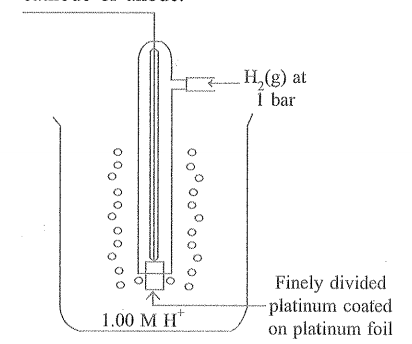
→ The standard hydrogen electrode consists of a platinum electrode coated with platinum black. The electrode is dipped in an acidic solution and pure hydrogen gas bubbled through it.
→ The concentration of both the reduced and oxidised forms of hydrogen is maintained at unity.
→ This implies that the pressure of hydrogen gas is one bar and the concentration of hydrogen ion in the solution is one molar.
→ When this half cell connected to other half cells, To form a complete all, The SHE can acts as as cathode or anode
Image
→ If it acts as cathode the following reduction reaction takes place on the platinum strip
$H ^{+}( aq )(1 M )+ e ^{-} \rightleftharpoons \frac{1}{2} H _2(g, 1 bar )$
→ If it acts as anode the oxidation reaction takes places on the anode
$\frac{1}{2} H _2(g, 1$ bar $) \rightleftharpoons H ^{+}( aq , 1 M )+ e ^{-}$
→ Electrode potential of Standard Hydrogen gas Electrode is accepted zero at all temperature.
View full question & answer
Question 183 Marks
What is cell potential and emf? Explain representation of galvanic cell with examples?
Answer
$\rightarrow $ "The potential difference between the two electrodes of a galvanic cell is called the cell potential and it is measured in volts."
$\rightarrow $ The cell potential is the difference between the electrode potentials $($reduction potentials$)$ of the cathode and anode. It is called the cell electromotive force $\text{(EMF)}$ of the cell when no current is drawn through the cell.
$ E _{\text {cell }}= E _{\text {right }}- E _{\text {left }} Or$
$E _{\text {cell }}= E _{\text {red(cathode) }}- E _{\text {red(anode) }}$
Cell Representation:
$\rightarrow $ We keep the anode on the left and the cathode on the right while representing the galvanic cell.
$\rightarrow $ A glavanic cell is generally represented by putting a vertical line between metal and electrolyte solution and putting a double vertical line between the two electrolytes connected by a salt bridge
Anode half cell $||$ cathode half cell
Example :
Cell reaction :
$Cu ( s )+2 Ag ^{+}( aq ) \rightarrow Cu ^{2+}( aq )+2 Ag ( s )$
Half$-$cell reaction :
Cathode $($reduction$) : 2 Ag ^{+}( aq )+2 e ^{-} \rightarrow 2 Ag ( s )$
Anode $($oxidation$) : Cu ( s ) \rightarrow Cu ^{2+}( aq )+2 e ^{-}$
$\rightarrow $ Silver electrode acts as a cathode and copper electrode acts as an anode. The cell can be represented as :
$Cu ( s )\left| Cu ^{2+}( aq ) \| Ag ^{+}( aq )\right| Ag ( s )$and we have $E _{\text {cell }}= E _{\text {right }}- E _{\text {left }}= E _{ Ag ^{+} \mid Ag }- E _{ Cu ^2 \mid Cu }$
View full question & answer
Question 193 Marks
Explain construction of the galvanic cell according to Daniell cell and explain electrode potential.
Answer
→ We can construct innumerable number of galvanic cells based on the pattern of Daniell cell by taking combination of different half-cells
→ Each half-cell consists of a metallic electrode dipped into an electrolyte. The two half-cells are connected by a mettalic wire through a voltmeter and a switch externally.
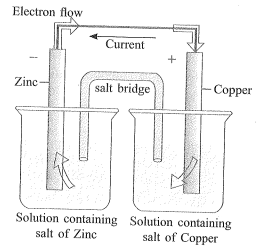
→ The electrolytes of the two half-cells are connected internally through a salt bridge as shown in Fig.
Image
→Sometimes, both the electrodes dip in the same elecrtolyte solution and in such cases we don't require a salt bridge.
→At the interface of each electrode and electrolyte, metal ions from the solution tend to deposit on the metal electrode, to make it positively charged.
→ At the same time, metal atoms of the electrode have a tendency to go into the solution as ions leaving behind electrons at the electrode, there by trying to make it negatively charged.
→ At equilibrium, there is a separation of charges occurs, and depending on the tendencies of the two opposing reactions, the electrode may become positively or negatively charged with respect to the solution.
→ A potential difference develops between the electrode and the electrolyte is called as electrode potential.
→ When the concentrations of all the species involved in a half-cell in unity then the electrode potential is known as standard electrode potential.
→ In a galvanic cell, the half-cell in which oxidation takes place is called anode and it hasti a negative potential with respect to the solution.
→ The other half-cell in which reduction takes place is called cathode and it has positive potential with respect to the solution.
→ Thus, there exists a potential difference between the two electrodes and as soon as the switch is in the on position the electrons flow from negative electrode to positive electrode. The direction of current flow is opposite to that of electron flow.
View full question & answer
Question 203 Marks
What is galvanic cell? Give half cell reaction of Daniell cell.
Answer
→ "Galvanic cell is an electrochemical cell that converts the chemical energy of a spontaneous redox reaction into electrical energy."
→ In this device the Gibbs energy of the sponteneous redox reaction is converted into electrical work which may be used for running a motor or other electrical gadgets like heater, fan, geyser, etc.
→ Following chemical reaction occurs in Daniell cell
$
Zn ( s )+ Cu ^{+2}( aq ) \rightarrow Zn ^{2+}( aq )+ Cu ( s )
$
→This reaction is a combination of two half reactions whose addition gives the overall cell reaction:
(i) $Cu ^{2+}+2 e ^{-} \rightarrow Cu$ (s) (reduction half reaction)
(ii) $Zn ( s ) \rightarrow Zn ^{2+}+2 e ^{-}$(oxidation half reaction)
Image
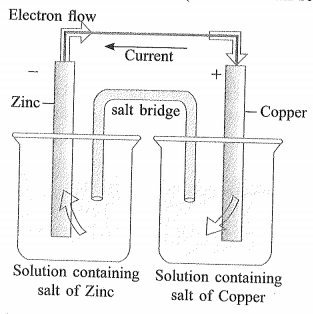
→ These reactions occur in two different portions of the Daniell cell.
→ The reduction half reaction occurs on the copper electrode while the oxidation half reaction occurs on the zinc electrode.
→These two portions of the cell are also called half-cells or redox couples. The copper electrode may be called the reduction half cell and the zinc electrode, the oxidation half-cell
View full question & answer
3 Marks Question - Chemistry STD 12 Science Questions - Vidyadip