Question
Write one difference between each of the following :
  1. Multimolecular colloid and Macromolecular colloid.
  2. Sol and Gel.
  3. O/W emulsion and W/O emulsion.

Answer

  1. Multimolecular colloid : a large number of atoms or smaller molecules of a substance aggregate together to form species having size in the colloidal range.
Macromolecular: Large sized molecules whose particle size lies in the colloidal range.
  1. Sol are solid dispersed in liquid while gel are liquid dispersed in solid.
  2. In O/W emulsion, water acts as dispersion medium while in W/O oil acts as dispersion medium.

Need a full question paper?

Generate a complete, print-ready paper with questions like this in minutes — across 16+ boards, with answer keys.

Start Generating Free

Similar questions

Why does the electrical conductivity of semiconductors increase with rise in temperature?
Short note on: Maltose
A compound $‘X’ (C_2H_4O)$ on oxidation gives $‘Y’ (C_2H_4O_2)$. ‘X’ undergoes haloform reaction. On treatment with HCN ‘X’ forms a product ‘Z’ which on hydrolysis gives 2-hydroxy propanoic acid.
  1. Write down structures of ‘X’ and ‘Y’.
  2. Name the product when ‘X’ reacts with dil. NaOH.
  3. Write down the equations for the reactions involved.
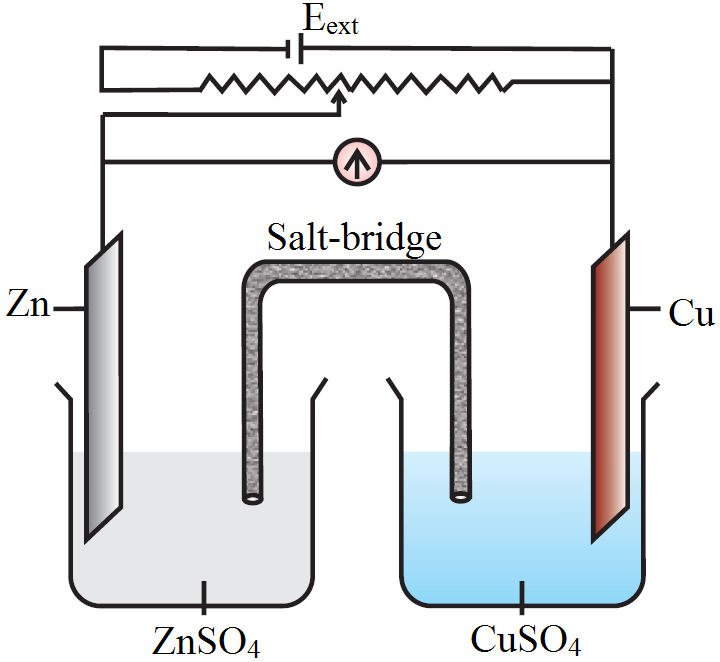
The electrochemical cell given alongside converts the chemical energy released during the redox reaction
$\text{Zn(s) + Cu}^{2+}\text{(aq)}\xrightarrow{ \ \ \ \ \ \ \ }\text{Zn}^{2+}(\text{aq) + Cu(s)}$
to electrical energy. It gives an electrical potential of $1.1V$ when concentration $Zn^{2+}$ and $Cu^{2+}$ ions is unity. State the direction of flow of current and also specify whether zinc and copper are deposited or dissolved at their respective electrodes when:
  1. An external opposite potential of less than $1.1V$ is applied.
  2. An external potential of $1.1V$ is applied.
  3. An external potential of greater than $1.1V$ is applied.
An organic compound ' $A$ ' having molecular formula $\mathrm{C}_3 \mathrm{H}_6$ on treatment with aqueous $\mathrm{H}_2 \mathrm{SO} 4$ gives ' $B$ ' which on treatment with $\mathrm{HCl} / \mathrm{ZnCl}_2$ gives ' C '. The compound C on treatment with ethanolic KOH gives back the compound ' A '. Identify the compounds A, B, C.
Henry’s law constant for $CO_2$ in water is $1.67 x 10⁸$ Pa at $298$ K. Calculate the quantity of $CO_2$ in $500$ mL of soda water when packed under $2.5$ atm $CO_2$ pressure at $298$ K.
Define the following:
  1. Anionic detergents.
  2. Narrow spectrum antibiotics.
  3. Antacids.
Name the reagents which are used in the following conversions:
i. A primary alcohol to an aldehyde
ii. Butan-2-one to butan-2-ol
iii. Phenol to 2, 4, 6-tribromophenol
An unknown aldehyde ‘A’ on reacting with alkali gives a β-hydroxy aldehyde, which loses water to form an unsaturated aldehyde, 2-butenal. Another aldehyde ‘B’ undergoes disproportionation reaction in the presence of conc. alkali to form products C and D. C is an arylalcohol with the formula, $C_7H_8O$.
  1. Identify A and B.
  2. Write the sequence of reactions involved.
  3. Name the product, when ‘B’ reacts with zinc amalgam and hydrochloric acid.
Write structures of compounds A, B and C in each of the following reactions:
  1. $ \text{C}_6\text{H}_5\text{Br}\xrightarrow{\text{Mg/dry ether}}\text{A}\xrightarrow[(b )\text{ }\text{H}_3\text{O}^+]{(a)\text{ }\text{Co}_{2\text{(g)}}}\text{B}\xrightarrow{\text{PC}l_5}\text{C}$
  2. $ \text{C}\text{H}_3\text{CN}\xrightarrow[(b )\text{ }\text{H}_3\text{O}^+]{(a)\text{ }\text{SnC}l_{2}/\text{HC}l}\text{A}\xrightarrow{\text{dil.NaOH}}\text{B}\xrightarrow{\text{ }\text{ }\text{ }\text{ }\text{ }\triangle\text{ }\text{ }\text{ }\text{ }\text{ }\text{ }\text{ }\text{ }}\text{C}$