Question
Write Short note: Budding in hydra.
Answer


Image
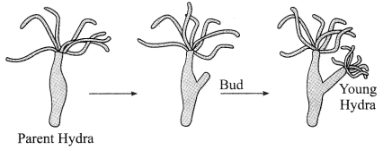
In multicellular organisms asexual reproduction by budding is shown by hydra. In fully grown Hydra, at specific part of its body there is development of bud.

This development is only during favourable period. The bud is an outgrowth developed due to repeated divisions of regenerative cells of body wall. It grows up gradually to form a small hydra. Parent hydra’s dermal layers and digestive cavity are in continuity with those of the budding hydra. It receives all the nutrition from parent hydra.When the budding hydra grows sufficiently, it detaches from parent hydra. Then it leads an independent life.

Need a full question paper?

Generate a complete, print-ready paper with questions like this in minutes — across 16+ boards, with answer keys.
Start Generating Free

Similar questions

While conducting experiments to study the effect of various stimuli on the plants, it was observed that the roots of a plant X grow and bend towards two stimuli A and B but bend away from a third stimulus C. The stem of the plant X, however, bends away from stimuli A and B but bends towards the stimulus C. The stimulus B is known to act on the roots due to too much weight of the earth. Keeping these points in mind, answer the following question:
  1. What could stimulus A be?
  2. Name the stimulus B.
  3. What could stimulus C be?
  4. The branches of a fallen tree in a forest grow straight up in response to two stimuli. What could be these two stimuli out of A, B and C? Also name these two stimuli.
Write short note: Cloning.
Complete the chart as per the objectives of first aid.
There are five animals P, Q, R, S and T. The animal P always lives in water and has gills for breathing. The animal Q can stay in water as well as on land and can breathe both, through moist skin and lungs. The animal R lives in soil and breathes only through its skin. The animal S lives on land and breathes through spiracles and tracheae. And animal T lives in water and breathes through its cell membrane.
  1. Which of the animals could be Amoeba?
  2. Which of the animals could be frog?
  3. Which animal could be fish?
  4. Which animal could be grasshopper?
  5. Which animal could be earthworm?
Decide the unit for specific heat capacity.
An element A which is a part of common salt and kept under kerosene reacts with another element B of atomic number 17 to give a product C. When an aqueous solution of product C is electrolysed then a compound D is formed and two gases are liberated.
  1. What are A and B?
  2. Identify C and D.
  3. What will be the action of C on litmus solution? Why?
  4. State whether element B is a solid, liquid or gas at room temperature.
  5. Write formula of the compound formed when element B reacts with an element E having atomic number 5.
When a broken piece of the stem of a plant X is planted in the soil, a new plant grows from it in a week's time. The leaves of plant X also have many small entities Y in their margins which can fall to the ground alone or alongwith leaves and grow into new plants.
  1. Name a plant which X could be.
  2. What are the entities Y present on the leaves of X known as?
  3. Name a plant other than X which can be reproduced from its leaves.
  4. Name a common plant grown in many homes which can be propagated from its broken stems like plant X.
  5. Name a kind of dormant organs present in dry stems of old grass plants lying in the fields which get activated and produce green grass plants after the rains.
What is short-sightedness? State the two causes of short-sightedness (or myopia). With the help of ray diagrams, show:
  1. The eye-defect short-sightedness.
  2. Correction of short-sightedness by using a lens.
Which device is used to produce electricity? Describe with a neat diagram.
(1) Electric motor
(2) Galvanometer
(3) Electric generator (DC)
(4) Voltmeter
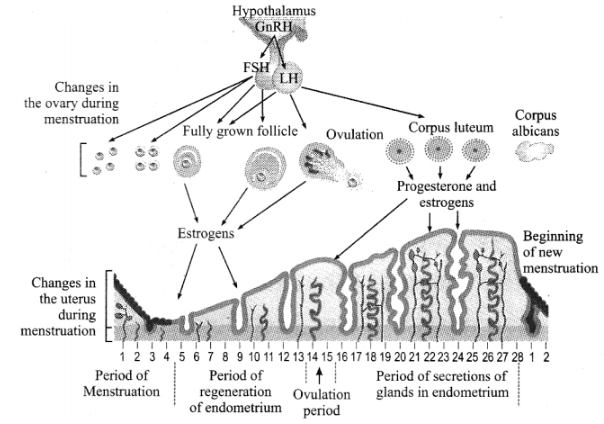
Observe the diagram of menstrual cycle and answer the following questions:
Image
(1) What is the period of menstruation?
(2) On which day does ovulation occur during menstrual cycle?
(3) During which period is corpus luteum active during menstrual cycle? Which hormones are secreted by corpus luteum ?
(4) In menstrual cycle which reproductive organs undergo changes?
(5) Which period is said to be period of regeneration of endometrium?
(6) Which period is said to be period of secretions of glands in endometrium?