Question
Describe how washing soda is produced starting from sodium chloride (common salt). Write equations of all the reactions involved.

Answer

  1. Production of washing soda: Washing soda is produced from sodium chloride (or common salt) in the following three steps:
  1. A cold and concentrated solution of sodium chloride (called brine) is reacted with ammonia and carbon dioxide to obtain sodium hydrogen carbonate:
$\ \ \ \ \ \ \text{N}\bar{\text{a}}\text{Cl}\ \ +\ \ \text{NH}_3\ \ +\ \ \text{H}_2\text{O}\ \ +\ \ \text{CO}_2\rightarrow\text{NaHCO}_3\ \ +\ \ \text{NH}_4\text{Cl}\\^{\text{Sodium chloride}}\ ^{\text{Ammonia}}\ \ \ \ \ \ ^{\text{Water}}\ \ \ \ \ \ \ \ ^\text{Carbon}\ \ \ ^{\text{Sodium hydrogen}}\ \ \ \ \ \ ^{\text{Ammonium}}\\\ ^{\text{(Common Salt)}}\ \ \ \ \ \ \ \ \ \ \ \ \ \ \ \ \ \ \ \ \ \ \ \ \ \ \ \ \ \ \ \ \ \ \ \ \ ^{\text{dioxde}}\ \ \ \ \ \ ^{\text{Carbonate}}\ \ \ \ \ \ \ \ \ \ \ \ ^{\text{Chloride}}$

Sodium hydrogen carbonate formed is only slightly soluble in water, so it precipitates out as a solid.
  1. Sodium hydrogen carbonate is separated by filtration, dried and heated. On heating, sodium hydrogen carbonate decomposes to form sodium carbonate:
$\ \ 2\text{NaCHO}_3\ \ \xrightarrow{\text{Heat}}\ \ \text{Na}_2\text{CO}_3\ \ +\ \ \text{CO}_2\ \ +\ \ \text{H}_2\text{O}\\^{\text{Sodium hydrogen}}\ \ \ \ \ \ \ \ ^{\text{Sodium carbonate}}\ \ \ ^{\text{Carbonate}}\ \ \ \ \ \ ^{\text{Water}}\\\ \ \ \ \ ^\text{Carbonate}\ \ \ \ \ \ \ \ \ \ \ \ \ \ \ \ \ ^{\text{(Sodaash)}}\ \ \ \ \ \ \ \ \ \ ^{\text{dioxide}}$

The anhydrous sodium carbonate obtained here is called soda ash.
  1. Anhydrous sodium carbonate (soda ash) is dissolved in water and recrystallised to get washing soda crystals containing 10 molecules of water of crystallisation:
$\ \ \ \ \ \ \ \ \ \ \text{Na}_2\text{CO}_3\ \ \ \ \ \ \ \ \ +1\text{CH}_2\text{O}\rightarrow\ \ \ \text{Na}_2\text{CO}_3,1\text{CH}_2\text{O}\\^{\text{Anhydroussdiuumcarbonate}}\ \ \ \ \ \ ^{\text{Water}}\ \ \ \ \ \ \ \ ^{\text{Sodiumcarbonatedecahydrate}}\\\ \ \ \ \ \ \ \ \ \ \ \ \ ^{\text{(Sodaas)}}\ \ \ \ \ \ \ \ \ \ \ \ \ \ \ \ \ \ \ \ \ \ \ \ \ \ \ \ \ \ \ \ \ \ \ \ \ \ \ \ \ \ ^{\text{(Washingsoda)}}$
  1. An aqueous solution of washing soda is alkaline because it turns red litmus to blue.
  2. Washing soda has detergent properties because it can remove dirt and grease from dirty clothes.
  1.  
  1. It is used as cleansing agent for domestic purposes.
  2. It is used for removing permanent hardness of water.

Need a full question paper?

Generate a complete, print-ready paper with questions like this in minutes — across 16+ boards, with answer keys.
Start Generating Free

Similar questions

Write short notes: Functional group.
Water and dissolved minerals get into the root hair of a plant by a process called A and enter the conducting tissue B. The process C helps the water and dissolved minerals to move up through the tissue B in roots and stem, and reach the leaves of a plant. In the leaves food is made by a process D. This food is then transported to all the parts of a plant through tissue E. The process of distributing food made in the leaves to all the parts of the plants is called F.
  1. What are (i) A, (ii) B, (iii) C, (iv) D, (v) E, and (vi) F?
  2. Which tissue is made up of living cells: B or E?
  3. Which tissue, B or E, contains sieve tubes?
  4. Which tissue, B or E, contains tracheids?
With a neat labelled diagram, explain advanced sunrise and delayed sunset.
In a village, farmers started cultivating crops all around a lake which was always filled with water. They added lot of materials W to the soil in their fields to increase the yield of crops. Soon they found that the whole surface of water in the lake was covered with a green layer made up of tiny organisms X. After some time, the fish present in the lake started dying in large numbers because they could not get sufficient Y due to a process Z which had occurred in lake water and drained out all the Y present in the water of lake.
  1. What do you think materials W are?
  2. Name (i) X, and (ii) Y?
  3. What is the process Z known as?
  4. What happens during the process Z which uses up all the Y present in lake water?
  5. What does this example tell us about the use of materials like W?
What is meant by an artificial satellite? How are the satellites classified based on their functions?
(OR)
Write the importance of artificial satellites in your words. (Practice Activity Sheet – 3)
What is ten per cent law? Explain with an example.
How much time a satellite in an orbit at height $35780 \ km$ above earth's surface would take, if the mass of the earth would have been four times its original mass?
what are the physical properties of metals and nonmetals?
Explain the factors affecting the rate of chemical reaction with example.
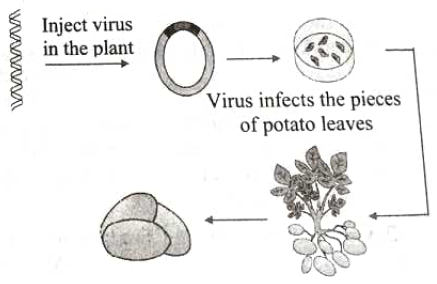
Observe the figure and answer the following questions:
Image
i. Identify the process given in the above figure.
ii. Write the importance of above process.
iii. Write any two benefits of Biotechnology.