Question
Write short note on the following:
Golgi apparatus.
Mitochondria.

Answer

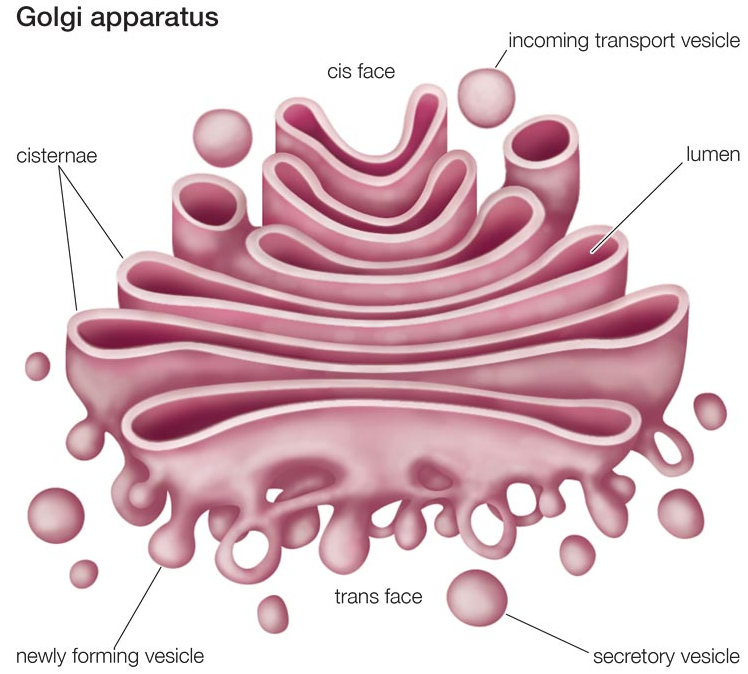
  1. Golgi apparatus consists of a set of membrane$-$bounded, fluid filled vesicles, vacuoles and flattened cisternae. Cisternae are usually stacked together $($placed one above the other$)$ in parallel rows. Golgi apparatus exists as an extensive network near the nucleus in the animal cells. However, the plant cells contain many freely distributed subunits of Golgi apparatus, called dictyosomes.
The Golgi apparatus arises from the membrane of the smooth endoplasmic reticulum, which in turn originates from the rough endoplasmic reticulum.
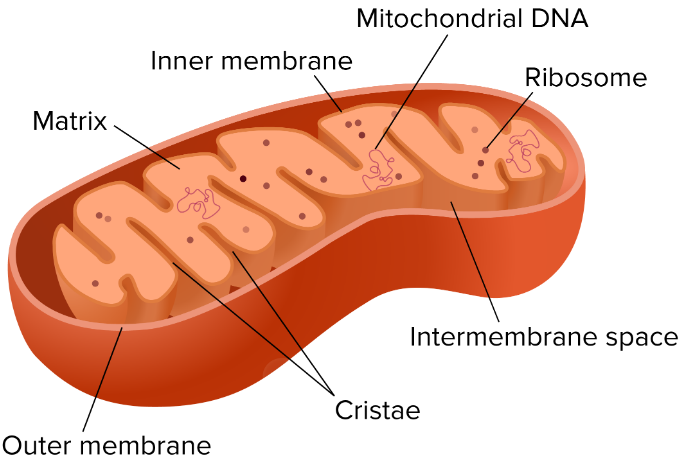
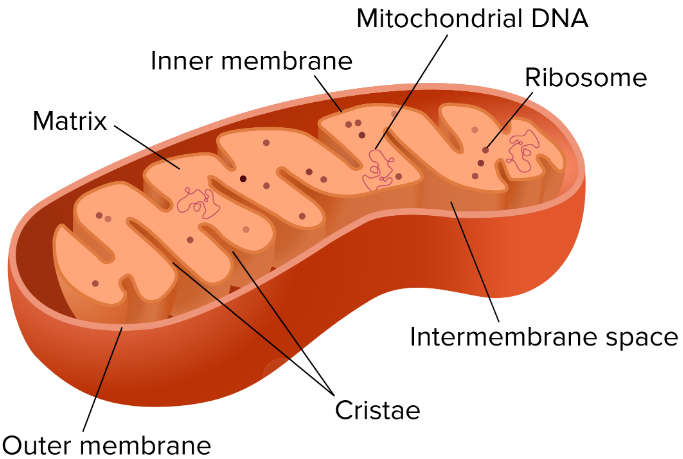
  1. The mitochondria are tiny bodies of varying shapes and size. Each mitochondria is bounded by a double membrane envelope. Outer membrane is porous. The inner membrane is thrown into folds. These folds are called cristae and are studded with small rounded bodies known as $F_{1 }$ particles or oxysomes. The interior cavity of the mitochondria is filled with a proteinaceous matrix which contains a few small$-$sized ribosomes, a circular $ \text{DNA}$ molecule and phosphate granules. Mitochondria are sites of cellular respiration.

Need a full question paper?

Generate a complete, print-ready paper with questions like this in minutes — across 16+ boards, with answer keys.
Start Generating Free

Similar questions

What is feed? What are different type of feed? How is it differ with respect to age and functions?
Explain various types of irrigation systems in India. How can efficiency of applied water be increased in agriculture.
Which has more number of atoms?
$100g of N_2 or 100g of NH_3$
A liquid compound $X$ of molecular mass $18u$ can be obtained from a number of natural sources. All the animals and plants need liquid $X$ for their survival. When an electric current is passed through $200$ grams of pure liquid $X$ under suitable conditions, then $178$ grams of gas $Y$ and $22$ grams of gas $Z$ are produced. Gas $Y$ is produced at the positive electrode whereas gas $Z$ is obtained at the negative electrode. Moreover, gas $Y$ supports combustion whereas gas $Z$ burns itself causing explosions.
  1. Name $(i)$ liquid $X$ $(ii)$ gas $Y$, and $(iii)$ gas $Z$
  2. What is the ratio to the mass of element $Z$ to the mass of element $Y$ in the liquid $X$?
  3. Which law of chemical combination is illustrated by this example?
  4. Name two sources of liquid $X$.
  5. Gate an important use of $Y$ in our life.
Two objects having equal masses are moving with uniform velocities of $2m/s$ and $6m/s$ respectively. Calculate the ratio of their kinetic energies.
  1. Identify the structures marked below as $A, B$ and $C.$
  2. Complete the labeling of each structure.
  3. Write the function of each structure.
Discuss:
  1. Principles of treatment.
  2. Vaccination.
State and explain Newton’s second law of motion.
How is the power related to the speed at which a body can be lifted$?$ How many kilograms will a man working at the power of $100W,$ be able to lift at constant speed of $1ms^{-1}$ vertically? $(g = 10ms^{-2})$
How will you separate common salt, sand and iron filings from their mixture?