Question
Write short notes :
Ammonolysis

Answer

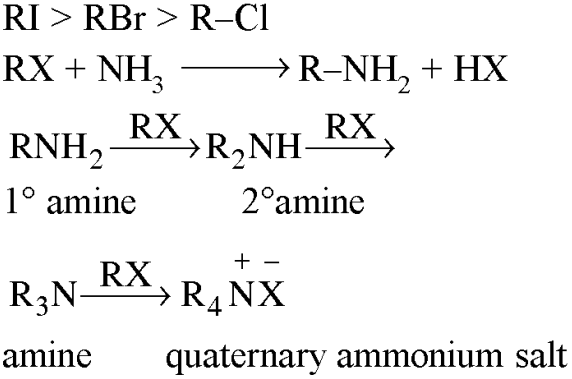
Ammonolysis : An alkyl or benzyl halide on reaction with an ethanoic solution of ammonia under goes nucleophilic substitution reaction in which the halogen atom is replaced by an ammino $\left(- NH _2\right)$ group. This process of cleavage of the $C - X$ bond by ammonia molecule is known as ammonolysis the reaction is carried out in sealed tube at 373 K . The primary amine thus obtained can further react with alkyl halide to form secondary and tertiary amines and finally quaternary ammonium salt. So here mixture of compounds is formed. For this reaction order of reactivity of alkyl halides is as follows :
Image
Amine obtained from reaction reacts with HX and forms salt. Which is treated with strong base and again amine is obtained.
Image
(i) By this reaction to obtain primary amine as main product ammonia should be taken in excess.
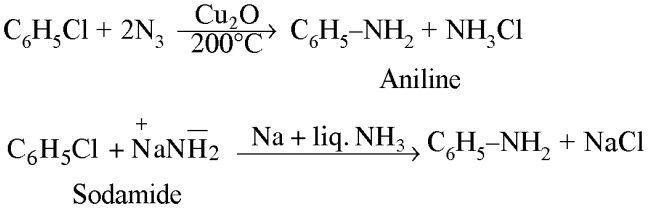
(ii) By this reaction for motion of aniline is difficult because due to + M effect in chlorobenzene and carbonchlorine bond attains double bond character so reactivity of this is decreases. So formation of aniline is performed by following specific methods :
Image

Need a full question paper?

Generate a complete, print-ready paper with questions like this in minutes — across 16+ boards, with answer keys.

Start Generating Free

Similar questions

i. How will you convert:
a. Nitrobenzene to phenol,
b. Aniline to chlorobenzene
Primary alkyl halide C4H9Br (a) reacted with alcoholic KOH to give compound (b). Compound (b) is reacted with HBr to give (c) which is an isomer of (a). When (a) is reacted with sodium metal it gives compound (d), C8H18 which is different from the compound formed when n-butyl bromide is reacted with sodium. Give the structural formula of (a) and write the equations for all the reactions.
Explain the methods of preparation alcohol from the following compounds:
(a) From carbonyl compound
(b) From carboxylic acid
(c) From esters
(d) From Grignard reagent
The activation energy of a reaction is $75.2kJ \ mol^{-1}$ in the absence of a catalyst and it lowers to $50.14\ kJ \ mol^{-1}$ with a catalyst. How many times will the rate of reaction grow in the presence of a catalyst if the reaction proceeds at $25^\circ C?$

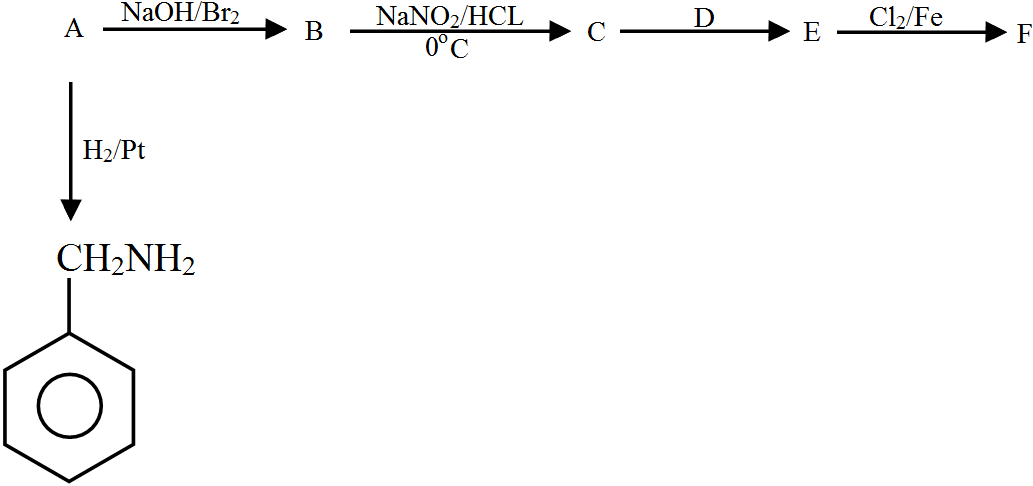
Write the structures of reagents/ organic compounds (A to F) in the following sequence of reactions:
Explain the properties and uses of methanol and ethanol.
List various types of isomerism possible for coordination compounds, giving an example of each.
What is lanthanoid contraction? Write its reasons and results.
  1. Define the following terms:
  1. Molarity.
  2. Molal elevation constant$(Kb).$
  1. A solution containing $15\ g$ urea $($molar mass $= 60\ g\ mol^{–1})$ per litre of solution in water has the same osmotic pressure $($isotonic$)$ as a solution of glucose $($molar mass $= 180\ g\ mol^{–1})$ in water. Calculate the mass of glucose present in one litre of its solution.
Draw the structures of optical isomers of :
(i) $\left[ Cr \left( C _2 O _4\right)_3\right]^{3-}$
(ii) $\left[ PtCl _2( en )_2\right]^{2+}$
(iii) $\left[ Cr \left( NH _3\right)_2 Cl _2( en )\right]^{+}$