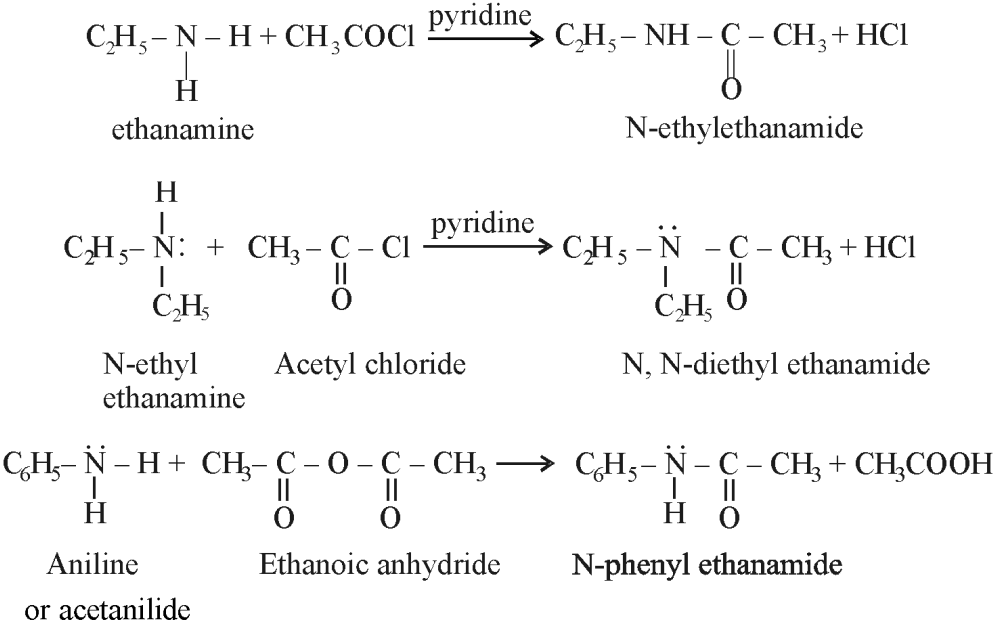
Acetylation : Aliphatic and aromatic primary and secondary amines react with acid chloride and acid anhydride by nucleophilic substitution reaction. This reaction is known as acylation. This reaction is considered as the replacement of hydrogen atom of $- NH _2$ or $> N - H$ group by aelyl group. when $CH _3 COCl$ is taken in this reaction then it is called acetylation. This reaction is performed in presence of pyridine which are moves HCl so formed shifts equilibrium to the right hand side.
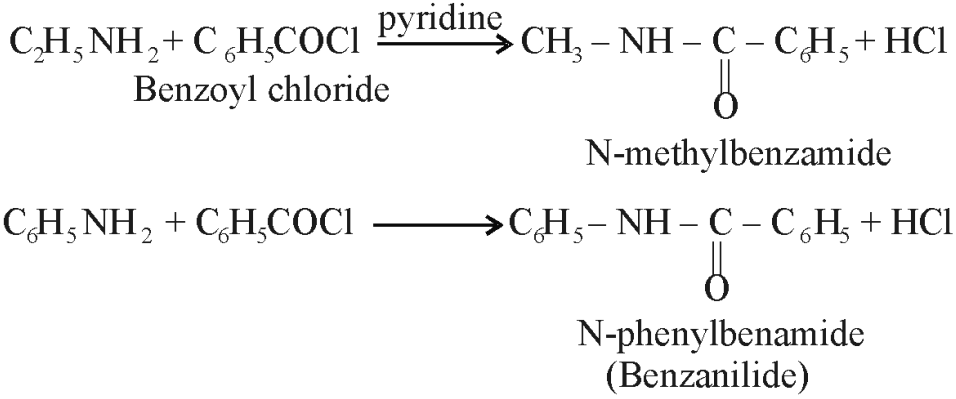
When amines are treated with benzoyl chloride then this reaction is called benzyoylation and on the basis of name of scientist this is called Schotten-Baumann reaction. Amines reacts wih carboxylic acids at room temperature forms salts.
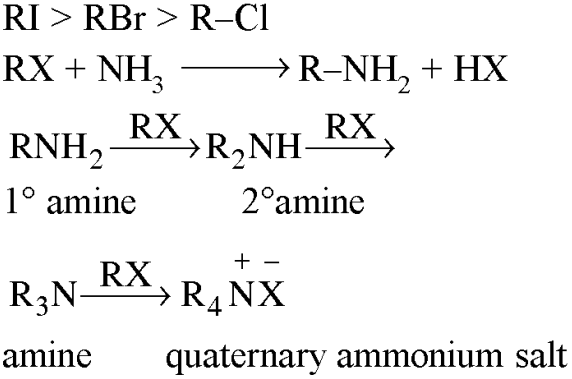
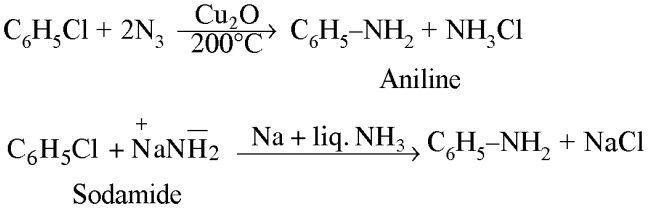
Ammonolysis : An alkyl or benzyl halide on reaction with an ethanoic solution of ammonia under goes nucleophilic substitution reaction in which the halogen atom is replaced by an ammino $\left(- NH _2\right)$ group. This process of cleavage of the $C - X$ bond by ammonia molecule is known as ammonolysis the reaction is carried out in sealed tube at 373 K . The primary amine thus obtained can further react with alkyl halide to form secondary and tertiary amines and finally quaternary ammonium salt. So here mixture of compounds is formed. For this reaction order of reactivity of alkyl halides is as follows : Amine obtained from reaction reacts with HX and forms salt. Which is treated with strong base and again amine is obtained. (i) By this reaction to obtain primary amine as main product ammonia should be taken in excess. (ii) By this reaction for motion of aniline is difficult because due to + M effect in chlorobenzene and carbonchlorine bond attains double bond character so reactivity of this is decreases. So formation of aniline is performed by following specific methods :
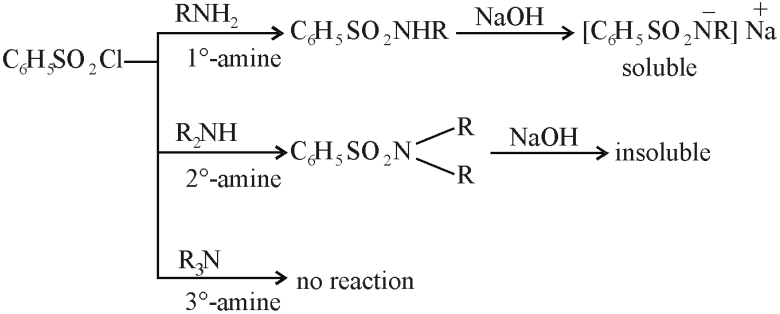
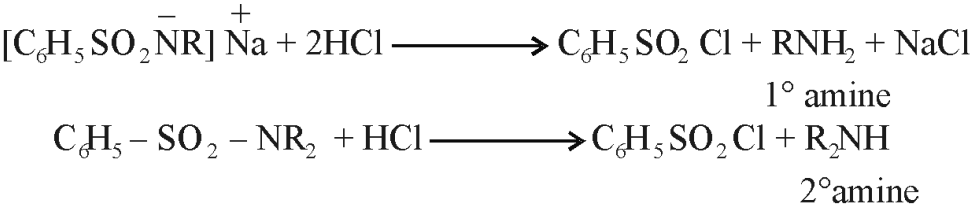
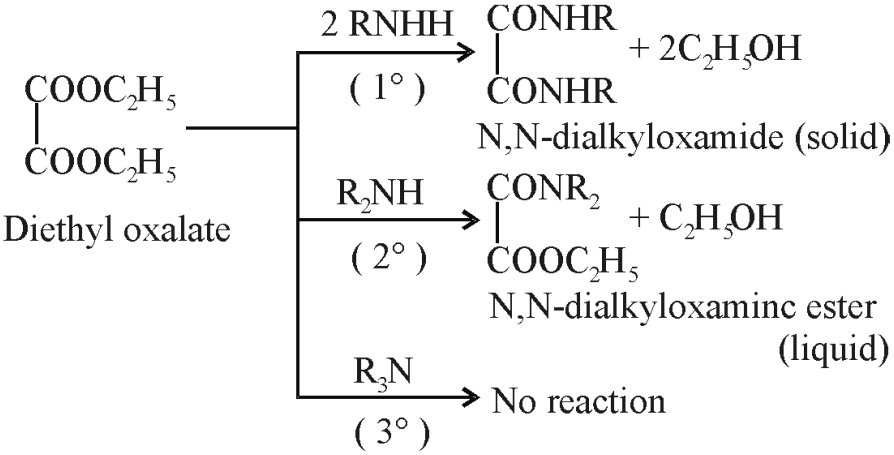
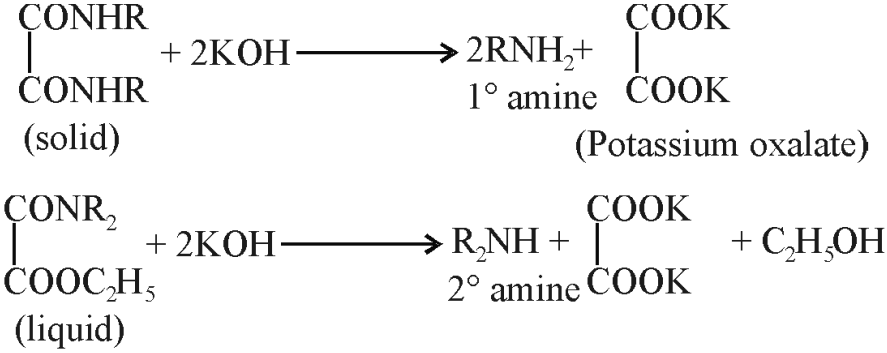
Describe a method for the identification of primary, secondary and tertiary amines. Also write chemical equations of the reaction involved.
Answer
Identification of primary, secondary and tertiary amines are performed by these methods. (i) Carbyl amine reaction : Aliphatic and aromatic primary amine are heated with chloroform and ethanolic potassium hydroxide then pungent smelling substance isocyanide or carbyl amine is formed. This reaction is not shown by secondary and tertiary amines. (ii) Reaction with Hinsberg reagent : In the Hinsberg method mixture of $1^{\circ}, 2^{\circ}$ and $3^{\circ}$ amines is treated with Hinsberg reagent $\left( C _6 H _5 SO _4\right)$ then product obtained from $1^{\circ}$ amine is soluble in alkali and the product obtained from $2^{\circ}$ amine is insoluble in alkali $( NaOH )$ while $3^{\circ}$ amine does not react with Hinsberg reagent. When steam distillation of reaction mixture is done then $3^{\circ}$ amine is distilled and remaining part is filtered so $C _6 H _5 SO _2 NR _2$ insoluble in $NaOH$ is separated. So $\left( C _6 H _5 SO _2 \stackrel{-}{ NR }\right) \stackrel{+}{ Na }$ is left. Both of these are treated with $25 \% HCl$ followed by hydrolysis then free $1^{\circ}$ and $2^{\circ}$ amines are obtained. (iii) Hoffman method (Reaction with oxalic ester) : In Hoffman method mixture of amines is treated with oxalic esters $3^{\circ}$-amine does not react, liquid product from $2^{\circ}$-amine and solid product is formed from $1^{\circ}$-amine. When reaction mixture is distilled then unreacted $3^{\circ}-$ amine is distilled. Remaining residue is filtered and solid and liquid products are separated. Then these are distilled with KOH or NaOH separately so $1^{\circ}$ and $2^{\circ}$ amine become free.