Question
Write short notes: Homologous series.

Answer

The length of the carbon chains in carbon compounds is different their chemical properties are very much similar due to the presence of the same functional group in them. The series of compounds formed by joining the same functional group in place of a particular hydrogen atom on the chains having sequentially increasing length is called homologous series. Two adjacent members of the series differ by only one $-\mathrm{CH}_2-$ (methylene) unit and their mass differ by 14 units. The homologous series of straight chain alkanes can be represented by the general formula $\mathrm{C}_n \mathrm{H}_{2 n+2}$
The members of this series are as follows:
Methane - $\mathrm{CH}_4$ Ethane $-\mathrm{C}_2 \mathrm{H}_6$ - These differ by $-\mathrm{CH}_2$ units
Ethane - $\mathrm{C}_2 \mathrm{H}_6$ Propane $-\mathrm{C}_3 \mathrm{H}_8$ - These differ by $-\mathrm{CH}_2$ units
Butane $-\mathrm{C}_4 \mathrm{H}_{10}$ Pentane - $\mathrm{C}_5 \mathrm{H}_{12}$ - These differ by $-\mathrm{CH}_2$ units
Characteristics:
(1) In homologous series while going in an increasing order of the length of carbon chain
(a) one methylene unit $\left(-\mathrm{CH}_2-\right)$ gets added
(b) molecular mass increases by 14 u
(c) number of carbon atoms increases by one.
(2) Chemical properties of members of a homologous series show similarity due to the presence of the same functional group in them.
(3) Each member of the homologous series can be represented by the same general molecular formula.
(4) while going in an increasing order of the length there is gradation in the physical properties i.e., the boiling and melting points.

Need a full question paper?

Generate a complete, print-ready paper with questions like this in minutes — across 16+ boards, with answer keys.
Start Generating Free

Similar questions

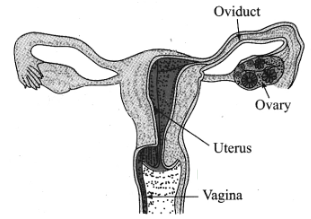
Observe the figure and answer the questions below:
Image
(a) What does the figure indicate?
(b) Which human organs are involved in this process?
(c) Which hormones take part in this process?
(d) What is the periodicity for these changes?
(e) The body of woman undergoing this process is impure, she should remain away from other people. What is your opinion about this statement? Give justification for your opinion.
Explain budding in yeast.
A colourless organic liquid $X$ of molecular formula $C_2H_4O_2$ turns blue litmus to red. Another colourless organic liquid $Y$ of molecular formula $C_3H_6O$ has no action on any litmus but it is used as a nail polish remover. A yet another colourless organic liquid $Z$ of molecular formula $C_2H_6O$ has also no action on litmus but it is used in tincture of iodine.
  1. Name the liquid $X.$ To which homologous series does it belong? Give the name of another member of this homologous series.
  2. Name the liquid $Y.$ To which homologous series does it belong? Write the name of another member of this homologous series.
  3. Can you name an organic compound having the same molecular formula as liquid $Y$ but which belongs to a different homologous series? What is this homologous series?
  4. Name the liquid $Z.$ To which homologous series does it belong? Write the name of another member of this homologous series.
An electric bulb of resistance $20 Ω$ and a resistance wire of $4 Ω $are connected in series with a 6V battery. Draw the circuit diagram and calculate:
  1. Total resistance of the circuit.
  2. Current through the circuit.
  3. Potential difference across the electric bulb.
  4. Potential difference across the resistance wire.
Explain the principle of dialysis with the help of a labelled diagram.
You are given three resistances of 1,2 and 3 ohms. Show by diagrams, how with the help of these resistances you can get:
  1. $6\Omega$
  2. $\frac{6}{11}\Omega$
  3. $1.5\Omega$
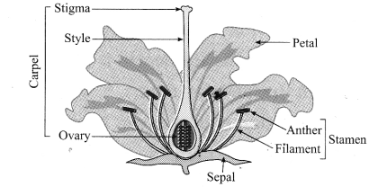
Describe the structure of a flower.
Image
Sketch, labell and classify: star fish
Gas A, which is the major cause of global warming, combines with hydrogen oxide $B$ in nature in the presence of an environmental factor $C$ and a green material $D$ to form a six carbon organic compounds $E$ and a gas $F$. The gas $F$ is necessary for breathing.
  1. What is gas $A?$
  2. What is the common name of $B?$
  3. What do you think could be $C?$
  4. What is material $D?$ Where is it found$?$
  5. Name the organic compound $E.$
  6. What is gas $F? $ Name the natural process during which it is released.
An electric iron of 1100 W is operated for 2 hrs daily. What will be the electrical consumption expenses for that in the month of April? (The electric company charges Rs 5 per unit of energy).