Question
Write short notes: Mendeleev’s periodic law.

Answer

when the elements are arranged in the order of their increasing atomic masses, Mendeleev found that the elements with similar physical and chemical properties repeat after a definite interval. On the basis of these finding Mendeleev stated the periodic law. The physical and chemical properties of elements are a periodic function of their atomic masses.

Need a full question paper?

Generate a complete, print-ready paper with questions like this in minutes — across 16+ boards, with answer keys.
Start Generating Free

Similar questions

When a mixture of gases $X$ and $Y$ is compressed to $300$atm pressure and then passed over a catalyst consisting of a mixture of zinc oxide and chromium oxide $($heated to a temperature of $300^\circ C),$ then an organic compounds $Z$ having the molecular formula $CH_4O$ is formed. $X$ is a highly poisonous gas which is formed in appreciable amounts when a fuel burns in a limited supply of air; $Y$ is a gas which can be made by the action of a dilute acid on an active metal; and $Z$ is a liquid organic compound which can react with sodium metal to produce hydrogen gas:
  1. What are $X, Y$ and $Z?$
  2. Write a balanced chemical equation of the reaction which takes place when $X$ and $Y$ combine to form $Z.$ Indicate the conditions under which the reaction occurs.
Explain the need and importance of space missions.
Write short notes: Connecting link.
Write short note: Nature of disaster management.
Explain the factors affecting the value of $g.$
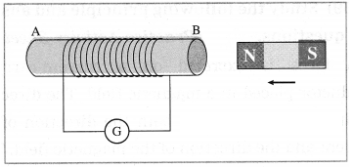
Take a coil AB having 10-15 turns. Connect the two ends of the coil to the galvanometer as shown in Figure. Take a strong bar magnet. (1) Move the north pole of the magnet towards the end B of the coil.
Image

Observe the deflection of the pointer in the galvanometer. Note the direction of the deflection (i.e. right or left). (2) Now repeat this with the south pole of the magnet towards the end B of the coil. Again observe the deflection. Note its direction. (3) What will happen if instead of the magnet, the coil is moved? (4) If both the coil and the magnet are kept stationary, do you observe any deflection? (5) Compare the direction of the deflection when the north pole of the magnet is moved towards the end B of the coil with that when the end B of the coil is moved away from the north pole of the magnet. (6) What conclusions do you draw from the observations?

Two organic compounds $A$ and $B$ have the same molecular formula $C_6H_{12}.$ Write the names and structural formulae:
  1. If $A$ is a cyclic compound.
  2. If $B$ is an open chain compound.
  3. Which compound contains single bonds as well as a double bond?
  4. Which compound contains only single bonds?
The sea water contains water beetles, tadpole, fish and weeds.
  1. Write a food chain comprising all the given organisms?
  2. Which organisms in the food chain are (i) herbivore, and (ii) carnivores?
  3. Which organisms are (i) predators, and (ii) prey?
  4. Which organisms can trap solar energy to make food?
  5. Which organism is a secondary consumer?
A, B and C are three living organisms. The organism A is a unicellullar fungus which can live without air. It is used in the commercial production of an organic compound P from molasses. The organism B is a unicellular animal which lives in water and feeds and moves by using pseudopodia. It breathes through an organelle Q. The organism C is a tiny animal which acts as a carrier of malarial parasite. It breathes and respires through a kind of tiny holes R and air - tubes S in its body.
  1. What are organisms A, B and C?
  2. Name P, Q, R and S.
  3. Which organism/ organisms undergo aerobic respiration?
  4. Which organism/ organisms undergo anaerobic respiration?
  1. Match the terms given in column I with the terms given in column II and column III having the same meaning:
  1.   Column I Column II Column III
    (i)
    Secondary consumer
    Herbivore
    $1^{st}$ trophic level
    (ii)
    Primary consumer
    Autotroph
    $3^{rd}$ trophic level
    (iii)
    Producer
    Carnivore
    $4^{th}$ trophic level
    (iv)
    Tertiary consumer
    Large carnivore
    $2^{nd}$ trophic level
  2. Give one example of a food chain having four organisms. Below each organism write the three appropriate terms from the part $(a)$ above which you think it represents.