Question
Write short notes on:
  1. Mitochondria.
  2. Plastids.

Answer

  1. Mitochondria: The mitochondria are tiny bodies of varying shapes and size. Each mitochondria is bounded by a double membrane envelope. Outer membrane is porous. The inner membrane is thrown into folds. These folds are called cristae and are studded with small rounded bodies known as F1 particles or oxysomes. The interior cavity of the mitochondria is filled with a proteinaceous matrix which contains a few small-sized ribosomes, a circular DNA molecule and phosphate granules. Mitochondria are sites of cellular respiration.

  2. Plastids: Plastids occur in most plant cells and are absent in animal cells. They have their own genome and ribosomes. There are three types of plastids: chromoplasts, chloroplasts and leucoplasts.

Need a full question paper?

Generate a complete, print-ready paper with questions like this in minutes — across 16+ boards, with answer keys.
Start Generating Free

Similar questions

Discuss the conservation of momentum in each of the following cases:
  1. A rocket taking off from ground.
  2. Flying of a jet aeroplane.
What is organic farming? What are its advantages?
A liquid compound X of molecular mass 18u can be obtained from a number of natural sources. All the animals and plants need liquid X for their survival. When an electric current is passed through 200 grams of pure liquid X under suitable conditions, then 178 grams of gas Y and 22 grams of gas Z are produced. Gas Y is produced at the positive electrode whereas gas Z is obtained at the negative electrode. Moreover, gas Y supports combustion whereas gas Z burns itself causing explosions.
  1. Name (i) liquid X (ii) gas Y, and (iii) gas Z
  2. What is the ratio to the mass of element Z to the mass of element Y in the liquid X?
  3. Which law of chemical combination is illustrated by this example?
  4. Name two sources of liquid X.
  5. Gate an important use of Y in our life.
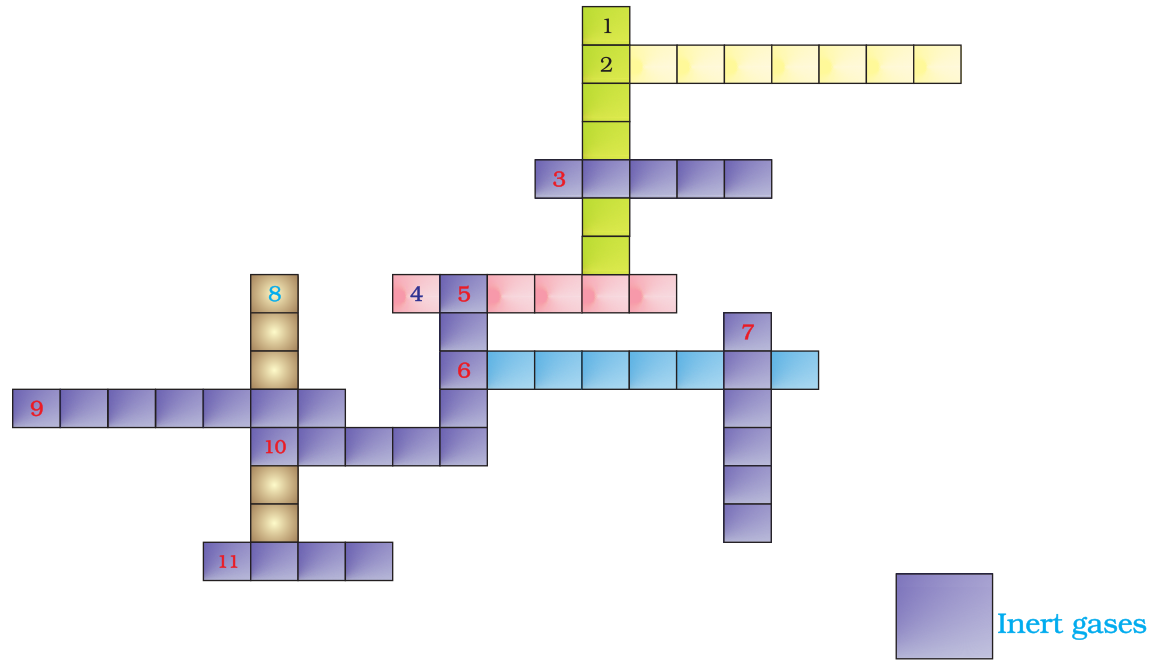
In this crossword puzzle (Figure), names of 11 elements are hidden. Symbols of these are given below. Complete the puzzle.
  1. Cl
  2. H
  3. Ar
  4. O
  5. Xe
  6. N
  7. He
  8. F
  9. Kr
  10. Rn
  11. Ne

Describe structure of a chromosome.
What is irrigation? Discuss the various methods of irrigation.
Write a note on cattle feed.
What is kidnapped, blindfolded and imprisoned in a big room. How could the man tell if he was in: (a) a city (b) a village (c) a bare room (d) a furnished room.

The graph given alogside shows the positions of a body at different times. Calculate the speed of the body as it moves from:
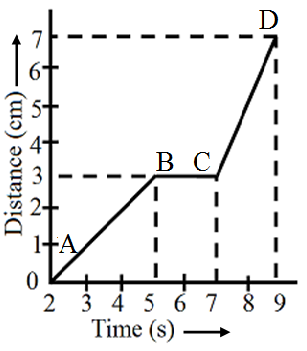
  1. A to B.
  2. B to C.
  3. C to D.
How would you prepare a saturated solution of sodium chloride in water at 25°C? What will happen if this solution is cooled to 10°C?