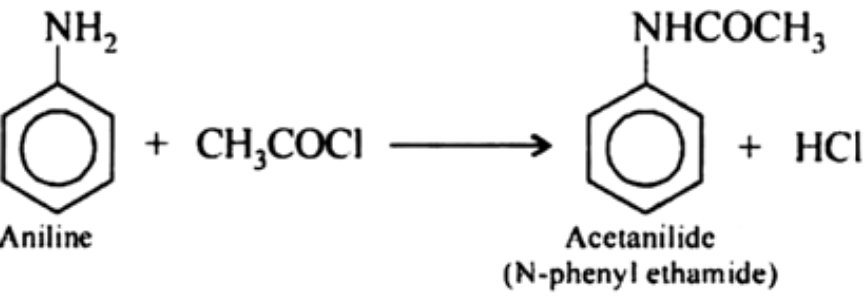
Acetylation: The process, in which acetyl group $ \ \ \ \ \ \ \ \ \ \ \ \ \ \ \ \ \ \ \ \text{O} \\ \ \ \ \ \ \ \ \ \ \ \ \ \ \ \ \ \ \ \ ||\\\ \ \ \ \Bigg(\text{CH}_3-\text{C}-\Bigg)$ is introduced, is called acety lation. It is done by reaction with acetyl chloride or aceticanhydride.
Aliphatic and aromatic primary and secondary amines undergo acetylation reaction by nucleophilic substitution when treated with acid chlorides, anhydrides or esters.
Generate a complete, print-ready paper with questions like this in minutes — across 16+ boards, with answer keys.
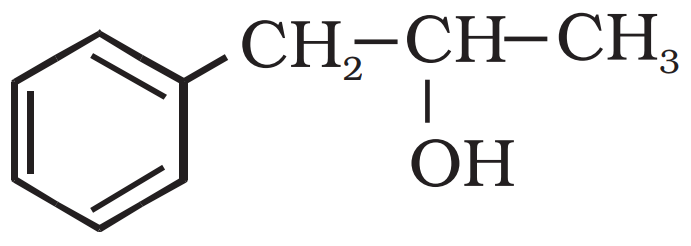
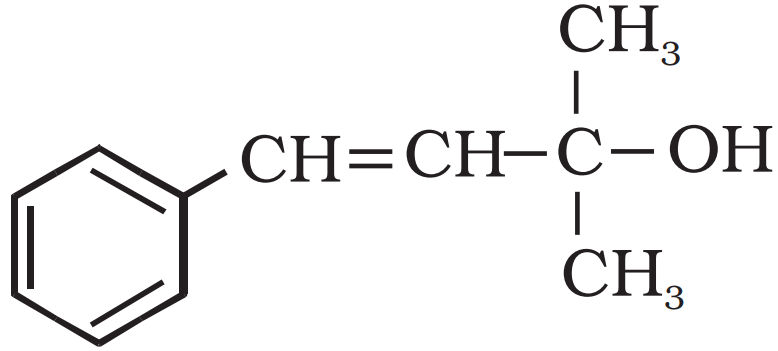
Identify allylic alcohols in the above examples.
$\ \ \ \ \ \ \ \ \ \ \text{CH}_3 \\ \ \ \ \ \ \ \ \ \ \ \ \ \ |\\\text{CH}_3-\text{C}-\text{CH}_2 \text{OH}\\\ \ \ \ \ \ \ \ \ \ \ \ \ |\\\ \ \ \ \ \ \ \ \ \ \text{CH}_3$
$\text{H}_2\text{C}=\text{CH}-\text{CH}_2\text{OH}$
$\text{CH}_3-\text{CH}_2-\text{CH}_2-\text{OH}$
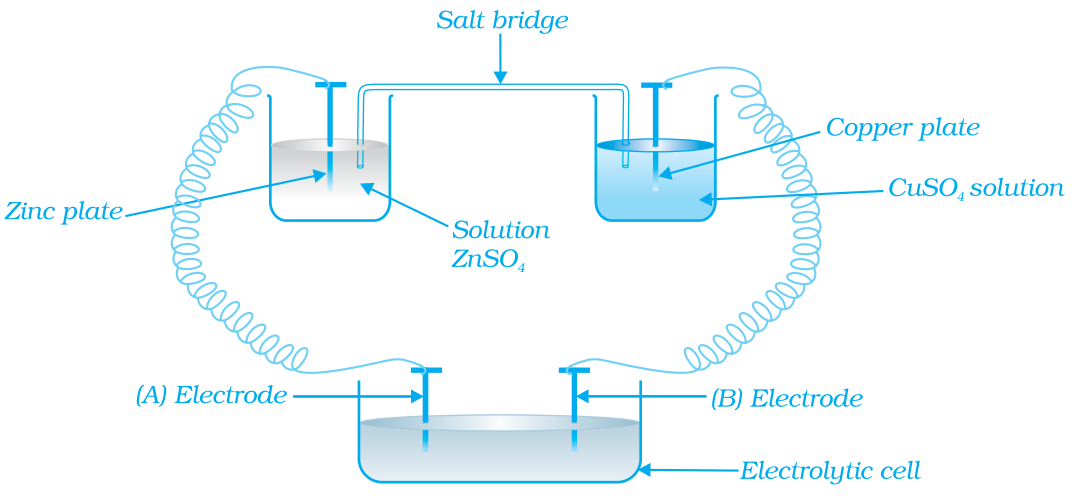
Consider the following diagram in which an electrochemical cell is coupled to an electrolytic cell. What will be the polarity of electrodes ‘A’ and ‘B’ in the electrolytic cell?
Semicarbazone.