50 questions · timed · auto-graded

$\text{CH}_3(\text{CH}_2)\text{CN}\xrightarrow[(\text{Partial hydrolysis})]{\text{H}_2\text{O}/ \text{H}^+}\text{CH}_3(\text{CH}_2)_4\text{CONH}_2\xrightarrow[]{\text{Br}_2/\text{KOH}}\text{CH}_3(\text{CH}_2)_4\text{NH}_2\\\text{Hexane nitrate} \ \ \ \ \ \ \ \ \ \ \ \ \ \ \ \ \ \ \ \ \ \ \ \ \ \ \ \ \ \text{Hexanamide} \ \ \ \ \ \ \ \ \ \ \ \ \ \ \ \ \ \ \ \ \ \ \ \ \ \ \ \ \ \text{I-amino Pentane}$
The nitration of aniline is carried out using conc. HNO3 and H2SO4. However, in the presence of conc. H2SO4, aniline forms aniline hydrogen sulphate in which the anilinium ion, C6H5NH3+ is meta directing because the positive charge on the nitrogen attracts electrons from the benzene ring.
P-nitro aniline < aniline < p-toluidine.
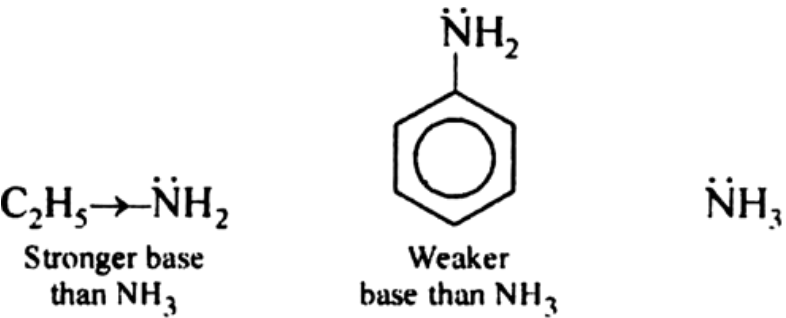
In C2H5NH2, the C2H5 group has a + I effect and increases the electron density on N atom. This results in stronger intermolecular H-bonding. While in C6H5NH2 due to resonance, N acquires a +ve charge and electron density on N decreases. The tendency to form H-bonding diminishes. Hence, ethylamine is soluble while C6H5NH2 is insoluble.
In decreasing order of the pKb values:
C2H5NH2, C6H5NHCH3, (C2H5)2NH and C6H5NH2