Question
  1. Write symbolically the $\beta^–$ decay process of$\frac{15}{32}$P.
  2. Derive an expression for the average life of a radionuclide. Give its relationship with the half-life.

Answer

$\beta^–$  decay process
$^{32}_{15}\text{P}\rightarrow^{32}_{16}\text{S} + \text{e}^{-} + \overline{\text{v}}\text{ or }^{32}_{15}\text{P}\rightarrow^{32}_{15}\text{X} + _{-1}\text{e}^{0} + \overline{\text{v}}$
Derivation of average life:
$\tau=\frac{\lambda\text{N}_{0}\int\limits_{0}^{\infty}\text{te}^{-\lambda\text{t}}\text{dt}}{\text{N}_{0}} = \lambda\int\limits_{0}^{\infty}\text{te}^{-\lambda\text{t}}\text{dt}$
$\Rightarrow\tau = 1/ \lambda$
Relation of average life with half life:
$\text{T}_{1/2} = \frac{\ell\text{n}2}{\lambda} = \tau\ell\text{n} 2$

Need a full question paper?

Generate a complete, print-ready paper with questions like this in minutes — across 16+ boards, with answer keys.
Start Generating Free

Similar questions

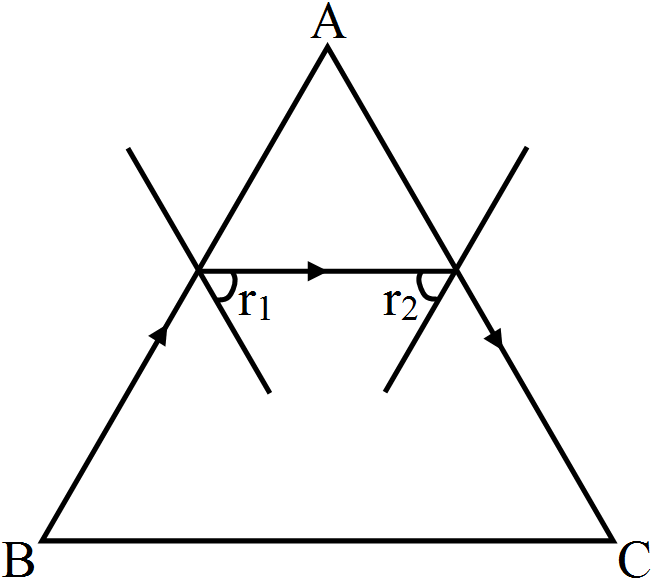
A light ray incident at grazing angle on the face AB of a prism ABC, follows the path shown in the figure. Obtain the relation between the angle of prism A and the refractive index $\mu$ of its material.
  1. Write three characteristic properties of nuclear force.
  2. Draw a plot of potential energy of a pair of nucleons as a function of their separation. Write two important conclusions that can be drawn from the graph.
A mosquito is sitting on an L.P. record disc rotating on a turn table at $33\frac{1}{3}$ revolutions per minute. The distance of the mosquito from the centre of the turn table is 10cm. Show that the friction coefficient between the record and the mosquito is greater than $\frac{\pi^2}{81}.$ Take $g =10 m/s^2.$
Give a circuit diagram of a common emitter amplifier using an n-p-n transistor. Draw the input and output waveforms of the signal. Write the expression for its voltage gain.
Answer the following questions.
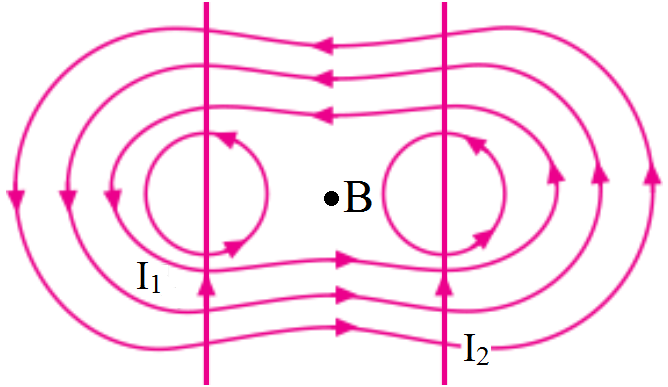
  1. Draw the magnetic field lines due to two straight, long, parallel conductors carrying currents $I_1$ and $I_2$ in the same direction. Write an expression for the force acting per unit length on one conductor due to other. Is this force attractive or repulsive?
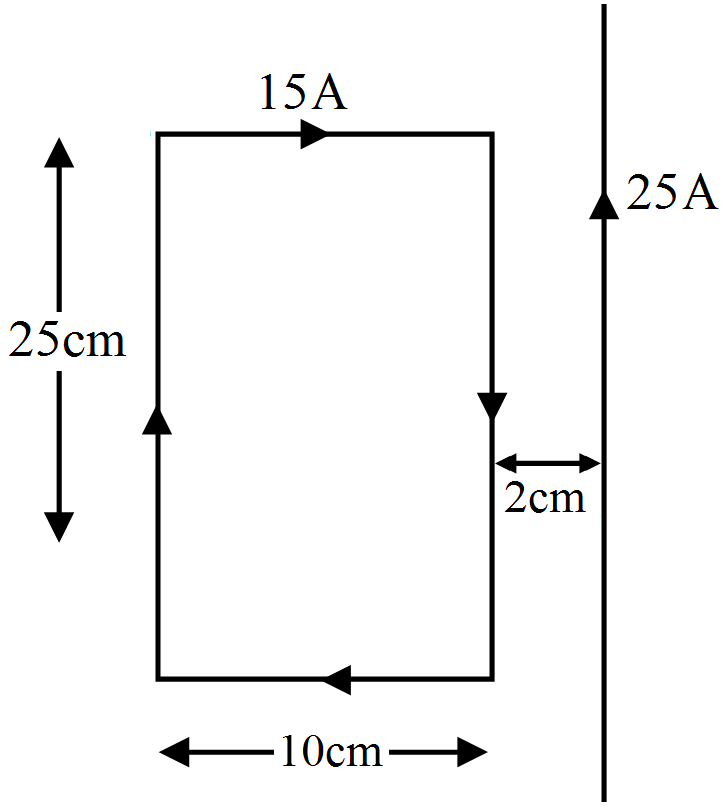
  1. Figure shows a rectangular current-carrying loop placed 2cm away from a long, straight, current-carrying conductor. What is the direction and magnitude of the net force acting on the loop?
A 5.0 diopter lens forms a virtual image which is 4 times the object placed perpendicularly on the principal axis of the lens. Find the distance of the object from the lens.
A charge of $+2.0 \times 10^{-8}C$ is placed on the positive plate and a charge of $-1.0 \times 10^{-8}C$ on the negative plate of a parallel-plate capacitor of capacitance $1.2\times10^{-3}\mu\text{F}.$ Calculate the potential difference developed between the plates.
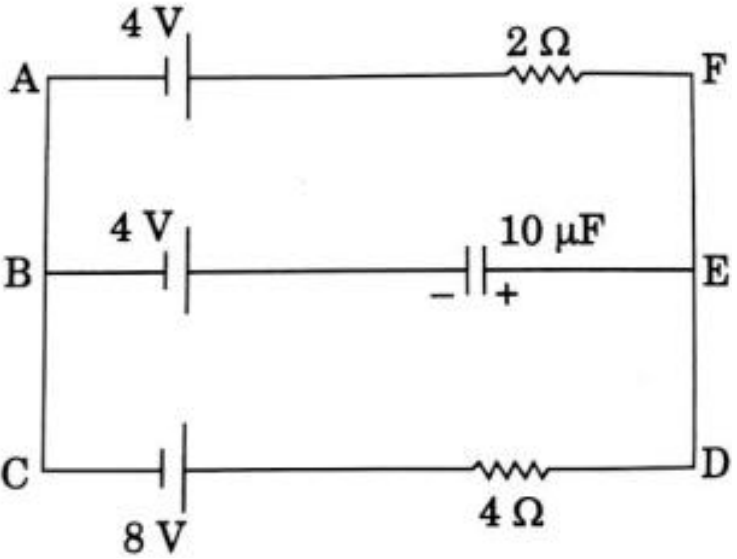
In the given circuit, with steady current, calculate the potential drop across the capacitor and the charge stored in it.
Define the term ‘decay constant’ of a radioactive sample. The rate of disintegration of a given radioactive nucleus is 10000 disintegrations/ s and 5,000 disintegrations/ s after 20hr. and 30hr. respectively from start. Calculate the half life and initial number of nuclei at t = 0.
Explain, with the help of a schematic diagram, the principle and working of a Light Emitting Diode. What criterion is kept in mind while choosing the semiconductor material for such a device? Write any two advantages of Light Emitting Diode over conventional incandescent lamps.