Question
Write the applications of beats.

Answer

Beats are used to:
  1. Determine an unknown frequency by listening to the beat frequency $\Delta \text{v}.$ Then unknown frequency $\text{v}'=\text{v}+\Delta\text{v}$ where $v$ is known and it is close to the unknown frequency. Exact values of $v$ is found by loading and filling the turning fork of unknown frequency from which $+$ or $-$ sign is chosen;
  2. Tune musical instruments by sounding them together and reducing beats number to zero.
  3. Make a sound rich in musical effect by deliberate introduction of beats between different musical instruments.
  4. To produce very low frequency pulses which otherwise cannot be produced. Beat frequency is the low frequency sound.
  5. Receive radio programme by superheterodyne method.
  6. Detect harmful gases in mines.

Need a full question paper?

Generate a complete, print-ready paper with questions like this in minutes — across 16+ boards, with answer keys.
Start Generating Free

Similar questions

What are the basic requirements of a cooking utensil in respect of specific heat, thermal conductivity and coefficient of expansion?
Determine a unit vector which is perpendicular to both $\vec{\text{A}}=2\hat{\text{i}}+\hat{\text{j}}+\hat{\text{k}}$ and $\vec{\text{B}}=\hat{\text{i}}-\hat{\text{j}}+2\hat{\text{k}}.$
A simple microscope has a magnifying power of $3.0$ when the image is formed at the near point $(25\ cm)$ of a normal eye.
  1. What is its focal length?
  2. What will be its magnifying power if the image is formed at infinity?
Prove that for an earth satellite, the ratio of its velocity at apogee (when farthest from earth) to its velocity at perigee (when nearest to earth) is equal to the inverse ratio of its distances from apogee and perigee.
The efficiency of an ideal engine is $\frac{1}{8}$ access. After reducing the temperature 100 K , increase to $\frac{1}{6}$ of access. Find the original and final temperature.
In a HCl molecule, we may treat Cl to be of infinite mass and H alone be oscillating. If the oscillation of HCl molecule shows a frequency of $9 \times 10^{13}s^{-1}$, deduce the force constant. [Given: Avogadro's number = $6 \times 10^{26}$ per kg mole.)
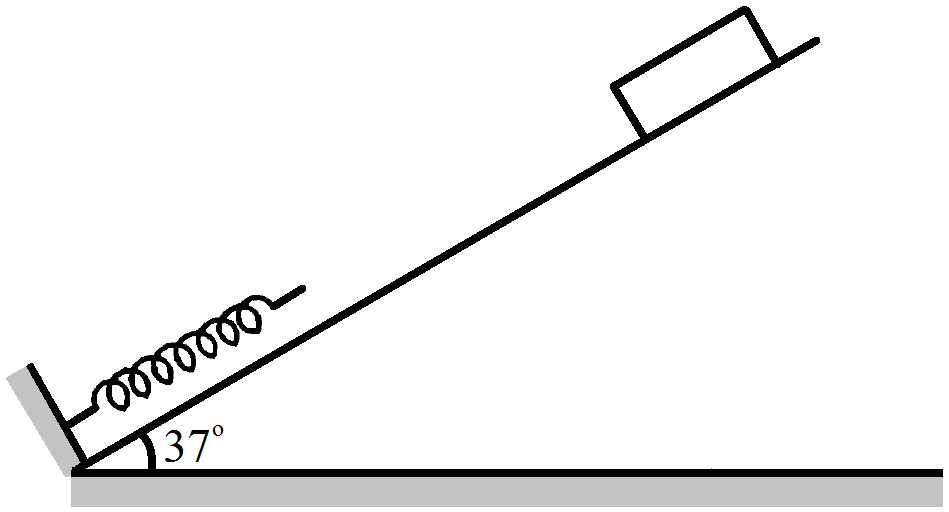
Figure shows a spring fixed at the bottom end of an incline of inclination $37^\circ$. A small block of mass 2kg starts slipping down the incline from a point 4.8m away from the spring. The block compresses the spring by 20cm, stops momentarily and then rebounds through a distance of 1m up the incline. Find.
  1. The friction coefficient between the plane and the block.
  2. The spring constant of the spring. Take $g = 10m/s^2.$
Find the ratio of units of viscosity coefficient in the M.K.S. and C.G.S. system
Mathematically establish the third equqtion of rotational motion $\omega^2-\omega^2_0=2\alpha\theta$
The drift current in a reverse-biased p-n junction increases in magnitude if the temperatu,re of the junction is increased. Explain this on the basis of creation of hole-electron pairs.