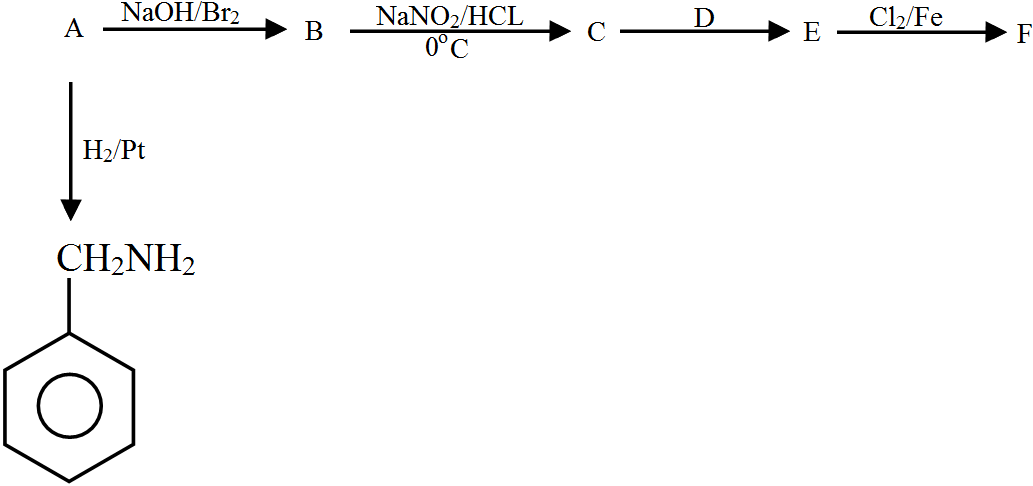
Question
Write the applications of d- and f-block elements.

Answer

self

Need a full question paper?

Generate a complete, print-ready paper with questions like this in minutes — across 16+ boards, with answer keys.

Start Generating Free

Similar questions

Explain the general characteristics of actinoids in the following terms:
(i) Physical properties
(ii) Chemical reactivity
(iii) Magnetic properties
(iv) Ionization enthalpy.
Match the catalysts given in Column I with the processes given in Column II.
 
Column I (Catalyst)
 
Column II (Process)
(i)
Ni in the presence of hydrogen
(a)
Zieglar Natta catalyst
(ii)
Cu2Cl2
(b)
Contact process
(iii)
V2O5
(c)
Vegetable oil to ghee
(iv)
Finely divided iron
(d)
Sandmeyer reaction
(v)
TiCl4 + Al (CH3)3
(e)
Haber’s Process
 
 
(f)
Decomposition of KClO3
Explain the terms primary and secondary structure of proteins. What is the difference between α-helix and β-pleated sheet structure of proteins?
  1. Complete the following equations:
  1. $\text{Cr}_{2}\text{O}_{7}^{2-}+\text{2OH}^{-}\rightarrow$
  2. $\text{MnO}_{4}^{-}+\text{4H}^{+}+\text{3e}^{-}\rightarrow$
  1. Account for the following:
  1. Zn is not considered as a transition element.
  2. Transition metals form a large number of complexes.
  3. The Eo value for the Mn3+/Mn2+ couple is much more positive than that for Cr3+/Cr2+ couple.
What is the relationship between Gibbs free energy of the cell reaction in a galvanic cell and the emf of the cell? When will the maximum work be obtained from a galvanic cell?
  1. How are lipids classified? Give an example of each class.
  2. Explain the following terms:
  1. Mutarotation.
  2. Avitaminosis.
Describe the common name system and IUPAC system of naming amines.
Match the items given in Column I with the type of solutions given in Column II.
 
Column I
 
Column II
i.
Soda water
a.
A solution of gas in solid.
ii.
Sugar solution
b.
A solution of gas in gas.
iii.
German silver
c.
A solution of solid in liquid.
iv.
Air
d.
A solution of solid in solid.
v.
Hydrogen gas in palladium
e.
A solution of gas in liquid.
 
 
f.
A solution of liquid in solid.
Answer the following questions:
Give chemical reactions for the following observations:
  1. Potassium permanganate is a good oxidising agent in basic medium.
  2. Inter convertibility of chromate ion and dichromate ion in aqueous solution depends upon pH of the solution.
  3. Potassium permanganate is thermally unstable at 513K.