Question
Write the basic features of the photon picture of electromagnetic radiation on which Einstein's photoelectric equation is based.

Answer

The basic features of the photon picture of e.m. radiation are as follows:
i. Light is composed of discrete packets of energy called quanta or photons.
ii. Each photon carries an energy $E (=h \nu)$ and momentum $p (= h / \lambda)$, which depend on the frequency $\nu$ of the incident radiation and not on its intensity.
iii. During the collision of a photon with an electron, the total energy of the photon gets absorbed by the electron.
iv. Photoelectric emission from the metal surface occurs due to the absorption of a photon by an electron.

Need a full question paper?

Generate a complete, print-ready paper with questions like this in minutes — across 16+ boards, with answer keys.
Start Generating Free

Similar questions

A rectangular wire loop of sides 8cm and 2cm with a small cut is moving out of a region of uniform magnetic field of magnitude 0.3T directed normal to the loop. What is the emf developed across the cut if the velocity of the loop is $1\ cms^{–1}$ in a direction normal to the:
  1. Longer side,
  2. shorter side of the loop?
For how long does the induced voltage last in each case?
Two particles of masses $m_1$ and $m_2$ are joined by a light rigid rod of length r. The system rotates at an angular speed co about an axis through the centre of mass of the system and perpendicular to the rod. Show that the angular momentum of the system is $\text{L}=\mu\text{r}^2\omega$ where $\mu$ is the reduced mass of the system defined as $\mu=\frac{\text{m}_1\text{m}_2}{\text{m}_1+\text{m}_2}.$
Assume that the mass of a nucleus is approximately given by $M = Am_p$ where A is the mass number. Estimate the density of matter in kg/m$^3$ inside a nucleus. What is the specific gravity of nuclear matter?
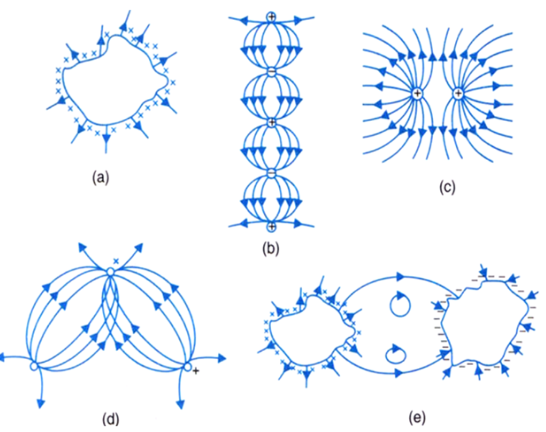
Which among the curves shown in Fig. 1.35 cannot possibly represent electrostatic field lines?
  1. A circular coil of 30 turns and radius 8.0 cm carrying a current of 6.0 A is suspended vertically in a uniform horizontal magnetic field of magnitude 1.0 T. The field lines make an angle of 60º with the normal of the coil. Calculate the magnitude of the counter torque that must be applied to prevent the coil from turning.
  2. Would your answer change, if the circular coil in (a) were replaced by a planar coil of some irregular shape that encloses the same area? (All other particulars are also unaltered.)
A diver having a moment of inertia of $6.0kg-m^2$ about an axis through its centre of mass rotates at an angular speed of 2rad/s about this axis. If he folds his hands and feet to decrease the moment of inertia to $5.0kg-m^2$, what will be the new angular speed?
A water particle of mass 10.0mg and having a charge of $1.50 \times 10^{-6}C$ stays suspended in a room. What is the magnitude of electric field in the room? What is its direction?
What is the energy of a hydrogen atom in the first excited state if the potential energy is taken to be zero in the ground state?
Distinguish between isotopes and isobars. Give one example for each of the species.
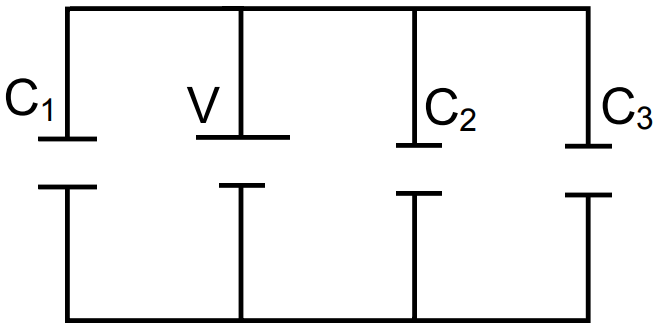
Find the charges on the three capacitors connected to a battery as shown in figure. Take $\text{C}_1=2.0\mu\text{F},\ \text{C}_2=4.0\mu\text{F},\ \text{C}_3=6.0\mu\text{F}$ and V = 12 volts.