Question
A neutron initially at rest, decays into a proton, an electron and an antineutrino. The ejected electron has a momentum of 1.4 × 10⁻²⁶kg-m/s and the antineutrino 6.4 × 10⁻²⁷kg-m/s. Find the recoil speed of the proton:
  1. If the electron and the antineutrino are ejected along the same direction.
  2. If they are ejected along perpendicular directions. Mass of the proton = 1.67 × 10⁻²⁷kg.
Answer

Mass of proton = 1.67 × 10⁻²⁷

Let ‘Vp’ be the velocity of proton.

Given, momentum of electron = 1.4 × 10⁻²⁶kg m/sec.

Given, momentum of antineutrino = 6.4 × 10⁻²⁷kg m/sec

  1. The electron & the antineutrino are ejected in the same direction. As the total momentum is conserved the proton should be ejected in the opposite direction.

1.67 × 10⁻²⁷ × Vp = 1.4 × 10⁻²⁶ + 6.4 × 10-27 = 20.4 × 10⁻²⁷

$\Rightarrow\text{V}_{\text{p}}=\Big(\frac{20.4}{1.67}\Big)=12.2\text{m}/\text{sec}$ in the opposite direction.

  1. The electron & antineutrino are ejected $\perp$ to each other.

Total momentum of electron and antineutrino,

$=\sqrt{(14)^2+(6.4)^2}\times10^{-27}\text{kg}\ \ \text{m}/\text{s}=15.4\times10^{-27}\text{kg}\ \ \text{m}/\text{sec}$

Since, 1.67 × 10⁻²⁷, Vp = 15.4 × 10⁻²⁷kg m/s

So, Vp = 9.2m/s

Need a full question paper?

Generate a complete, print-ready paper with questions like this in minutes — across 16+ boards, with answer keys.

Start Generating Free

Similar questions

Three rods of lengths 20cm each and area of cross section 1cm2 are joined to form a triangle ABC. The conductivities of the rods are $\text{K}_\text{AB}=50\text{Js}^{-1}\text{m}^{-1}{^{\circ}}\text{C}^{-1},\ \text{K}_\text{BC}=200\text{Js}^{-1}\text{m}^{-1}{^{\circ}}\text{C}^{-1}$ and $\text{K}_\text{AC}=400\text{Js}^{-1}\text{m}^{-1}{^{\circ}\text{C}}^{-1}.$ The junctions A, B and C are maintained at 40°C, 80°C and 80°C respectively. Find the rate of heat flowing through the rods AB, AC and BC.
A rod, when suspended in a magnetic field, stays in the east-west direction. Can we be sure that the field is in the east-west direction? Can it be in the north-south direction?
Define induction coefficient. Explain the phenomenon of mutual inductance with the help of an experiment. Obtain an expression for mutual inductance coefficient of two solenoids and prove that $M=\sqrt{L_1 L_2}$.
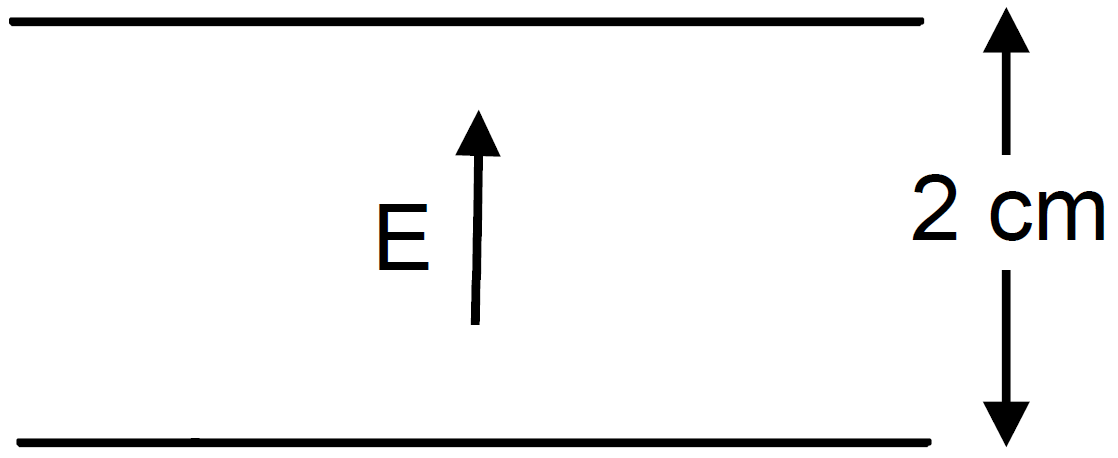
An electric field of magnitude 1000NC-1 is produced between two parallel plates having a separation of 2.0cm as shown in figure.

  1. What is the potential difference between the plates?
  2. With what minimum speed should an electron be projected from the lower plate in the direction of the field so that it may reach the upper plate?
  3. Suppose the electron is projected from the lower plate with the speed calculated in part (b). The direction of projection makes an angle of 60° with the field. Find the maximum height reached by the electron.

  1. State Ampere's circuital law. Use this law to obtain the expression for the magnetic field inside an air cored toroid of average radius 'r' having 'n' turns per unit length and carrying a steady current I.
  2. An observer to the left of a solenoid of N turns each of cross section area 'A' observes that a steady current I in it flows in the clockwise direction. Depict the magnetic field lines due to the solenoid specifying its polarity and show that it acts as a bar magnet of magnetic moment m = NIA.
Monochromatic light of wavelength 589 nm is incident from air on a water surface. What are the wavelength, frequency and speed of (a) reflected, and (b) refracted light? Refractive index of water is 1.33.
(a) Estimate the average drift speed of conduction electrons in a copper wire of cross-sectional area $1.0 \times 10^{-7} m ^2$ carrying a current of 1.5 A. Assume that each copper atom contributes roughly one conduction electron. The density of copper is $9.0 \times 10^3 kg / m ^3$, and its atomic mass is $63.5 u$. (b) Compare the drift speed obtained above with, (i) thermal speeds of copper atoms at ordinary temperatures, (ii) speed of propagation of electric field along the conductor which causes the drift motion.
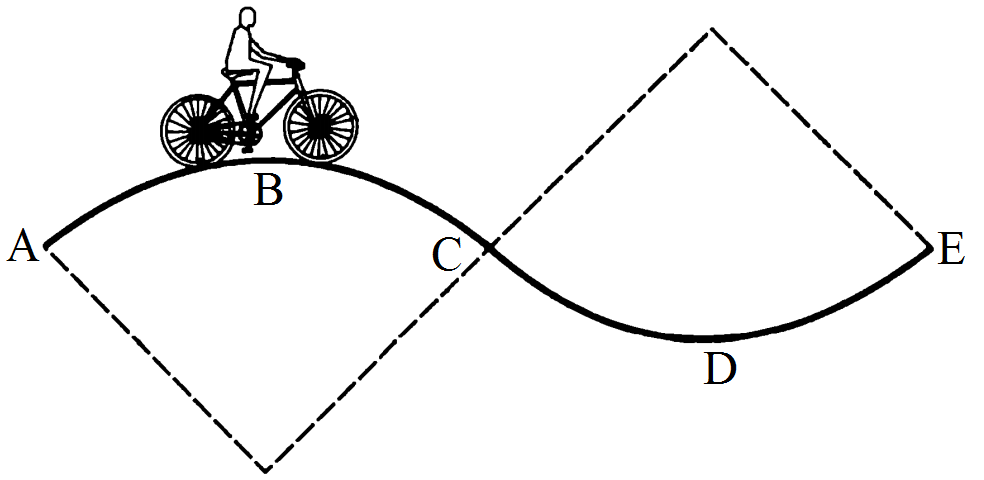
A track consists of two circular parts ABC and CDE of equal radius 100m and joined smoothly as shown in figure. Each part subtends a right angle at its centre. A cycle weighing 100 kg together with the rider travels at a constant speed of 18km/h on the track.
  1. Find the normal contact force by the road on the cycle when it is at B and at D.
  2. Find the force of friction exerted by the track on the tyres when the cycle is at B, C and D.
  3. Find the normal force between the road and the cycle just before and just after the cycle crosses C.
  4. What should be the minimum friction coefficient between the road and the tyre, which will ensure that the cyclist can move with constant speed? Take g= 10m/s2.

In a Young's double slit experiment using monochromatic light, the fringe pattern shifts by a certain distance on the screen when a mica sheet of refractive index 1.6 and thickness 1.964 micron (1 micron = 10-6m) is introduced in the path of one of the interfering waves. The mica sheet is then removed and the distance between the screen and the slits is doubled. It is found that the distance between the successive maxima now is the same as the observed fringe-shift upon the introduction of the mica sheet. Calculate the wavelength of the monochromatic light used in the experiment.
Two vessels A and B of equal volume V0 are connected by a narrow tube that can be closed by a valve. The vessels are fitted with pistons that can be moved to change the volumes. Initially, the valve is open and the vessels contain an ideal gas $\Big(\frac{\text{C}_\text{P}}{\text{C}_\text{V}}=\gamma\Big)$ at atmospheric pressure p0 and atmospheric temperature T0. The walls of vessel A are diathermic and those of B are adiabatic. The valve is now closed and the pistons are slowly pulled out to increase the volumes of the vessels to double the original value.
  1. Find the temperatures and pressures in the two vessels.
  2. The valve is now opened for sufficient time so that the gases acquire a common temperature and pressure. Find the new values of the temperature and pressure.