Question
Write the difference between ideal gas and real gas.

Answer

 
Ideal Gas
Real Gas
(i)
It obeys ideal gas equation, $\text{pV}=\mu\text{RT}$ at all temperatures and pressures
It does not obey, $\text{pV}=\mu\text{RT}$ at all values of temperature and pressure.
(ii)
The volume of the molecules of an ideal gas is zero.
The volume of the molecules of a real gas is non-zero.
(iii)
There is no intermolecular force between the molecules.
There is intermolecular force of attraction or repulsion depending on whether intermolecular separation is larger or small.
(iv)
There is no intermolecular potential energy (U) because intermolecular force (F) is zero.
Potential energy (U) does not equal to zero as intermolecular force (F) is not zero.
(v)
It has only kinetic energy.
It has both kinetic and potential energy.
(vi)
At absolute zero, the volume, pressure and internal energy become zero.
All real gases get liquified before reaching absolute zero. The internal energy of the liquified gas is not zero.

Need a full question paper?

Generate a complete, print-ready paper with questions like this in minutes — across 16+ boards, with answer keys.
Start Generating Free

Similar questions

Establish a relation between angular velocity and time period.
A solid sphere of mass 2kg is rolling down an inclined plane of angle of inclination 30°. What is the agent which supplies the external torque for the rotational motion of the sphere? Calculate its value. Also find the value of the torque if radius of sphere is 40cm.
Calculate the maximum kinetic energy of the beta particle emitted in the following decay scheme:$\text{ }^{12}\text{N}\rightarrow{ }^{12}\text{C}^*+\text{e}^++\text{v}$
$\text{ }^{12}\text{C}^*\rightarrow\text{ }^{12}\text{C}+\gamma(4.43\text{MeV}).$
The atomic mass of $^{12}N$ is $12.018613u$.
Give examples of a one-dimensional motion where:
The particle moving along positive x-direction comes to rest periodically and moves forward.
Calculate focal length of a spherical mirror from the following observations: object distance $\text{u} = (50.1 \pm 0.5)\text{cm}$ and image distance $\text{v} = (20.1 \pm0.2)\text{cm} .$
An artificial satellite is moving in a circular orbit around the earth with a speed equal to half the magnitude of escape velocity from earth. Determine
  1. The height of satellite above earth's surface.
  2. If the satellite is suddenly stopped, find the speed with which the satellite will hit the earth's surface after falling down.
Determine a unit vector which is perpendicular to both $\vec{\text{A}}=2\hat{\text{i}}+\hat{\text{j}}+\hat{\text{k}}$ and $\vec{\text{B}}=\hat{\text{i}}-\hat{\text{j}}+2\hat{\text{k}}.$
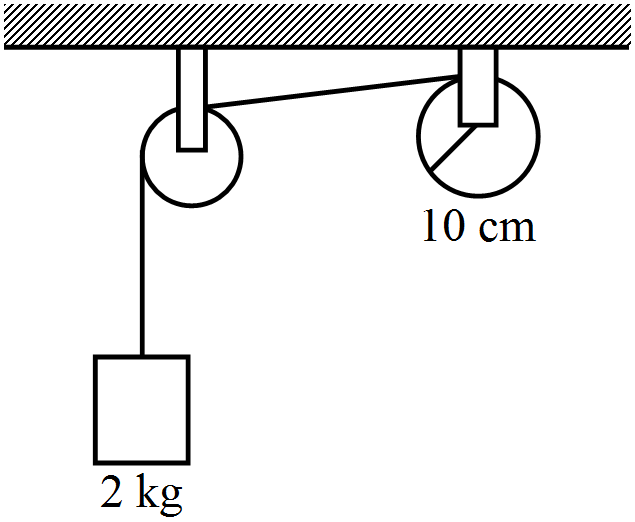
A string is wrapped on a wheel of moment of inertia $0.20kg-m^2$ and radius 10cm and goes through a light pulley to support a block of mass $2.0kg$ as shown in figure. Find the acceleration of the block.
A capacitor of capacitance $100\mu\text{F}$ is connected to a battery of 20 volts for a long time and then disconnected from it. It is now connected across a long solenoid having 4000 turns per metre. It is found that the potential difference across the capacitor drops to 90% of its maximum value in 2.0 seconds. Estimate the average magnetic field produced at the centre of the solenofd during this period.
A rocket is fired from the earth towards the sun. At what distance from the earth’s centre is the gravitational force on the rocket zero? Mass of the sun $= 2 \times 10^{30}kg$, mass of the earth $= 6\times 10^{24}kg$. Neglect the effect of other planets etc. (orbital radius $= 1.5 \times 10^{11}m).$