Question
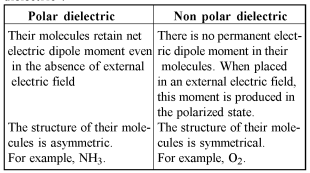
Write the difference between polar and non-polar dieelctric.

Answer

Difference between Polar and Non-Polar dielectric :
Image

Need a full question paper?

Generate a complete, print-ready paper with questions like this in minutes — across 16+ boards, with answer keys.
Start Generating Free

Similar questions

A smooth block loosely fits in a circular tube placed on a horizontal surface. The block moves in a uniform circular motion along the tube (figure). Which wall (inner or outer) will exert a nonzero normal contact force on the block?

Explain the effect of intersity of light on photocurrent.
The magnetic force on a charged particle is always perpendicular to its velocity. Can the magnetic force change the velocity of the particle? Speed of the particle?
A proton and an a particle are accelerated through the same potential difference. Which one of the two has (i) greater de-Broglie wavelength, and (ii) less kinetic energy? Justify your answer.
A farsighted person cannot see objects placed closer to 50cm. Find the power of the lens needed to see the objects at 20cm.
On which two factors the extent of polarization in a polar dielectric depends ? what is polarization of dielectric ? Write its formula.
A copper wire bent in the shape of a semicircle of radius r translates in its plane with a constant velocity v. A uniform magnetic field B exists in the direction perpendicular to the plane of the wire. Find the emf induced between the ends of the wire if:
  1. The velocity is perpendicular to the diameter joining free ends.
  2. The velocity is parallel to this diameter.
In a Quincke's experiment the sound detected is changed from a maximum to a minimum when the sliding tube is moved through a distance of 2.50cm. Find the frequency of sound if the speed of sound in air is 340m/s.
A circular wire-loop of radius a carries a total charge Q distributed uniformly over its length. A small length dL of the wire is cut off. Find the electric field at the centre due to the remaining wire.
The electric current existing in a discharge tube is $2.0\mu\text{A}.$ How much charge is transferred across a cross-section of the tube in 5 minutes?