Question
Write the differences between mass and weight of an object.

Answer

 
Mass
Weight
1.
The mass of an object is the quantity of matter contained in it.
The weight of an object is the force with which it is attracted towards the centre of the earth.
2.
SI unit of mass is kilogram (kg).
SI unit of mass is newton (N).
3.
The mass of an object is constant.
The weight of an object is not constant. It changes with the change in acceleration due to gravity.
4.
The mass of an object can never be zero.
The weight of an object can be zero.

Need a full question paper?

Generate a complete, print-ready paper with questions like this in minutes — across 16+ boards, with answer keys.
Start Generating Free

Similar questions

Iron powder and sulphur powder were mixed together and divided into two parts A and B. When part A was heated strongly over a burner, then a substance C was formed. The part B was, however, not heated at all. When dilute hydrochloric acid was added to substance C, then gas D was evolved and when dilute hydrochloric acid was added to part B then gas E was evolved.
  1. What type of substance is B?
  2. What type of substance is C?
  3. Name the gas (i) D, and (ii) E?
  4. Write one characteristic property of gas D.
List five characteristics by which compounds can be distinguished from mixtures.
State and explain Kepler’s laws of planetary motion. Draw diagrams to illustrate these laws.
The distance between Delhi and Agra is 200km. A train travels the first 100km at a speed of 50km/h. How fast must the train travel the next 100km, so as to average 70km/h for the whole journey?
There is a large group of materials P which can be divided into three groups Q, R, and S on the basis of their properties. The substances belonging to group Q can be solids, liquids or gases. The solids belonging to group Q are usually electrical insulators. Most of the substances of group R are solids which are good conductors of electricity. The substances belonging to group S are neither insulators like Q nor good conductors like R. The properties of S are intermediate between those of Q and R.
  1. What could the group of materials P be?
  2. Name the substances Q. Give two examples of such substances.
  3. Name the substances R. Write two examples of such substances.
  4. Name the substances S. Give two examples of such substances.
  5. Out of Q, R and S, which substances are malleable and ductile?
A ball of mass $200\ g$ falls from a height of $5$ metres. What is its kinetic energy when it just reaches the ground? $(8=$ $9.8 m / s$ ).
If the distance between two masses is increased by a factor of $5$, by what factor would the mass of one of them have to be altered to maintain the same gravitational force?
Would this be an increase or decrease in the mass?
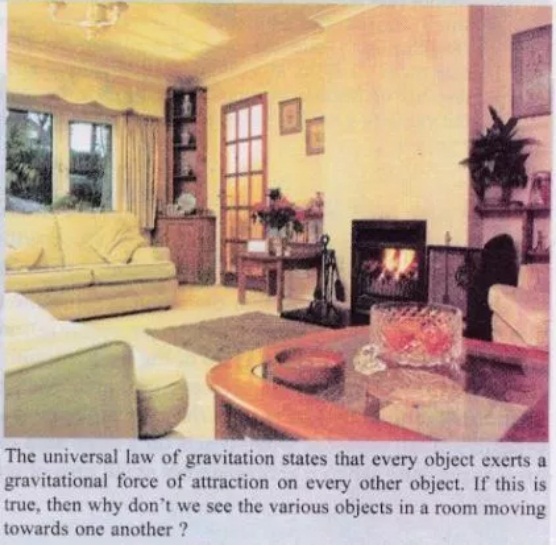
Universal law of gravitation states that every object exerts a gravitational force of attraction on every other object. If this is true, why don’t we notice such forces? Why don’t the two objects in a room move towards each other due to this force?

Give the formulate of the compounds formed from the following sets of elements:
  1. Calcium and fluorine.
  2. Hydrogen and sulphur.
  3. Nitrogen and hydrogen.
  4. Carbon and chlorine.
  5. Sodium and oxygen.
  6. Carbon and oxygen.
The mass of one molecule of a substance is $4.65 \times 10^{-23} g$. What is its molecular mass? What could this substance be?