Questions

Question Answer (5 Marks)

Take a timed test

20 questions · self-marked practice — reveal the answer and mark yourself.

Question 15 Marks
If the distance between two masses is increased by a factor of $5$, by what factor would the mass of one of them have to be altered to maintain the same gravitational force?
Would this be an increase or decrease in the mass?
Answer
Gravitational force is given by:
Distance between two masses is increased s.t. new distance is $= 5\ d$
New gravitational force $F_1 = F$
Let on of the mass is changed to $m_1$ so as to maintain the same gravitational force.
$\text{F}_1=\text{G}\times\frac{\text{m}_1\times\text{M}}{\text{D}^2}$
$\text{D}=5\text{d}$
$\text{F}=\text{F}_1$
$\text{G}\times\frac{\text{m}\times\text{M}}{\text{d}^2}=\text{G}\times\frac{\text{m}_1\times\text{M}}{\text{D}^2}$
$\text{G}\times\frac{\text{m}\times\text{M}}{\text{d}^2}=\text{G}\times\frac{\text{m}_1\times\text{M}}{25\text{d}^2}$
$\frac{\text{m}_1}{\text{m}}=25$
$\text{m}_1=25\text{m}$
Hence one of the masses should be increased by $25$ times in order to have the same gravitational force.
View full question & answer
Question 25 Marks
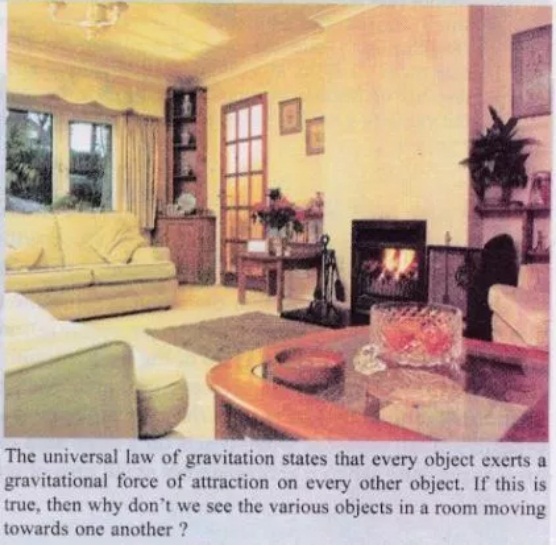
Universal law of gravitation states that every object exerts a gravitational force of attraction on every other object. If this is true, why don’t we notice such forces? Why don’t the two objects in a room move towards each other due to this force?

Answer
In order to be able to notice the gravitational force of attraction between any two objects, at least one of the objects on the earth should have an extremely large mass. Since no object on the earth have an extremely large mass, we cannot notice such forces.
The two objects in a room do not move towards each other because due to their small masses, the gravitational force of attraction between them is very, very weak.
View full question & answer
Question 35 Marks
The mass of a planet is $6 \times 10^{24}\ kg$ and its diameter is $12.8 \times 10^3\ km$. If the value of gravitational constant be $6.7 \times 10^{-}$ ${ }^{11}\ Nm ^2 / kg ^2$, calculate the value of acceleration due to gravity on the surface of the planet. What planet could this be?
Answer
Acceleration due to gravity,
$g=G \times \frac{M}{R^2}$
Mass, $M =6 \times 10^{24}\ kg$
Diameter $12.8 \times 10^3 km=12.8 \times 10^6\ m$
Radius, $R =\frac{\left(12.8 \times 10^6\right)}{2}=6.4 \times 10^6\ m$
Gravitational constant, $G =6.7 \times 10^{-11}\ Nm ^2 / kg ^2$
$g=\frac{6.7 \times 60}{6.4 \times 6.4}$
$g=9.8\ m / s^2$
As the value of $g=9.8\ m / s ^2$, the planet could be earth.
View full question & answer
Question 45 Marks
  1. How does a boat float in water?
  2. A piece of steel has a volume of $12cm\ ^3$, and a mass of $96\ g$. What is its density: (i) in $g/cm^3$​​​​​​​(ii) in $kg/m^3$​​​​​​​?
Answer
  1. A floating boat displace water equal to its own weight. This displaced water exerts buoyant force to balance the weight of boat and keep if a float.
  1.  
  1. Mass of $= 96\ g$
Volume $= 12\ cm$
Density of substance $=\frac{\text{Mass of substance}}{\text{Volume of substance}}$
Density of substance $ =\frac{96}{12}=8\text{g}/\text{cm}^3$
  1. Mass $= 96 \times 10^{-3}\ kg$
Volume $= 12 \times 10^{-6}\ m^3$
Density of substance $=\frac{\text{Mass of substance}}{\text{Volume of substance}}$
Density of substance $ =\frac{96\times10^{-3}}{12\times10^{-6}}=8\times10^3\text{kg}/\text{m}^3$
View full question & answer
Question 55 Marks
Write the differences between mass and weight of an object.
Answer
 
Mass
Weight
1.
The mass of an object is the quantity of matter contained in it.
The weight of an object is the force with which it is attracted towards the centre of the earth.
2.
SI unit of mass is kilogram (kg).
SI unit of mass is newton (N).
3.
The mass of an object is constant.
The weight of an object is not constant. It changes with the change in acceleration due to gravity.
4.
The mass of an object can never be zero.
The weight of an object can be zero.
View full question & answer
Question 65 Marks
A stone is dropped from a height of $20\ m.$
How long will it take to reach the ground?
Answer
Height, $s = 20\ m$
Initial velocity, $u = 0$
Acceleration due to gravity, $g = 10\ m/s^2$
Final velocity,$ v = ?$
Time taken, $t = ?$
Using relation,
$\text{s}=\text{ut}+\frac{1}{2}\text{gt}^2$
$20=0\times\text{t}+\frac{1}{2}\times10\times\text{t}^2$
$20=0+5\text{t}^2$
$\text{t}^2=\frac{20}{5}=4$
$\text{t}=\sqrt4=2\text{s}$
View full question & answer
Question 75 Marks
Suppose a planet exists whose mass and radius both are half those of the earth. Calculate the acceleration due to gravity on the surface of this planet.
Answer
Acceleration due to gravity of earth,
$\text{g}=\text{G}\times\frac{\text{M}}{\text{R}^2}=9.8\text{m/s}^2$
If mass of planet, $\text{m} = \frac{\text{M}}{2}$
And radius of planet, $\text{r}=\frac{\text{R}}{2}$
Acceleration due to gravity on the surface of planet will be:
$\text{g}=\text{G}\times\frac{\text{m}}{\text{r}^2}\ ...(\text{i})$
$\text{m}=\frac{\text{M}}{2}\ ...(\text{ii})$
$\text{r}=\frac{\text{R}}{2}\ ...(\text{iii})$
Put (ii) and (iii) in (i) eq. we get
$\text{g}=\text{G}\times\frac{\frac{\text{M}}{2}}{\Big(\frac{\text{R}}{2}\Big)^2}=\frac{4}{2}\times\Big(\text{G}\times\frac{\text{M}}{\text{R}^2}\Big)$
$\text{g}=2\times9.8\text{m/s}^2$
$\text{g}=19.6\text{m/s}^2$
View full question & answer
Question 85 Marks
A stone falls from a building and reaches the ground $2.5$ seconds later. How high is the building? $(g = 8m/s^2)$
Answer
Initial velocity, $u = 0m/s$
Acceleration due to gravity, $g = 9.8m/s^2$
Time taken to reach the ground, $t = 2.5 sec$
Height, $h = ?$
Using relation,
$\text{s}=\text{ut}+\frac{1}{2}\text{gt}^2$
$\text{s}=0\times2.5+\frac{1}{2}\times9.8\times2.5\times2.5$
$\text{s}=0+4.9\times2.5\times2.5$
$\text{s}=30.625\text{m}$
View full question & answer
Question 95 Marks
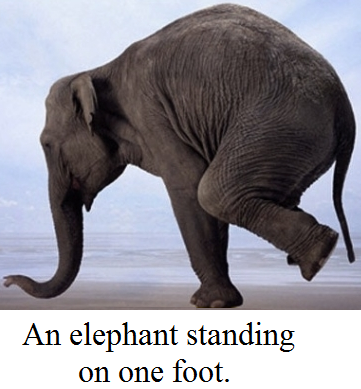
An elephant weighing $40,000\ N$ stands on one foot of area $1000\ cm^2$ whereas a girl weighing $400\ N$ is standing on one ‘stiletto’ heel of area $1cm^2.$​​​​​​​

  1. Which of the two, elephant or girl, exerts a larger force on the ground and by how much?
  2. What pressure is exerted on the ground by the elephant standing on one foot?
  3. What pressure is exerted on the ground by the girl standing on one heel?
  4. Which of the two exerts larger pressure on the ground: elephant or girl?
  5. What is the ratio of pressure exerted by the girl to the pressure exerted by the elephant?
Answer
Weight of elephant $= 40000\ N$
Area of one foot $= 1000\ cm^2 = 1000 \times 10^{-4}\ m^2$​​​​​​​
Weight of girl $= 400\ N$
Area of heel of girl $= 1cm^2 = 1 \times 10^{-4}\ m^2$​​​​​​​
  1. Elephant has a larger weight of $40000\ N$, therefore, elephant exerts a larger force on the ground. Elephant exerts a larger force on the ground by $40000\ N - 400\ N = 39600\ N.$
  1. Weight of elephant $= 40000\ N$
Area of one foot $= 1000cm^2 = 1000 \times 10^{-4}m^2$
$\text{Pressure}=\frac{\text{Force}}{\text{Area}}$
$\text{Pressure}=\frac{40000}{1000\times10^{-4}}=400000\text{N}/\text{m}^2$
  1. Weight of the girl $= 400\ N$
Area of heel of girl $= 1cm^2 = 1 \times 10^{-4}m^2$​​​​​​​
$\text{Pressure}=\frac{\text{Force}}{\text{Area}}$
$\text{Pressure}=\frac{400}{1\times10^{-4}}=4000000\text{N}/\text{m}^2$​​​​​​​
  1. Girl exerts a larger pressure on the ground.
  1. ​​​​$\text{Ratio}=\frac{\text{Pressure exerted by the girl}}{\text{Pressure exerted by the elephant}}$
$=\frac{4000000}{400000}=\frac{10}{1}$
The pressure exerted by girl is 10 times greater than that exerted by the elephant.
View full question & answer
Question 105 Marks
State and explain Kepler’s laws of planetary motion. Draw diagrams to illustrate these laws.
Answer
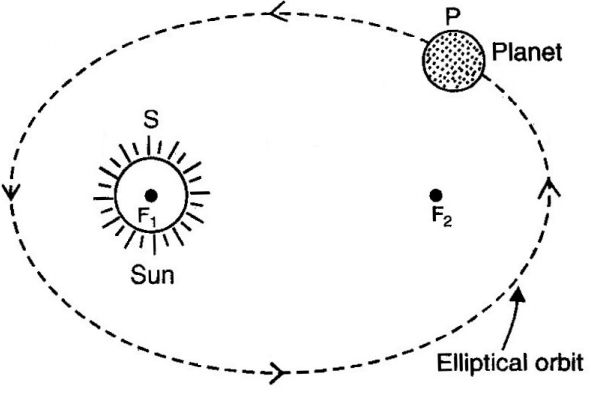
Kepler's first law: The planets move in elliptical orbits around the sun, with the sun at one of the two foci of the elliptical orbit. This law means that the orbit of a planet around the sun is an ellipse and not an exact circle. An elliptical path has two foci, and the sun is at one of the two foci of the elliptical path.

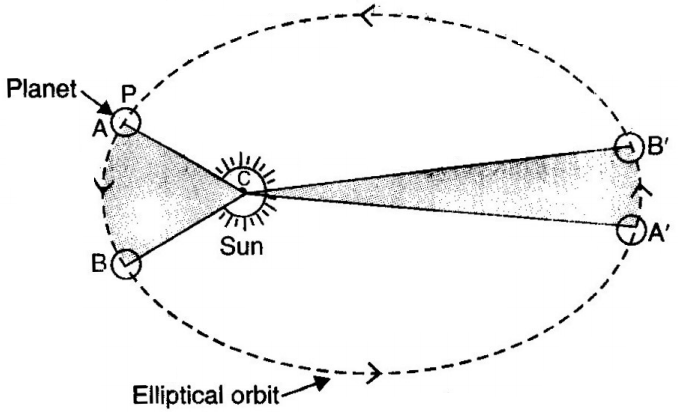
Kepler's Second law states that: Each planet revolves around the sun in such a way that the line joining the planet to the sun sweeps over equal areas in equal intervals of time. This means that a planet does not move with constant speed around the sun. The speed is greater when the planet is nearer the sun, and less when the planet is farther away from the sun.

Kepler's Third Law states that: The cube of the mean distance of a planet from the sun is directly proportional to the square of time it takes to move around the sun.
$\text{r}^3\propto\text{T}^2$
View full question & answer
Question 115 Marks
If the distance between two masses is increased by a factor of $5$, by what factor would the mass of one of them have to be altered to maintain the same gravitational force? Would this be an increase or decrease in the mass?
Answer
Gravitational force is given by:
Distance between two masses is increased s.t. new distance is = $5d$
New gravitational force $F_1 = F$
Let on of the mass is changed to $m_1$ so as to maintain the same gravitational force.
$\text{F}_1=\text{G}\times\frac{\text{m}_1\times\text{M}}{\text{D}^2}$
$\text{D}=5\text{d}$
$\text{F}=\text{F}_1$
$\text{G}\times\frac{\text{m}\times\text{M}}{\text{d}^2}=\text{G}\times\frac{\text{m}_1\times\text{M}}{\text{D}^2}$
$\text{G}\times\frac{\text{m}\times\text{M}}{\text{d}^2}=\text{G}\times\frac{\text{m}_1\times\text{M}}{25\text{d}^2}$
$\frac{\text{m}_1}{\text{m}}=25$
$\text{m}_1=25\text{m}$
Hence one of the masses should be increased by $25$ times in order to have the same gravitational force.
View full question & answer
Question 125 Marks
Universal law of gravitation states that every object exerts a gravitational force of attraction on every other object. If this is true, why don’t we notice such forces? Why don’t the two objects in a room move towards each other due to this force?

Answer
In order to be able to notice the gravitational force of attraction between any two objects, at least one of the objects on the earth should have an extremely large mass. Since no object on the earth have an extremely large mass, we cannot notice such forces.
The two objects in a room do not move towards each other because due to their small masses, the gravitational force of attraction between them is very, very weak.
View full question & answer
Question 135 Marks
The mass of a planet is $6 \times 10^{24} kg$ and its diameter is $12.8 \times 10^3 km$. If the value of gravitational constant be $6.7 \times 10^{-}$ ${ }^{11} Nm ^2 / kg ^2$, calculate the value of acceleration due to gravity on the surface of the planet. What planet could this be?
Answer
Acceleration due to gravity,
$g=G \times \frac{M}{R^2}$
Mass, $M =6 \times 10^{24} kg$
Diameter $12.8 \times 10^3 km=12.8 \times 10^6 m$
Radius, $R=\frac{\left(12.8 \times 10^6\right)}{2}=6.4 \times 10^6 m$
Gravitational constant, $G =6.7 \times 10^{-11} Nm ^2 / kg ^2$
$g=\frac{6.7 \times 60}{6.4 \times 6.4}$
$g=9.8 m / s^2$
As the value of $g =9.8 m / s ^2$, the planet could be earth.
View full question & answer
Question 145 Marks
  1. How does a boat float in water?
  2. A piece of steel has a volume of $12\ cm^3$, and a mass of $96\ g$. What is its density: (i) in $g/cm\ ^3$​​​​​​​(ii) in $kg/m\ ^3$?
Answer
A. floating boat displace water equal to its own weight. This displaced water exerts buoyant force to balance the weight of boat and keep if a float.
B. (i).Mass of $= 96\ g$
Volume $= 12\ cm$
Density of substance $=\frac{\text{Mass of substance}}{\text{Volume of substance}}$
Density of substance $ =\frac{96}{12}=8\text{g}/\text{cm}^3$
(ii).Mass$ = 96 \times 10^{-3}kg$
Volume $= 12 \times 10^{-6}m^3$
Density of substance $=\frac{\text{Mass of substance}}{\text{Volume of substance}}$
Density of substance $ =\frac{96\times10^{-3}}{12\times10^{-6}}=8\times10^3\text{kg}/\text{m}^3$
 
View full question & answer
Question 155 Marks
Write the differences between mass and weight of an object.
Answer
 
Mass
Weight
1.
The mass of an object is the quantity of matter contained in it.
The weight of an object is the force with which it is attracted towards the centre of the earth.
2.
SI unit of mass is kilogram (kg).
SI unit of mass is newton (N).
3.
The mass of an object is constant.
The weight of an object is not constant. It changes with the change in acceleration due to gravity.
4.
The mass of an object can never be zero.
The weight of an object can be zero.
View full question & answer
Question 165 Marks
A stone is dropped from a height of $20\ m.$
How long will it take to reach the ground?
Answer
Height, $s = 20\ m$
Initial velocity, $u = 0$
Acceleration due to gravity, $g = 10\ m/s^2$
Final velocity, $v = ?$
Time taken, $t = ?$
Using relation,
$\text{s}=\text{ut}+\frac{1}{2}\text{gt}^2$
$20=0\times\text{t}+\frac{1}{2}\times10\times\text{t}^2$
$20=0+5\text{t}^2$
$\text{t}^2=\frac{20}{5}=4$
$\text{t}=\sqrt4=2\text{s}$
View full question & answer
Question 175 Marks
Suppose a planet exists whose mass and radius both are half those of the earth. Calculate the acceleration due to gravity on the surface of this planet.
Answer
Acceleration due to gravity of earth,
$\text{g}=\text{G}\times\frac{\text{M}}{\text{R}^2}=9.8\text{m/s}^2$
If mass of planet, $\text{m} = \frac{\text{M}}{2}$
And radius of planet, $\text{r}=\frac{\text{R}}{2}$
Acceleration due to gravity on the surface of planet will be:
$\text{g}=\text{G}\times\frac{\text{m}}{\text{r}^2}\ ...(\text{i})$
$\text{m}=\frac{\text{M}}{2}\ ...(\text{ii})$
$\text{r}=\frac{\text{R}}{2}\ ...(\text{iii})$
Put (ii) and (iii) in (i) eq. we get
$\text{g}=\text{G}\times\frac{\frac{\text{M}}{2}}{\Big(\frac{\text{R}}{2}\Big)^2}=\frac{4}{2}\times\Big(\text{G}\times\frac{\text{M}}{\text{R}^2}\Big)$
$\text{g}=2\times9.8\text{m/s}^2$
$\text{g}=19.6\text{m/s}^2$
View full question & answer
Question 185 Marks
A stone falls from a building and reaches the ground $2.5$ seconds later. How high is the building? $(g = 8\ m/s^2)$
Answer
Initial velocity, $u = 0\ m/s$
Acceleration due to gravity, $g = 9.8m/s^2$
Time taken to reach the ground, $t = 2.5\ sec$
Height, $h = ?$
Using relation,
$\text{s}=\text{ut}+\frac{1}{2}\text{gt}^2$
$\text{s}=0\times2.5+\frac{1}{2}\times9.8\times2.5\times2.5$
$\text{s}=0+4.9\times2.5\times2.5$
$\text{s}=30.625\text{m}$
View full question & answer
Question 195 Marks
An elephant weighing $40,000\ N$ stands on one foot of area $1000\ cm^2$ whereas a girl weighing $400\ N$ is standing on one ‘stiletto’ heel of area $1cm^2.$​​​​​​​


  1. Which of the two, elephant or girl, exerts a larger force on the ground and by how much?
  2. What pressure is exerted on the ground by the elephant standing on one foot?
  3. What pressure is exerted on the ground by the girl standing on one heel?
  4. Which of the two exerts larger pressure on the ground: elephant or girl?
  5. What is the ratio of pressure exerted by the girl to the pressure exerted by the elephant?
Answer
Weight of elephant = $40000\ N$
Area of one foot = $1000 cm^2 = 1000 \times 10^{-4}m^2$
Weight of girl =$400N$
Area of heel of girl =$1cm^2 = 1 \times 10^{-4}m^2$
Elephant has a larger weight of $40000N$, therefore, elephant exerts a larger force on the ground. Elephant exerts a larger force on the ground by $40000N - 400N=39600N.$
Weight of elephant =$40000N$
Area of one foot $= 1000cm^2 = 1000 \times 10^{-4}m^2$​​​​​​​
$\text{Pressure}=\frac{\text{Force}}{\text{Area}}$
$\text{Pressure}=\frac{40000}{1000\times10^{-4}}=400000\text{N}/\text{m}^2$
Weight of the girl $= 400N$
Area of heel of girl $= 1cm^2 = 1 \times 10^{-4}m^2$​​​​​​​
$\text{Pressure}=\frac{\text{Force}}{\text{Area}}$
$\text{Pressure}=\frac{400}{1\times10^{-4}}=4000000\text{N}/\text{m}^2$
Girl exerts a larger pressure on the ground.
​​​​$\text{Ratio}=\frac{\text{Pressure exerted by the girl}}{\text{Pressure exerted by the elephant}}$
$=\frac{4000000}{400000}=\frac{10}{1}$
The pressure exerted by girl is $10$ times greater than that exerted by the elephant.
View full question & answer
Question 205 Marks
State and explain Kepler’s laws of planetary motion. Draw diagrams to illustrate these laws.
Answer
Kepler's first law: The planets move in elliptical orbits around the sun, with the sun at one of the two foci of the elliptical orbit. This law means that the orbit of a planet around the sun is an ellipse and not an exact circle. An elliptical path has two foci, and the sun is at one of the two foci of the elliptical path.

Kepler's Second law states that: Each planet revolves around the sun in such a way that the line joining the planet to the sun sweeps over equal areas in equal intervals of time. This means that a planet does not move with constant speed around the sun. The speed is greater when the planet is nearer the sun, and less when the planet is farther away from the sun.

Kepler's Third Law states that: The cube of the mean distance of a planet from the sun is directly proportional to the square of time it takes to move around the sun.
$\text{r}^3\propto\text{T}^2$
View full question & answer