Question
Write the differences between wind-pollinated and insect-pollinated flowers. Give an example of each type.

Answer

S. No.
Wind-pollinated flowers
Insect-pollinated flowers
(i)
These produce large numbers of pollen grains.
These produce less number of pollen grains.
(ii)
These are dull, nectarless and scentless.
These are bright, scented and have nectar.
(iii)
Stamens are long and protrude above petals.
Stamens lie within the corolla tube.
(iv)
The pollen grains are dry, light, small and smooth. For example, ragweed.
The pollen grains are larger, heavier with appendages like hooks and barbs. For example, rose, sweet pea.

Need a full question paper?

Generate a complete, print-ready paper with questions like this in minutes — across 16+ boards, with answer keys.
Start Generating Free

Similar questions

  1. Why is there a fear amongst the guardians that their adolescent wards may get trapped in drug/ alcohol abuse?
  2. Explain 'addiction' and 'dependence'in respect of drug/ alcohol abuse in youth.
Ignoring our traditional knowledge can we prove costly in the area of biological patenting. Justify.
  1. How are recombinant vectors created?
  2. For creating one recombinant vector only one type of restriction endonuclease is required. Give reason.
Why did Hershey and Chase work with bacteriophages in their experiments to prove that DNA is the genetic material? Explain.
While creating genetically modified organisms, genetic barriers are not respected. How can this be dangerous in the long run?
Explain - adaptive radiation
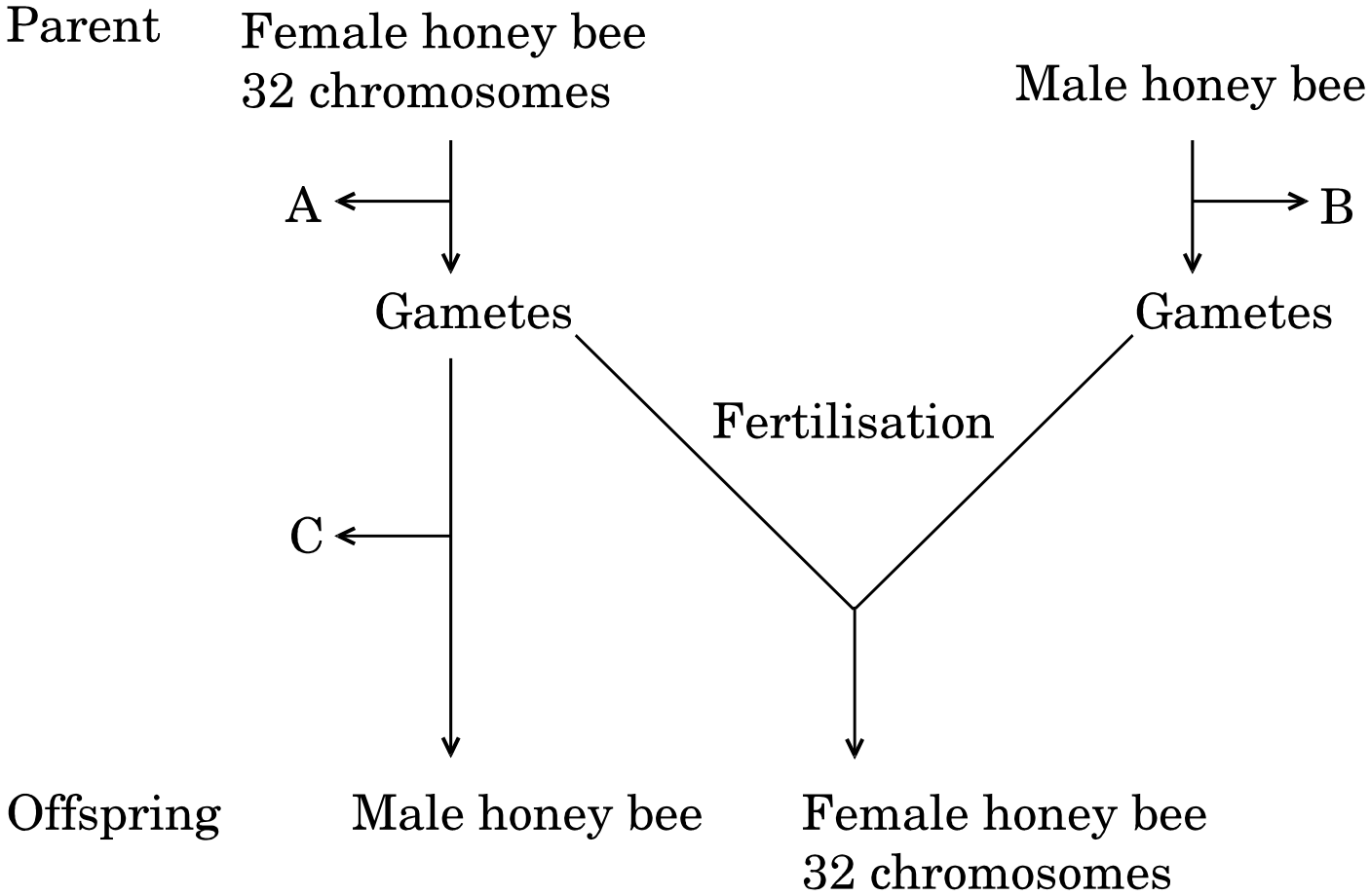
The cytological observations made in a number of insects led to the development of the concept of genetic/ chromosomal basis of sex-determination mechanism. Honey bee is an interesting example to study the mechanism of sex-determination. Study the schematic cross between the male and the female honey bees given below and answer the questions that follow:

  1. Identify the cell divisions ‘A’ and ‘B’ that lead to gamete formation in female and male honey bees respectively.
  2. Name the process ‘C’ that leads to the development of male honey bee (drone).
Why is hormone releasing IUD considered a good contraceptive to space children?
What are the fundamental difference between In-situ and Ex-situ conservation.
What are Cry proteins? Name an organism that produce it. How has man exploited this protein to his benefit?