Question
Write the dimensions of:
  1. Linear density.
  2. Power.
  3. Impulse.
  4. Velocity gradien.
  5. Mass per unit area.
  6. Kinetic energy.
  7. Angular acceleration.
  8. Couple.
  9. Moment of force.
  10. Work done.

Answer

  1. [ML-1T0)

  2. [ML2T-3]

  3. [MLT-1)

  4. [M0L0T-1]

  5. [ML-2T0)

  6. [M1L2T-2]

  7. [M0L0T-2]

  8. [ML2T-2]

  9. [ML2T-2]

  10. [ML2T-2].

Need a full question paper?

Generate a complete, print-ready paper with questions like this in minutes — across 16+ boards, with answer keys.

Start Generating Free

Similar questions

Write the applications of beats.
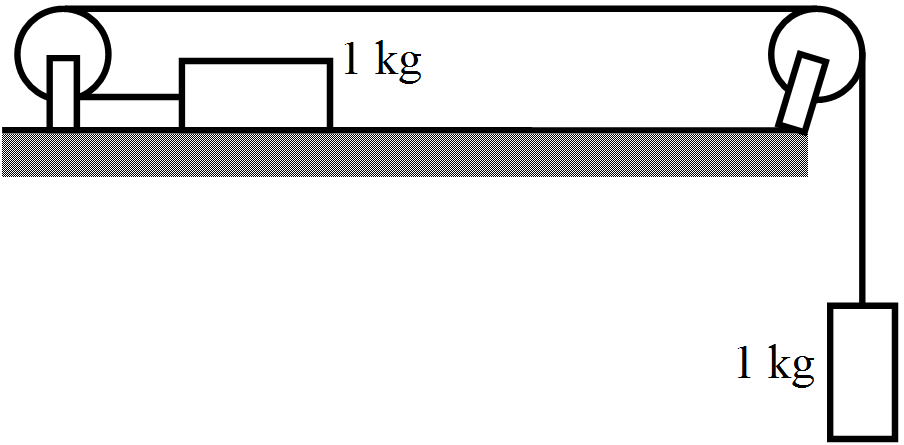
Calculate the tension in the string shown in figure. The pulley and the string are light and all surfaces are frictionless. Take g = 10m/s2.

A person standing on the top of a cliff 171ft high has to throw a packet to his friend standing on the ground 228ft horizontally away. If he throws the packet directly aiming at the friend with a speed of 15.0ft/s, how short will the packet fall?
A thin prism of crown glass $(\mu_\text{r}=1.515,\mu_\text{v}=1.525)$ and a thin prism of flint glass $(\mu_\text{r}=1.612,\mu_\text{v}=1.632)$ are placed in contact with each other. Their refracting angles are 5.0° each and are similarly directed. Calculate the angular dispersion produced by the combination.
Four persons K, L, M and N start from the vertices of a square of side 'a', simultaneously and move towards the neighbour in order always with the same speed of v. When and where do they meet?
Rain is falling vertically with a speed of 30m s-1. A woman rides a bicycle with a speed of 10ms-1 in the north to south direction. What is the direction in which she should hold her umbrella?
The count rate from a radioactive sample falls from 4.0 × 10⁶ per second to 1.0 × 10per second in 20 hours. What will be the count rate 100 hours after the beginning?
A soap bubble of radius 4 cm and surface tension 30 dyne $cm ^{-1}$ is blown at the end of a tube of length 10 cm and internal radius 0.20 cm . If the viscosity of air is $1.89 \times 10^{-4}$ poise, find the time taken by the bubble to be reduced to a radius of 2 cm .
The resultant of two vector $\vec{P}$ and $\vec{Q}$ is $\vec{R}$. If the direction of $\vec{Q}$ is reversed, then the resulting vector becomes $\vec{S}$. Then prove that,
$
R ^2+ S ^2=2\left( P ^2+ Q ^2\right)
$
Earth also moves in circular orbit around sun once every year with on orbital radius of 1.5 × 10¹¹m. What is the acceleration of earth (or any object on the surface of the earth) towards the centre of the sun? How does this acceleration compare with g = 9.8m/ s2?

$\Big(\text{Hint: acceleration}\frac{\text{V}^2}{\text{R}}=\frac{4\pi^2\text{R}}{\text{T}^2}\Big)$