Question
Write the expression for distance covered in $n^{th}$ second by a uniformly accelerated body.
Answer

If a is the uniform acceleration, then $\text{s}=\text{u}+\frac{\text{a}}{2}(2\text{n}-1),$ where u is the initial velocity.

Need a full question paper?

Generate a complete, print-ready paper with questions like this in minutes — across 16+ boards, with answer keys.

Start Generating Free

Similar questions

If the velocity of a particle is fixed, can its speed change?
A tank with a square base of area $1.0 \mathrm{~m}^2$ is divided by a vertical partition in the middle. The bottom of the partition has a small-hinged door of area $20 \mathrm{~cm}^2$. The tank is filled with water in one compartment, and an acid (of relative density 1.7 ) in the other, both to a height of 4.0 m . compute the force necessary to keep the door close.
A mass m moving with a speed u collides on a similar stationary mass and sticks to it. What is the velocity after collision?
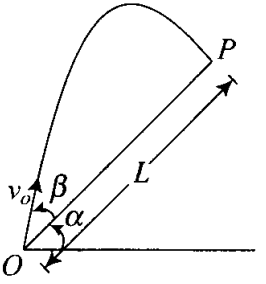
A particle is projected in air at an angle $\beta$ to a surface which itself is inclined at an angle $\alpha$ to the horizontal (Fig.).
  1. Find an expression of range on the plane surface (distance on the plane from the point of projection at which particle will hit the surface).
(Hint: This problem can be solved in two different ways:
  1. Point P at which particle hits the plane can be seen as intersection of its trajectory (parobola) and straight line. Remember particle is projected at an angle $(\alpha+\beta)$ w.r.t. horizontal.
  2. We can take x-direction along the plane and y-direction perpendicular to the plane. In that case resolve g (acceleration due to gravity) in two differrent components, $g_x$ along the plane and $g_y$ perpendicular to the plane. Now the problem can be solved as two independent motions in x and y directions respectively with time as a common parameter.)
Give the magnitude and direction of the net force acting on. A drop of rain falling down with a constant speed.
What should be the angle between force and displacement for maximum and minimum work?
Can the value of resultant vector of two vectors be less than the value of any one of the given vectors?
Place a safety pin on a sheet of paper. Hold the sheet over a burning candle, until the paper becomes yellow and charr. On removing the pin, its white trace is observed on the paper. Why?
Constant acceleration means that x-t graph will have constant slope? Yes/ No
On what factor does the coefficient of friction between two surfaces depend?