Question
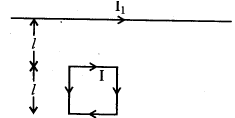
Write the expression for the magnetic moment ($\overrightarrow{\text{m}}$) due to a planar square loop of side ‘l’ carrying a steady current I in a vector form. In the given figure this loop is placed in a horizontal plane near a long straight conductor carrying a steady current $I_1$ at a distance l as shown. Give reasons to explain that the loop will experience a net force but no torque. Write the expression for this force acting on the loop.
Answer

$\overrightarrow{\text{m}} = \text{I}\overrightarrow{\text{A }} ( \overrightarrow{\text{A}} = \text{ area vector) }$
Torque: The magnetic field due to the long current carrying wire is perpendicular to the plane of paper. Hence the force acting on each of the four sides is in the plane of the paper and the net torque is zero.
Alternate Answer
$\overrightarrow{\text{m}}$is perpendicular to the plane of paper and$\overrightarrow{\text{B}}$ is perpendicular to the plane of paper. Hence $\overrightarrow{\tau} =\overrightarrow{\text{m}}\times\overrightarrow{\text{B}} = 0 $
Force:
Force on upper horizontal side $ = \frac{\text{I}l\mu_{o}\text{I}_{1}}{2\pi\text{l}} =\frac{\text{I}\mu_{o}\text{l}_{1}}{2\pi}\text{ (attractive) }$
Force on lower horizontal side $ = \frac{\text{I}l\mu_{o}\text{I}_{1}}{2\pi(2l)} = \frac{\text{I}\mu_{o}\text{I}_{1}}{4\pi}\text{ (repulsive)}$
The direction of these forces being opposite to each other therefore net force $ = \frac{\mu_{o}\text{I}_{1}\text{I}}{4\pi}\text{ (attractive) }$
(The net force on the two vertical sides is zero)
Torque: The magnetic field due to the long current carrying wire is perpendicular to the plane of paper. Hence the force acting on each of the four sides is in the plane of the paper and the net torque is zero.

Alternate Answer
$\overrightarrow{\text{m}}$is perpendicular to the plane of paper and$\overrightarrow{\text{B}}$ is perpendicular to the plane of paper. Hence $\overrightarrow{\tau} =\overrightarrow{\text{m}}\times\overrightarrow{\text{B}} = 0 $
Force: Award this mark irrespective of result obtained or calculation done by the students.

Need a full question paper?

Generate a complete, print-ready paper with questions like this in minutes — across 16+ boards, with answer keys.

Start Generating Free

Similar questions

In a pure semiconductor, the number of conduction electrons is $6 \times 10^{19}$ per cubic metre. How many holes are there in a sample of size $1cm × 1cm × 1mm?$
A circular coil of radius 8.0cm and 20 turns is rotated about its vertical diameter with an angular speed of 50rad $s^{–1}$ in a uniform horizontal magnetic field of magnitude $3.0 \times 10^{–2}T.$ Obtain the maximum and average emf induced in the coil. If the coil forms a closed loop of resistance 10Ω, calculate the maximum value of current in the coil. Calculate the average power loss due to Joule heating. Where does this power come from?
  1. Using the phenomenon of polarisation, show how transverse nature of light can be demonstrated.
  2. Two polaroids $\mathrm{P}_1$ and $\mathrm{P}_2$ are placed with their pass axes perpendicular to each other. Unpolarised light of intensity lo is incident on $P_1$. A third polaroid $P_3$ is kept in between $P_1$ and $P_2$ such that its pass axis makes an angle of $30^{\circ}$ with that of $P_1$. Determine the intensity of light transmitted through $P_1, P_2$ and $P_3$.
The voltage and current in a series AC circuit are given by, $\text{V}=\text{V}_0\cos\omega\text{t}$ and $\text{i}=\text{i}_0\sin\omega\text{t}.$ What is the power dissipated in the circuit?
Whenever a photon is emitted by hydrogen in Balmer series, it is followed by another photon in Lyman series. What wavelength does this latter photon correspond to?
Derive an expression for the electric field intensity at a point on the equatorial line of an electric dipole of dipole moment $\overrightarrow{\text{P}}$and length 2a. What is the direction of this field?
  1. What is total internal reflection? Under what conditions does it occur?
  2. Find a relation between critical angle and refractive index.
  3. Name one phenomenon which is based on total internal reflection.
In a silicon transistor, the base current is changed by $20\mu\text{A}.$ This results in a change of 0.02V in base to emitter voltage and a change of 2mA in the collector current.
  1. Find the input resistance, $\beta-$ac and trans conductance of the transistor.
  2. This transistor is used as an amplifier in CE configuration with a load resistance $5\text{k}\Omega$ What is the voltage gain of the amplifier?
Draw a graph showing the variation of binding energy per nucleon with mass number for different nuclei. Explain, with the help of this graph, the release of energy by the process of nuclear fusion.
Find the acceleration of a particle placed on the surface of the earth at the equator due to earth's rotation. The diameter of earth = 12800km and it takes 24 hours for the earth to complete one revolution about its axis.