Question
Write the factors affecting the capacitance of a capacitor.

Answer

SELF

Need a full question paper?

Generate a complete, print-ready paper with questions like this in minutes — across 16+ boards, with answer keys.
Start Generating Free

Similar questions

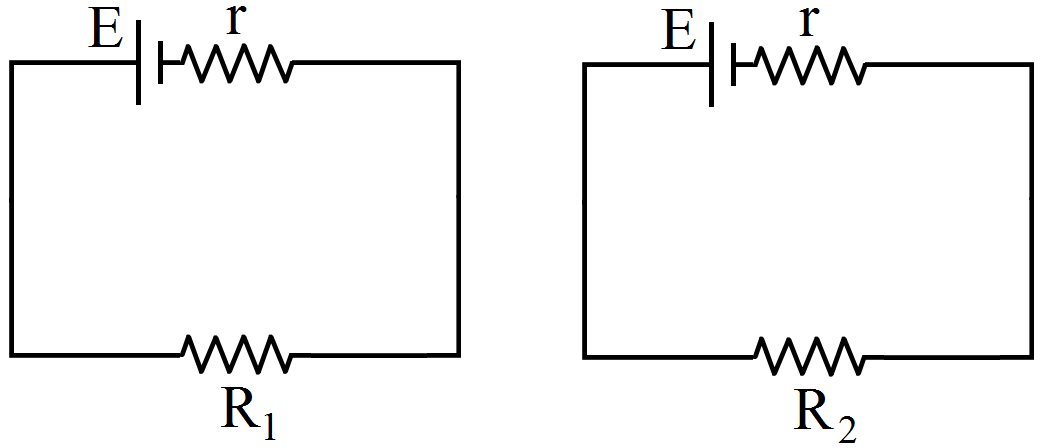
Two unequal resistances $R_1$ and $R_2$ are connected across two identical batteries of emf $\varepsilon$ and internal resistance $r.$ Can the thermal energies developed in $R_1$ and $R_{2}$ be equal in a given time. If yes, what will be the condition?
An alpha particle is projected vertically upward with a speed of $3.0 \times 10^4\ km s^{-1}$ in a region where a magnetic field of magnitude $1.0T$ exists in the direction south to north. Find the magnetic force that acts on the $\alpha-$ particle.
Whether the diffraction effects from a slit will be more clearly visible or less clearly, if the slit-width is increased?
Answer the following questions:
A choke coil in series with a lamp is connected to a dc line. The lamp is seen to shine brightly. Insertion of an iron core in the choke causes no change in the lamp’s brightness. Predict the corresponding observations if the connection is to an ac line.
Derive the equation of magnetic potential energy of a magnetic dipole placed in a uniform magnetic field and discuss its special cases.
A mass of $6 \times 10^{24}kg ($equal to the mass of the earth$)$ is to be compressed in a sphere in such a way that the escape velocity from its surface is $3 \times 10^8m/s.$ What should be the radius of the sphere?
Describe experiment of two stationary coil which explains clectromagnetic induction.
  1. An electrostatic field line is a continuous curve. That is, a field line cannot have sudden breaks. Why not?
  2. Explain why two field lines never cross each other at any point?
Show that there can be no net charge in a region m which the electric field is uniform at all points.
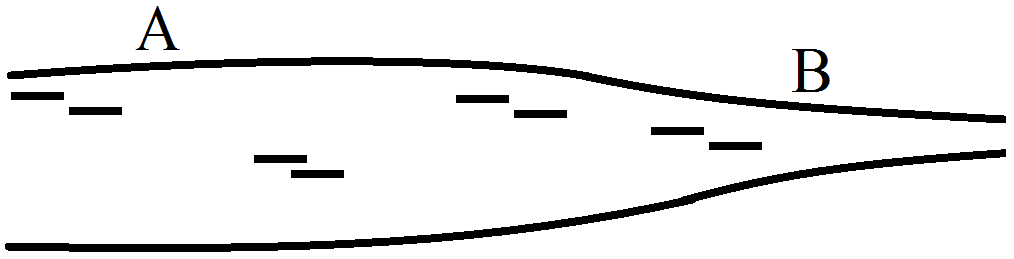
Water flows through a horizontal tube of variable cross$-$section. The area of cross-section at $A$ and $B$ are $4\ mm^2$ and $2\ mm^2$ respectively. If $1cc$ of water enters per second through $A,$ find,
  1. The speed ofwater at $A.$
  2. The speed of water at $B.$
  3. Thepressure difference $P_A- P_{B.}$