Question
Write the first five terms of the following sequences whose $n^{th}$ terms are:
$a_n=2 n^2-3 n+1$.

Answer

$a_n=2 n^2-3 n+1$
The given sequence is $a_n=2 n^2-3 n+1$.
To write first tive terms of given sequence an, we put $n=1,2,3,4,5$. Then we get
$ a_1=2.1^2-3.1+1=2-3+1=0 $
$ a_2=2.2^2-3.2+1=8-6+1=3 $
$ a_3=2.3^2-3.3+1=18-9+1=10 $
$ a_4=2.4^2-3.4+1=32-12+1=21 $
$ a_5=2.5^2-3.5+1=50-15+1=36$
$\therefore$ The required first five tms of given sequence $a_n=2 n^2-3 n+1$ are $0,3,10,21,36$.

Need a full question paper?

Generate a complete, print-ready paper with questions like this in minutes — across 16+ boards, with answer keys.
Start Generating Free

Similar questions

Show that the sequence defined by $a_n=3 n^2-5$ is not an $A.P.$
If the seventh term of an A.P. is $\frac{1}{9}$ and its ninth term is $\frac{1}{7}$, find its $(63)^{rd}$ term.
A bag contains lemon-flavoured condies only. Hema takes out one condy without looking into the bag. What is the probability that she takes out
  1. An orange-flavoured candy$?$
  2. A lemon-flavoured candy$?$
The $n^{th}$ term of an A.P is given by $(-4n + 15),$ Find the sum of first $20$ terms of this A.P.
A lawn is in the form of a rectangle whose sides are in the ratio $5 : 3.$ The area of the lawn is $3375m^2$. Find the cost of fencing the lawn at $₹\ 65$ per metre.
The corresponding sides of two similar triangles $ABC$ and $DEF$ are $BC = 9.1\ cm$ and $EF = 6.5\ cm.$ If the rerimeter of $\triangle\text{DEF}$ is $25\  cm,$ find the perimeter of $\triangle\text{ABC}.$
Prove the following identities:
$\sqrt{\frac{1-\cos\theta}{1+\cos\theta}}=(\text{cosec}\theta+\cot\theta)$
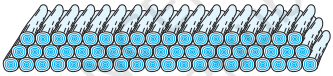
$200$ logs are stacked in the following manner: $20$ logs in the bottom row, $19$ in the next row, $18$ in the row next to it and so on $($see Fig.$)$. In how many rows are the $200$ logs placed and how many logs are in the top row$?$
If one zero of the quadratic polynomial $f(x) = 4x^2- 8kx - 9$ is negative of the other, find the value of $k.$
A solid is composed of a cylinder with hemispherical ends. If the whole length of the solid is $104\ cm$ and the radius of each of the hemispherical ends is $7\ cm,$ find the cost of polishing its surface at the rate of $Rs\ 10$ per $dm^2$.