Question
Write the first five terms of the following sequences whose $n^{th}$ terms are:
$\text{a}_\text{n}=\frac{\text{n}-3}{3}$

Answer

$\text{a}_\text{n}=\frac{\text{n}-3}{3}$
Here, the $n^{th}$ term is given by the above expression. So, to find the first term we use, $n = 1$, we get,
$\text{a}_1=\frac{(1)-2}{3}$
$=\frac{-1}{3}$
Similarly, we find the other four terms,
Second term (n = 2),
$\text{a}_1=\frac{(2)-2}{3}$
$=\frac{0}{3}$
$=0$
Third term (n = 3),
$\text{a}_3=\frac{(3)-2}{3}$
$=\frac{1}{3}$
Fourh terms (n = 4),
$\text{a}_4=\frac{(4)-2}{3}$
$=\frac{2}{3}$
Fifth term (n = 5),
$\text{a}_5=\frac{(5)-2}{3}$
$=\frac{3}{3}$
$=1$
Therefore, the first five terms for the given sequence are $\text{a}_1=\frac{-1}{3},\ \text{a}_2=0,\ \text{a}_3=\frac{1}{3},\ \text{a}_4=\frac{2}{3},\ \text{a}_5=1.$

Need a full question paper?

Generate a complete, print-ready paper with questions like this in minutes — across 16+ boards, with answer keys.
Start Generating Free

Similar questions

In $\triangle\text{ABC},$ if $\text{BD}\perp\text{AC}$ and $BC^2 = 2AC \times CD$, then prove that $AB = AC.$
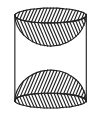
A wooden article was made by scooping out a hemisphere from each of the solid cylinder, as shown in fig. If the height of the cylinder is $10 \ cm$ and its base is of radius $3.5 \ cm .$ Find the total surface area of the article.
Image
Is this $–10, –6, –2, 2, ....$ an $AP$? If it forms an $AP$, find the common difference d and write three more terms.
In $\triangle\text{ABC},\ \angle\text{A}=60^\circ.$ Prove that $BC^2 = AB^2 + AC^2 - AB \times AC.$
Verify that each of the following is an AP, and then write its next three terms: $5,\frac{14}{3},\frac{13}{3},4,....$
Find the roots of the following quadratic equation (if they exist) by the method of completing the square.
$\sqrt{2}\text{x}^2-3\text{x}-2\sqrt{2}=0$
Find the zeroes of the polynomial $4 x^2+4 x-3$ and verify the relationship between zeroes and coefficients of the polynomial.
In a right angled triangle with sides a and b and hypotenuse c, the altitude drawn on the hypotenuse is x. Prove that ab = cx.
The sum of two numbers is 8. If their sum is four times their difference, find the numbers.
The angle of elevation of the top of a tower from a point $A$ on the ground is $30^{\circ}$. On moving a distance of $20$ metre towards the foot of the tower to a point $B$ the angle of elevation increases to $60^{\circ}$. Find the height of the tower and the distance of the tower from the point $A .$