MCQ
Write the function in the simplest form: $\tan ^{-1} \frac{x}{\sqrt{a^{2}-x^{2}}},|x| < a$
  • A
    $\tan ^{-1} \frac{a}{x}$
  • B
    $\tan ^{-1} \frac{x}{a}$
  • C
    $\sin ^{-1} \frac{a}{x}$
  • $\sin ^{-1} \frac{x}{a}$

Answer

Correct option: D.
$\sin ^{-1} \frac{x}{a}$
d
$\tan ^{-1} \frac{x}{\sqrt{a^{2}-x^{2}}}$

Let, $x=a \sin \theta \Rightarrow \frac{x}{a}=\sin \theta \Rightarrow \sin ^{-1}\left(\frac{x}{a}\right)$

$\therefore \tan ^{-1} \frac{x}{\sqrt{a^{2}-x^{2}}}$

$=\tan ^{-1}\left(\frac{a \sin \theta}{\sqrt{a^{2}-a^{2} \sin ^{2} \theta}}\right)$

$=\tan ^{-1}\left(\frac{a \sin \theta}{a \sqrt{1-\sin ^{2} \theta}}\right)$

$=\tan ^{-1}\left(\frac{a \sin \theta}{a \cos \theta}\right)$

$=\tan ^{-1}(\tan \theta)=\theta=\sin ^{-1} \frac{x}{a}$

Need a full question paper?

Generate a complete, print-ready paper with questions like this in minutes — across 16+ boards, with answer keys.
Start Generating Free

Similar questions

If the system of linear equations $x + ky + 3z = 0;3x + ky - 2z = 0$ ; $2x + 4y - 3z = 0$  has a non-zero solution $\left( {x,y,z} \right)$ then $\frac{{xz}}{{{y^2}}} = $. . . . .
The value of $\tan\bigg[\frac{1}{2}\cos^{-1}\Big(\frac{2}{3}\Big)\bigg]:$
If one of the roots of $\left |\begin{matrix} 3 &\text{amp; 5} &\text{amp; x}\\ 7 &\text{amp; x} &\text{amp; 7}\\ \text{x} &\text{amp; 5} &\text{amp; 3}\end{matrix}\right |=0$ is $-10,$ the other roots are:
Let $A = \{1, 2, 3\}$ and consider the relation $R = \{(1, 1), (2, 2), (3, 3), (1, 2), (2, 3), (1, 3)\}.$ Then, $R$ is:
The differential coefficient of $\text{f}(\log\text{x}) \ w.r.t. x,$ where $\text{f(x)}=\log\text{x}$ is:
$\int_{}^{} {{x^2}{{(3)}^{{x^3} + 1}}dx = } $
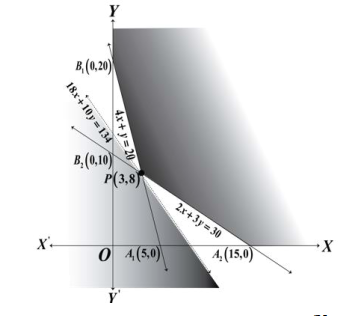
A linear programming problem (LPP) along eith the graph of its constraints is shown below.The correspondig objective function is :Z = 18x + 10y which has to be minimized. The smallest value of the objective function Z is 134 and is obtained at the corner point (3,8).
Image
The optimal solution of the above linear programming problem_______________.
Let $A=\{2,3,6,7\}$ and $B=\{4,5,6,8\}$. Let $R$ be a relation defined on A $\times$ B by $\left(a_1, b_1\right) R\left(a_2, b_2\right)$ is and only if $a_1+a_2=b_1+b_2$. Then the number of elements in $\mathrm{R}$ is ...........
The value of $c$ in the Lagrange's mean value theorem for the function $\mathrm{f}(\mathrm{x})=\mathrm{x}^{3}-4 \mathrm{x}^{2}+8 \mathrm{x}+11$ when $\mathrm{x} \in[0,1]$ is
If $y=\log _a x+\log _x a+\log _x x+\log _a a$, then $\frac{d y}{d x}$ is equal to